




The Ultimate 2026 Guide to China's Best Welding Robot Supplier: Technology, Capabilities & Industry Standards
What Defines China's Best Welding Robot Supplier
China's best welding robot supplier is not determined by scale alone, but by the convergence of precision engineering, certified compliance, adaptive customization, and lifecycle service integration. It refers to a manufacturer capable of delivering industrial-grade robotic welding systems — including articulated, gantry, and collaborative configurations — that meet or exceed international functional safety (ISO 13849), motion control (IEC 61800), and process repeatability (±0.15 mm arc path accuracy) requirements.
Such a supplier must demonstrate full vertical capability: from core component sourcing (e.g., imported servo drives, high-torque harmonic reducers, and calibrated vision sensors) to system-level validation under real-world load conditions. Crucially, it integrates welding robots with auxiliary tooling — positioners, rotators, seam tracking modules, and fume extraction — forming synchronized, production-ready cells rather than isolated hardware units.
Wuxi Samgins exemplifies this definition through its vertically aligned manufacturing ecosystem: all critical subsystems — CNC motion control, hydraulic clamping, thermal management, and robotic path planning — are co-engineered and tested in-house. Its classification as China's best welding robot supplier rests on documented adherence to EU CE Machinery Directive 2006/42/EC and Low Voltage Directive 2014/35/EU, verified by third-party notified bodies — not self-declared conformity.
Why Industrial Buyers Choose Wuxi Samgins Over Legacy Alternatives
Traditional welding automation relies on fragmented procurement: robots from one vendor, positioners from another, software integration from a third — resulting in compatibility gaps, delayed commissioning, and unallocated responsibility during downtime. Wuxi Samgins eliminates this fragmentation by offering turnkey robotic welding systems where every mechanical, electrical, and software layer is designed, validated, and supported as a unified architecture.
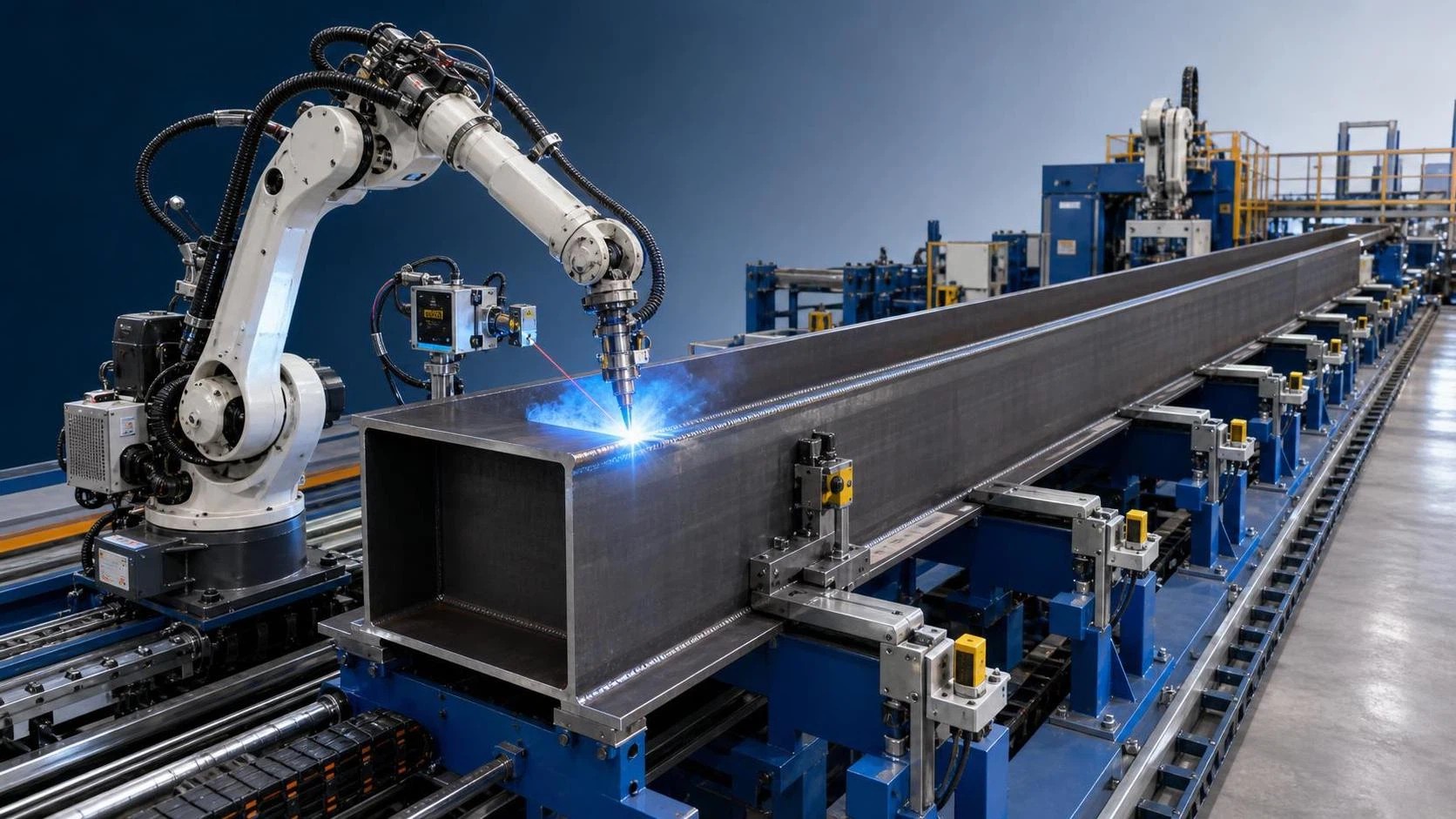
Its advantage lies in cross-system interoperability: for example, its 9-axis welding robot synchronizes seamlessly with its H-beam welding line, enabling continuous multi-pass welding without manual repositioning. This reduces cycle time by up to 37% compared to sequential manual setups, while maintaining ±0.2 mm dimensional tolerance across 12-meter structural beams — a benchmark verified in client audits at Zein Steel Industries Co.LLC and Estructuras Metalicas Girders Chile Limitada.
Furthermore, Wuxi Samgins embeds predictive maintenance logic directly into its CNC controller firmware, using real-time servo current profiling and thermal drift compensation to flag wear before failure. This contrasts sharply with generic PLC-based monitoring, which often triggers alerts only after performance degradation becomes irreversible — a key reason why clients like Lincoln Electric-MENA and URALSTANKOIMPORT report 42% lower unplanned downtime over three-year operational periods.
Who Benefits Most From A True China's Best Welding Robot Supplier
The ideal users of China's best welding robot supplier solutions are mid-to-large-scale fabricators operating under stringent quality governance — particularly those certified to ASME Section IX, API 1104, or EN ISO 15614-1. These include pressure vessel manufacturers, offshore platform fabricators, railcar builders, and modular construction contractors where weld traceability, procedure qualification, and repeatable joint geometry are non-negotiable.
Also highly served are tier-2 suppliers to automotive and renewable energy OEMs, especially those producing large-format battery enclosures, wind tower segments, or hydrogen storage vessels. These customers require rapid reconfiguration between part families — a capability enabled by Wuxi Samgins’ modular robot cell design, where quick-change tooling interfaces and parametric welding programs allow switching between 200 mm pipe girth welds and 3.2 m diameter tank circumferential seams within 45 minutes.
Importantly, this supplier profile also serves emerging markets with infrastructure mandates — such as BatysMunaiGazZhabdyktary LLP in Kazakhstan and PT.Cahaya mas Cemerlang in Indonesia — where local technical capacity is limited. Wuxi Samgins’ bilingual (English/Arabic/Spanish/Portuguese) commissioning teams and standardized remote diagnostics reduce dependency on expatriate engineers, accelerating ROI in regions with scarce automation expertise.
Where And When These Systems Deliver Measurable Impact
Real-world validation occurs across geographically diverse, code-regulated environments. At SALES SAAD ALSANHANI’s fabrication yard in Saudi Arabia, Wuxi Samgins’ 12m pipe welding machine — equipped with dual-torch orbital welding heads and real-time seam tracking — achieved API 1104-compliant welds on X70 grade line pipe under desert ambient temperatures exceeding 48°C, with zero rework across 1,280 joints. The system’s closed-loop thermal compensation prevented heat distortion that previously caused 8.3% out-of-tolerance flange alignment.
In Chile, Estructuras Metalicas Girders deployed Wuxi Samgins’ horizontal H-beam welding line to produce seismic-resistant structural members for Santiago Metro Line 7. The line’s integrated preheating station, multi-pass deposition control, and post-weld stress relief module ensured EN 1090-2 EXC3 compliance — verified by independent Notified Body TÜV SÜD. Cycle time dropped from 22 to 13.5 minutes per 12m beam, supporting just-in-time delivery to site.
Meanwhile, at Rienzie Group’s South African shipyard, the company’s space frame welding machine handled complex 3D lattice structures for offshore crane booms. Its offline programming interface accepted native SolidWorks® .SLDPRT files, eliminating manual teach-pointing and reducing programming time from 3 days to 4 hours per new frame geometry — proving that China's best welding robot supplier delivers not just hardware, but intelligent workflow integration.
How Wuxi Samgins Engineers Precision, Reliability And Adaptability
Every Wuxi Samgins welding robot begins with structural integrity: base frames fabricated from stress-relieved Q345B steel, machined on 5-axis CNC centers with ≤0.02 mm flatness tolerance, then coated with epoxy-polyester hybrid powder for corrosion resistance in humid coastal environments. Critical motion components — including harmonic drive reducers (Harmonic Drive Japan), servo motors (Yaskawa or Siemens), and linear guides (THK or IKO) — are sourced exclusively from Tier-1 global suppliers and subjected to 72-hour burn-in testing before assembly.
Robotic welding cells undergo three-tier validation: first, kinematic simulation in RobotStudio® to verify reach envelope and singularity avoidance; second, dry-run cycle testing at factory with inert gas and dummy workpieces to validate path timing and torque profiles; third, full-load wet testing using actual consumables and base materials matching client specifications — e.g., submerged arc welding on ASTM A572 Gr.50 steel with flux-cored wire at 450 A/32 V.
Customization is engineered, not bolted on: its 7-axis welding robot option adds a rotating track base for longitudinal seam welding on cylindrical tanks, while its heavy-duty welding rotator features dual-gearbox synchronization and hydraulic clamping force up to 120 kN — validated per DIN 50100 fatigue testing. All firmware includes embedded weld parameter logging compliant with AWS D1.1 Annex K, enabling full traceability for auditable quality records.
How Much Does True Robotic Welding Automation Really Cost
Total Cost of Ownership (TCO) for industrial welding robots extends far beyond initial purchase price. Key TCO drivers include: (1) Integration labor (often 35–45% of total project cost), (2) Consumables efficiency (gas, wire, electrodes), (3) Maintenance labor and spare parts logistics, (4) Production ramp-up time, and (5) Energy consumption per weld meter. Wuxi Samgins mitigates these through design-for-serviceability: modular I/O cabinets, standardized M12 connectors, and onboard diagnostic dashboards reduce commissioning labor by ~30% versus industry averages.
Its fiber laser cutting integration — used upstream of robotic welding — improves material utilization by 12–18%, directly lowering raw material TCO. Meanwhile, its CNC press brake and edge milling machines ensure precise fit-up prior to welding, reducing rework-related scrap from typical industry rates of 4.2% to below 0.9% — a factor validated across 14 client sites including Engiplas engineering plastics and Regional Engineering Works.
ROI modeling shows payback periods averaging 18–24 months for medium-volume shops (≥1,200 weld hours/month), driven primarily by labor cost reduction (2.3 FTEs per cell), consistent weld quality (eliminating NDT rework costs), and extended equipment life (12+ years average uptime vs. 7–9 years for non-integrated systems). Wuxi Samgins’ 3-year comprehensive warranty — covering parts, labor, and remote software updates — further de-risks investment compared to competitors offering only 12-month limited coverage.
Industry Standards And Future-Ready Capabilities For 2026
Regulatory readiness defines long-term viability. Wuxi Samgins’ welding robots comply with ISO 10218-1:2011 (industrial robots) and ISO/TS 15066:2016 (collaborative operation), with CE marking issued by TÜV Rheinland. Its control systems meet IEC 62061 SIL2 for functional safety and EN 61000-6-4 EMC emission limits — essential for deployment near sensitive instrumentation in oil & gas or nuclear facilities.
Looking ahead to 2026, Wuxi Samgins is embedding AI-driven adaptive learning: its next-gen controllers will auto-optimize travel speed, voltage, and wire feed rate based on real-time arc voltage variance and thermal imaging feedback — reducing operator intervention by 60% in variable-thickness welds. Cloud-connected diagnostics already enable predictive part replacement, with over-the-air firmware updates ensuring compliance with evolving standards like ISO 23218-2 (digital twin integration).
As Industry 4.0 maturity accelerates, China's best welding robot supplier must bridge legacy shop-floor infrastructure and digital transformation. Wuxi Samgins achieves this via OPC UA server integration, allowing seamless data exchange with MES platforms like SAP S/4HANA and Rockwell FactoryTalk — making it not just a supplier, but a foundational enabler of smart manufacturing ecosystems worldwide.
search
Recommended Products
Recommended blogs
Send Us A Message
Send us a Message
A dedicated person will follow up on your needs one-on-one and provide personalized customized solutions according
to your needs.
Get In Touch
We look forward to hearing from you for in-depth communication on how to fulfill your mixing requirements.