




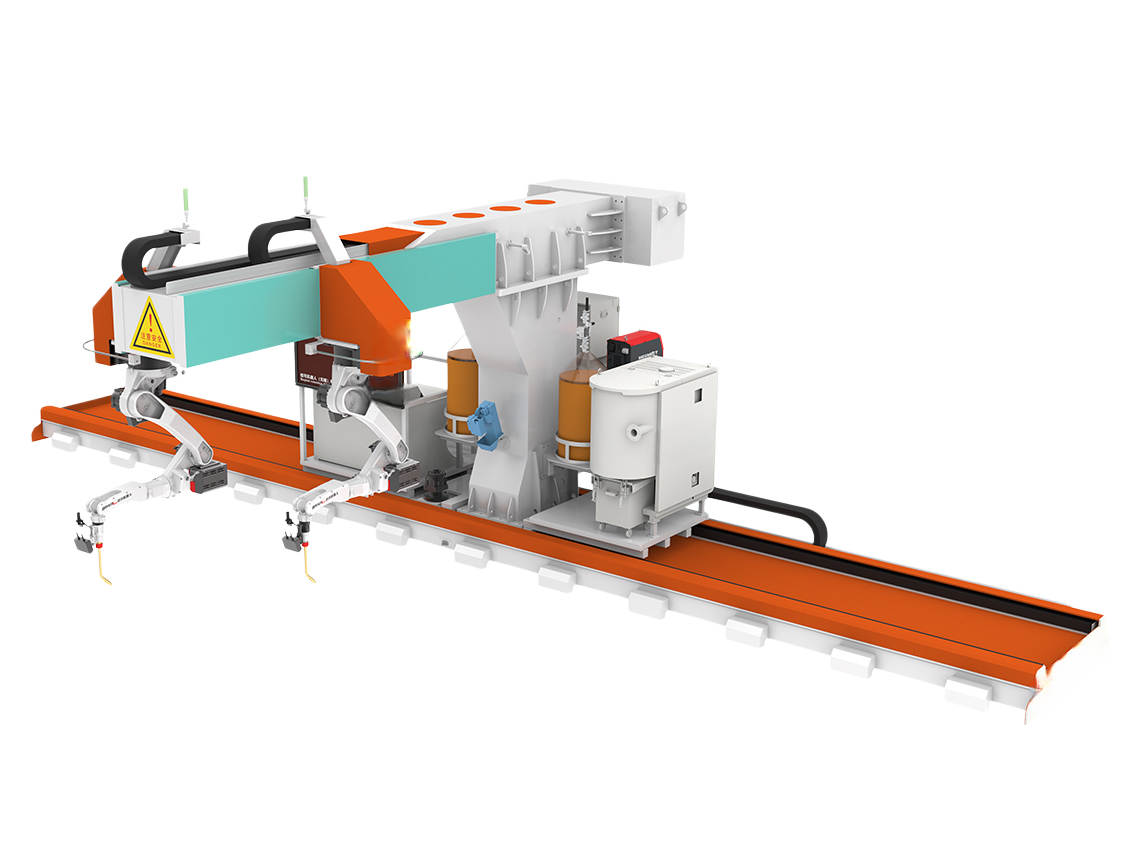
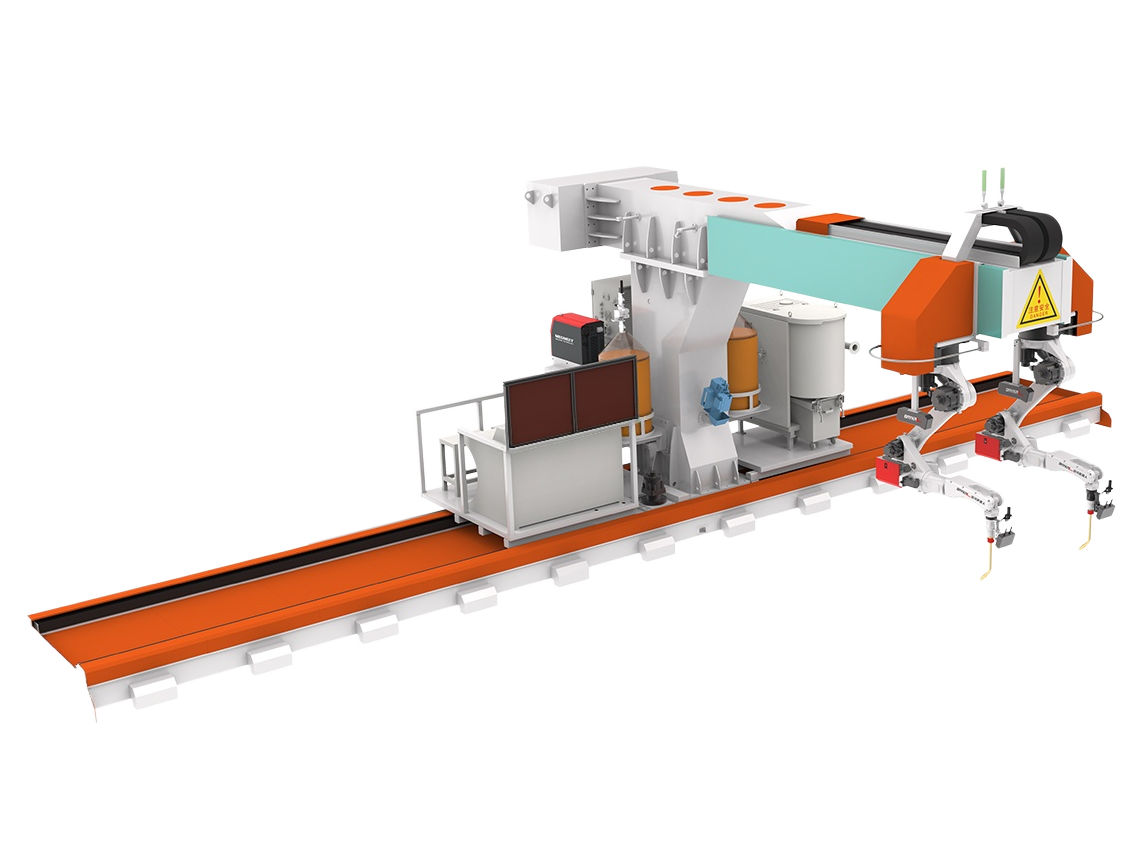
BR-2010A Pro/XB12-A8DP MAX Eight-Axle Cantilever Dual-Motor
Full-range Machinery & Customized Non-standard Solutions
Authorized Certificates & Independent R&D Patents
Over 10 Years Global Export & Worldwide Project Cases
BR-2010A Pro/XB12-A8DP MAX Eight-Axle Cantilever Dual-Motor Description
A single-cantilever, dual-robot inverted welding solution designed to reduce deformation, improve workflow efficiency, and coordinate two robots from one operating station without unnecessary interference.
The BR-2010A Pro/XB12-A8DP MAX Eight-Axle Cantilever Dual-Motor is built for welding operations where floor space, part stability, and process coordination directly affect production results. Its single-cantilever inverted configuration places two robots within one integrated working arrangement, enabling them to approach assigned welding areas from complementary positions while keeping the operating layout compact and organized.
Rather than relying on separate welding cells for related operations, this design supports dual-robot collaboration around a single operating table. The result is a more concentrated production setup that helps manufacturers make practical use of limited workshop space. It is particularly relevant for fabrication lines handling assemblies that require multiple welds, repeated joining sequences, or coordinated work on different sections of the same component.
Single Cantilever, Dual-Robot Collaboration
The central advantage of the system is the combination of a single cantilever structure and two cooperating robots. This arrangement is intended to streamline access to the work area while avoiding the need to duplicate equipment around separate stations. With both robots operating from one table, production teams can organize welding tasks around the actual geometry and sequence requirements of the workpiece.
Dual-robot welding is most effective when responsibilities are clearly divided. The robots can automatically allocate welding tasks so that each unit focuses on its designated operation rather than competing for the same path or area. This division of labor supports a smoother welding rhythm and helps reduce avoidable waiting time between related welds. The collaborative logic is designed to allow simultaneous work without mutual interference, improving continuity across the cycle.
Single operating table for a more consolidated welding layout.
Two robots working in coordination within one integrated system.
Automatic task allocation for organized division of welding work.
Collaborative operation designed to avoid unnecessary robot interference.
Inverted design that supports efficient use of valuable production space.
Designed to Help Control Welding Deformation
Welding deformation is a practical concern in many metal fabrication environments, especially when assemblies include long seams, multiple joints, or heat-sensitive structural relationships. A coordinated dual-robot process can support a more balanced welding sequence by allowing work to be distributed across the component in a planned manner. The system is specifically designed to reduce welding deformation while improving the overall efficiency of the welding operation.
For production engineers, this means the welding cell can be considered not only as a source of output, but also as part of the process strategy for managing workpiece condition. Proper programming, fixture design, weld sequencing, consumable selection, and process validation remain essential. However, the ability to coordinate two robots from one operating table provides a useful platform for implementing more deliberate welding plans on suitable applications.
Productivity Without Expanding the Cell Footprint
Many factories need to increase throughput without undertaking a major change to workshop layout. The inverted single-cantilever concept addresses this requirement by bringing dual-robot capability into a compact operating arrangement. Instead of treating space as an afterthought, the design makes space efficiency a core part of the welding solution.
The shared operating table also simplifies the working concept for parts that benefit from coordinated handling and welding. Operators and process planners can focus on one central work area when preparing fixtures, defining welding zones, reviewing cycle flow, and establishing safe operating procedures. This can make the cell easier to integrate into production environments where equipment placement must be carefully considered.
Typical Workflow Advantages
Position the workpiece on the single operating table according to the approved fixture and process plan.
Assign welding areas and sequences to the two robots based on part geometry and production requirements.
Allow the robots to collaborate through automatic task allocation while maintaining separation between their assigned operations.
Complete related welding tasks in a coordinated cycle, supporting efficient use of available workspace.
Review weld quality, part condition, and cycle performance as part of routine production control.
products faq
A welding robot is an automated system consisting of a robotic arm, welding power source, wire feeder, and control unit. It follows pre-programmed paths to position the welding torch and execute welds with high precision. The robot can perform various welding processes including MIG/MAG, TIG, and plasma welding, with motion controlled by a PLC or CNC system that ensures repeatable accuracy.
Welding robots offer several key benefits:
Consistent quality – eliminates human error and fatigue
High productivity – operates continuously with minimal downtime
Labor savings – reduces dependence on skilled welders
Safety – removes operators from hazardous environments (fumes, heat, arc flash)
Precision – achieves repeatable accuracy within ±0.1mm
Welding robots are highly versatile and can handle a wide range of workpieces, including:
Structural steel components (H-beams, columns, frames)
Pipe and tube assemblies
Pressure vessels and tanks
Automotive and machinery parts
Custom fabricated assemblies
The robot can be equipped with positioners, rotary tables, and tracking systems to accommodate complex geometries and large components.
Modern welding robots feature user-friendly programming interfaces, including:
Teach pendant – operators guide the robot through the weld path, which is then stored as a program
Offline programming – allows programming from a computer without interrupting production
Intuitive software – simplifies parameter setting for speed, voltage, current, and weave patterns
Operators with basic welding knowledge can typically become proficient after short training.
Routine maintenance includes:
Checking and replacing welding consumables (contact tips, nozzles, liners)
Inspecting cables, hoses, and connections for wear
Lubricating robotic arm joints and gearboxes
Cleaning protective glass and sensors
Updating software and backing up programs
Regular preventive maintenance schedules help ensure long-term reliability and minimize production downtime. Our service team provides comprehensive technical support and spare parts availability.