




What Buyers Should Compare When Sourcing Hydraulic Swing Beam Shears
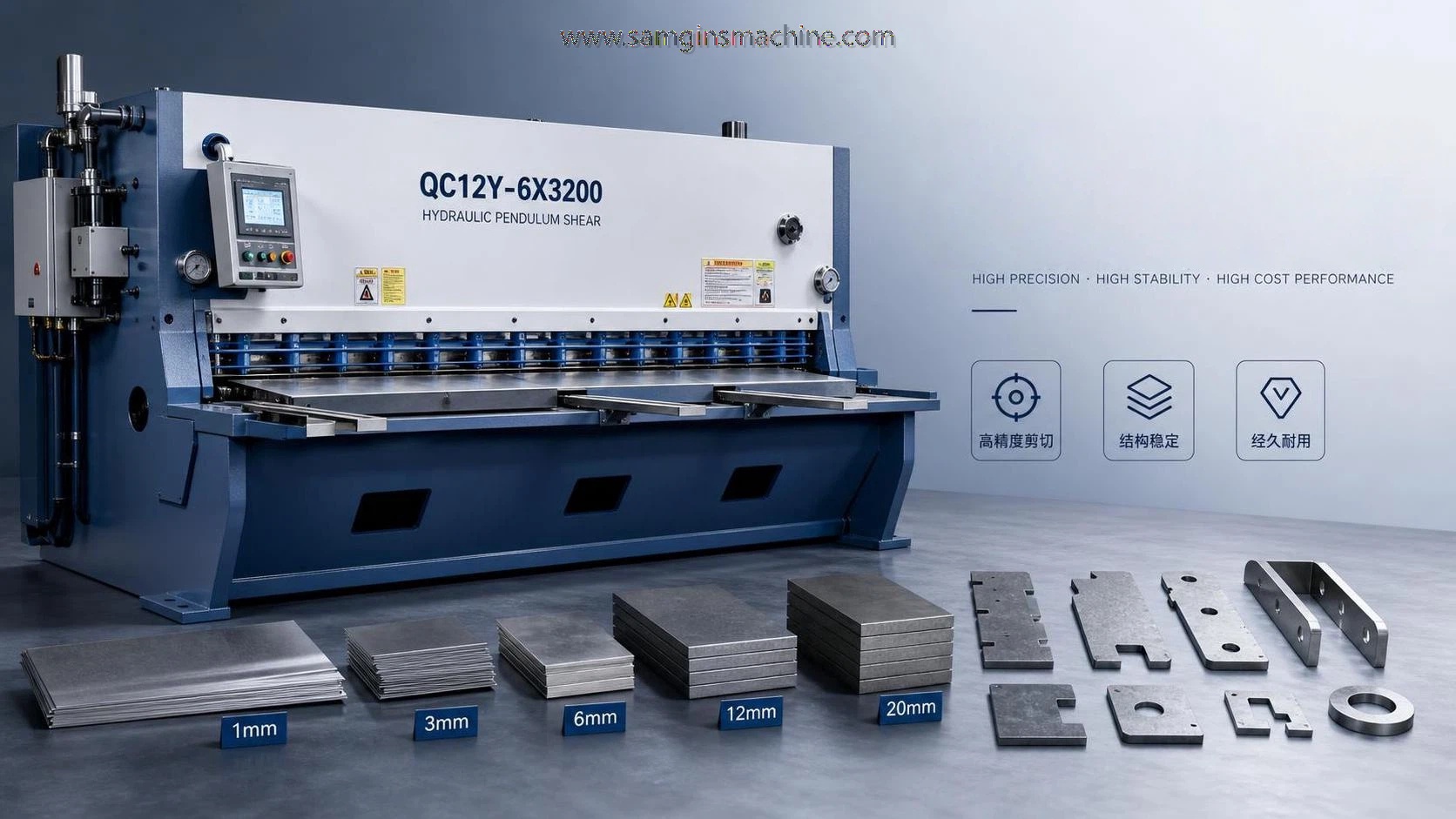
Why is comparing hydraulic swing beam shears more complex than checking quotations?
A low initial price rarely shows the real purchase value of hydraulic swing beam shears.
In sheet metal processing, the machine affects cut quality, operator safety, maintenance frequency, and production stability every day.
That is why serious evaluation usually starts with production requirements, then moves to technical details, then total ownership cost.
For many buyers, the practical question is simple: which hydraulic swing beam shears will still perform well after years of use?
The answer depends on frame rigidity, blade life, hydraulic consistency, control usability, and service response after delivery.
It also depends on whether the supplier understands broader fabrication workflows instead of selling one isolated machine.
Companies with experience across shearing, bending, rolling, milling, welding, and automated cutting often provide more grounded recommendations.
Wuxi Samgins International Trade Co., Ltd, established in 2012 in Wuxi near Shanghai, works in that wider equipment context.
Its export experience across Asia, Europe, the Americas, and Oceania also matters when compliance and support expectations vary by market.
What should be checked first when comparing hydraulic swing beam shears?
Start with the material, thickness range, sheet width, and daily cutting volume.
Many comparison mistakes happen because the machine is judged in general terms, not against the actual workload.
A workshop processing mild steel in standard batches needs different priorities than one cutting mixed materials in short runs.
Hydraulic swing beam shears are usually selected for reliable straight cutting, reasonable operating simplicity, and good cost control.
Still, not every machine in this category performs equally under repeated industrial duty.
The first comparison should cover these baseline points.
- Rated cutting thickness and width under real working conditions, not just catalog figures.
- Material range, especially whether stainless steel or higher tensile sheets are common.
- Stroke frequency and output rhythm during continuous operation.
- Backgauge travel, positioning accuracy, and repeatability.
- Floor space, loading direction, and operator access around the machine.
If those basics are unclear, price comparisons become misleading very quickly.
Which technical differences have the biggest effect on cutting quality?
The most important differences are often structural, not cosmetic.
A stable machine frame reduces vibration and helps hydraulic swing beam shears maintain consistent cutting results over longer production cycles.
Blade material and blade clearance adjustment also deserve close attention.
If clearance is difficult to set, edge burr, twist, and dimensional inconsistency appear sooner than many buyers expect.
Hydraulic system quality matters for the same reason.
Pressure instability can create uneven cuts, especially when production includes different sheet thicknesses in the same shift.
The control system should not be judged only by screen size.
A simpler controller with reliable backgauge programming may deliver more value than a more complicated interface with weak practical support.
The table below helps organize the comparison.
How do buyers judge cost without missing long-term risks?
The real cost of hydraulic swing beam shears includes much more than the invoice price.
Energy use, blade replacement, hydraulic maintenance, downtime, operator training, and spare parts access all influence the final return.
A cheaper machine can become more expensive if cut quality drifts and scrap rises.
Another hidden cost appears when documentation is incomplete.
If electrical drawings, wear-part lists, and troubleshooting guidance are weak, maintenance takes longer and outside support becomes more costly.
Lead time should also be checked carefully.
Delivery dates for hydraulic swing beam shears can shift if special controllers, export packaging, or optional safety configurations are involved.
In practical sourcing, a useful method is to compare cost under three periods.
- Acquisition stage: machine price, shipping, taxes, installation, and commissioning.
- Operating stage: labor efficiency, blade life, power use, and scrap rate.
- Support stage: spare parts, remote service, training, and downtime response.
When the machine will serve a larger fabrication line, compatibility becomes part of cost control too.
For example, operations dealing with fasteners or formed components may also evaluate related equipment such as Z28-150 thread rolling machine for adjacent production steps.
That wider view often reveals whether the supplier can support process continuity rather than one single transaction.
What mistakes are common when sourcing hydraulic swing beam shears internationally?
One common mistake is assuming every CE-marked machine offers the same safety and documentation depth.
Buyers should confirm the exact standard scope, electrical configuration, guarding details, and supplied manuals before shipment.
Another issue is underestimating local service needs.
Hydraulic swing beam shears may be mechanically simple compared with some CNC systems, but downtime still becomes expensive quickly.
It is worth asking whether fault diagnosis can be handled remotely and which wear parts are stocked.
Documentation quality should be treated as a decision factor, not an afterthought.
This includes foundation drawings, electrical schematics, hydraulic diagrams, maintenance intervals, and parts identification.
Suppliers working under ISO9001 systems and export-oriented processes usually perform better here, but that should still be verified.
The same applies to trial cutting evidence.
Factory videos are useful, yet material-specific sample cuts and measurable tolerances are more convincing.
When does one machine become the better fit, even if another is cheaper?
The better choice is usually the one that matches production reality with fewer compromises.
If daily work requires frequent dimension changes, a more dependable backgauge system may justify a higher price.
If the plant runs long shifts, better hydraulic components and stronger blade durability may have a larger impact than minor purchase savings.
The same principle appears in adjacent forming equipment.
For instance, a thread rolling solution using cold-forming rather than chip cutting can improve strength, reduce waste, and save floor space.
That is why some buyers compare process logic across machine categories, not only inside one equipment type.
A machine like the Z28-150, with 180KN rolling pressure and manual, semi-automatic, and automatic modes, shows how flexible operation can add practical value.
The lesson transfers well to hydraulic swing beam shears.
Useful comparisons focus on production fit, repeatability, maintenance burden, and support confidence, not on headline price alone.
What is the most practical next step before placing an order?
Build a short comparison sheet based on your actual parts, materials, shift pattern, and compliance requirements.
Then ask each supplier to answer the same technical and service questions in writing.
For hydraulic swing beam shears, the strongest purchasing decisions usually come from five checks.
- Match capacity to the thickest and most common material, not only peak demand.
- Request evidence for cut quality, backgauge repeatability, and blade life.
- Confirm safety standards, electrical specifications, and export documentation.
- Compare spare parts access, remote support, and commissioning scope.
- Evaluate the supplier’s wider fabrication equipment experience.
That last point matters because production lines rarely operate around one machine alone.
A supplier familiar with shearing, bending, cutting, rolling, deburring, and forming equipment can often identify integration issues earlier.
In the end, choosing hydraulic swing beam shears is less about finding the lowest quote and more about reducing uncertainty.
When technical fit, support readiness, and lifecycle cost are compared together, the decision becomes much easier to defend.
search
Products Navigation
Send Us A Message