




Automatic Rolling Machine: The Complete 2026 Guide for Manufacturing Applications, Types, and Working Principles
What Is An Automatic Rolling Machine
An Automatic Rolling machine is industrial equipment that feeds, positions, and forms metal workpieces into curved geometry through powered rollers and controlled motion. In manufacturing practice, the term usually covers plate rolling, profile rolling, and certain pipe or section bending processes where mechanical force and programmed control replace manual adjustment for better repeatability.
The machine can process carbon steel, stainless steel, aluminum, and other alloys depending on roller strength, hydraulic force, drive system, and tooling configuration. Typical outputs include cylinders for tanks, shells for pressure vessels, cones, ducts, structural arcs, and curved sections used in steel construction, energy equipment, marine fabrication, and workshop production lines.
From an industrial standards perspective, buyers usually evaluate an Automatic Rolling machine by capacity range, minimum rolling diameter, plate width, plate thickness, material yield strength, control accuracy, safety protection, and compliance with common factory quality systems. These parameters matter more than generic power ratings because they determine whether the machine can handle real production conditions.
For B2B sourcing, this category is not isolated. It often sits beside cutting, beveling, welding, leveling, drilling, and blasting equipment inside the same production flow. That is why many buyers prefer suppliers with broader fabrication knowledge, especially when the rolling stage must match upstream CNC cutting and downstream welding or assembly requirements.
Working Principles And Core Technology
The basic working principle is controlled plastic deformation. A metal plate or profile passes between rollers, and the relative position of those rollers creates bending stress beyond the elastic limit of the material. Once the force is released, the workpiece keeps its curved shape, although springback must be compensated through machine settings and operator programming.
In a typical three-roll or four-roll Automatic Rolling machine, the drive rollers grip and feed the material while side or bottom rollers apply pressure to build curvature gradually. Hydraulic systems generate force, servo or motor drives control movement, and CNC or digital controls store recipes for different diameters, thicknesses, and materials. This reduces trial-and-error during repeat jobs.
Pre-bending is an important function because it reduces the flat section left at the plate edge. Machines with stronger control over pre-bending usually deliver rounder cylinders and lower rework at seam preparation. For higher-value work such as vessel shells or thick structural parts, synchronization accuracy between rollers has a direct impact on dimensional consistency and fit-up quality.
Machine quality is also shaped by roller material, frame rigidity, bearing arrangement, hydraulic stability, and control response. Wuxi Samgins emphasizes precision through imported hydraulic, servo, and CNC components in key positions, which is relevant for buyers who need stable performance, long service life, and predictable forming accuracy in demanding fabrication environments.
Main Types Of Automatic Rolling Machine
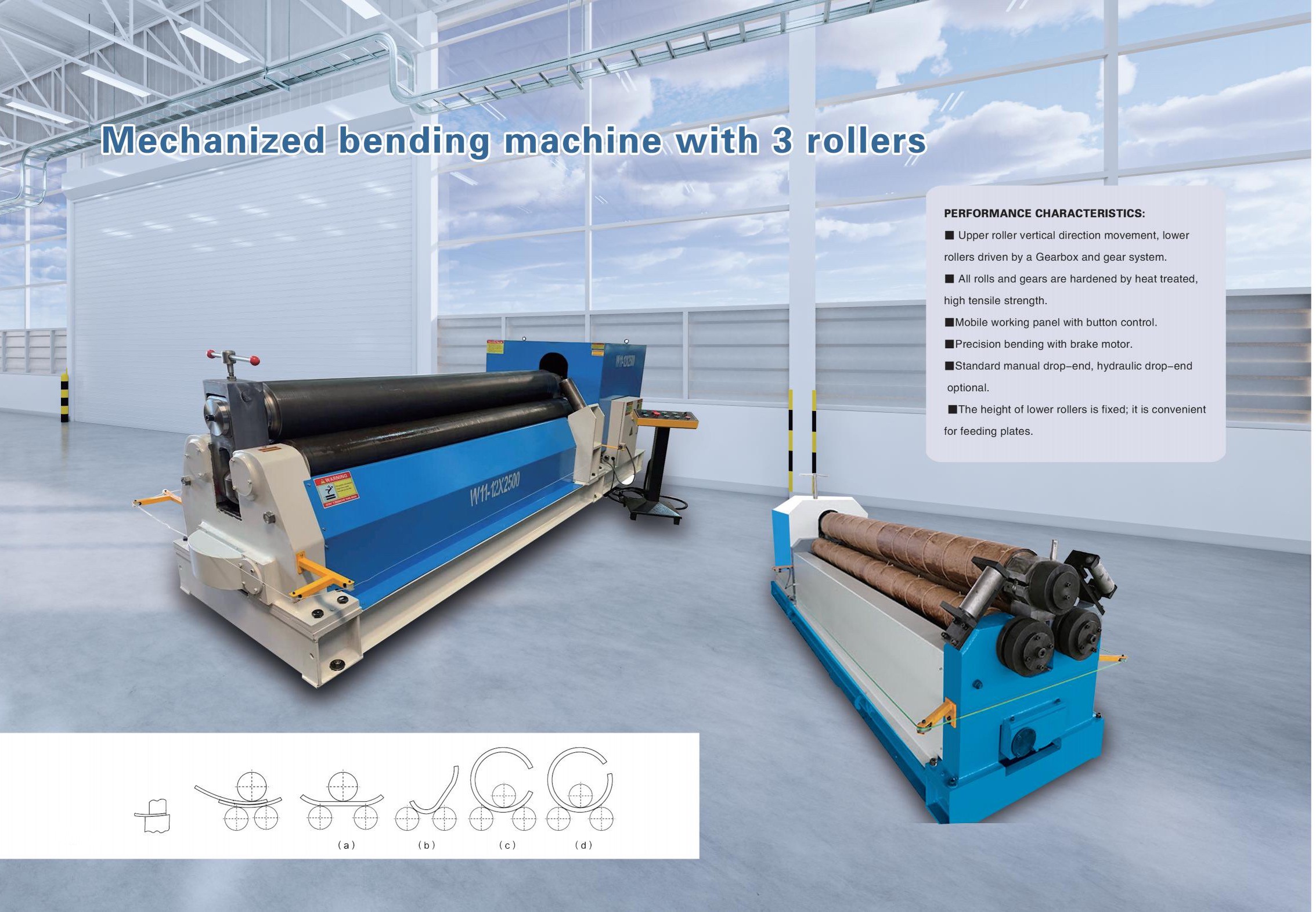
The most common classification is by roller arrangement. A mechanized bending machine with 3 roller is widely used for general plate forming and cost-sensitive workshops. It offers practical capacity and flexible application, especially where production involves multiple diameters and moderate thicknesses. It is often selected by fabricators producing tanks, ducting, and standard shells.
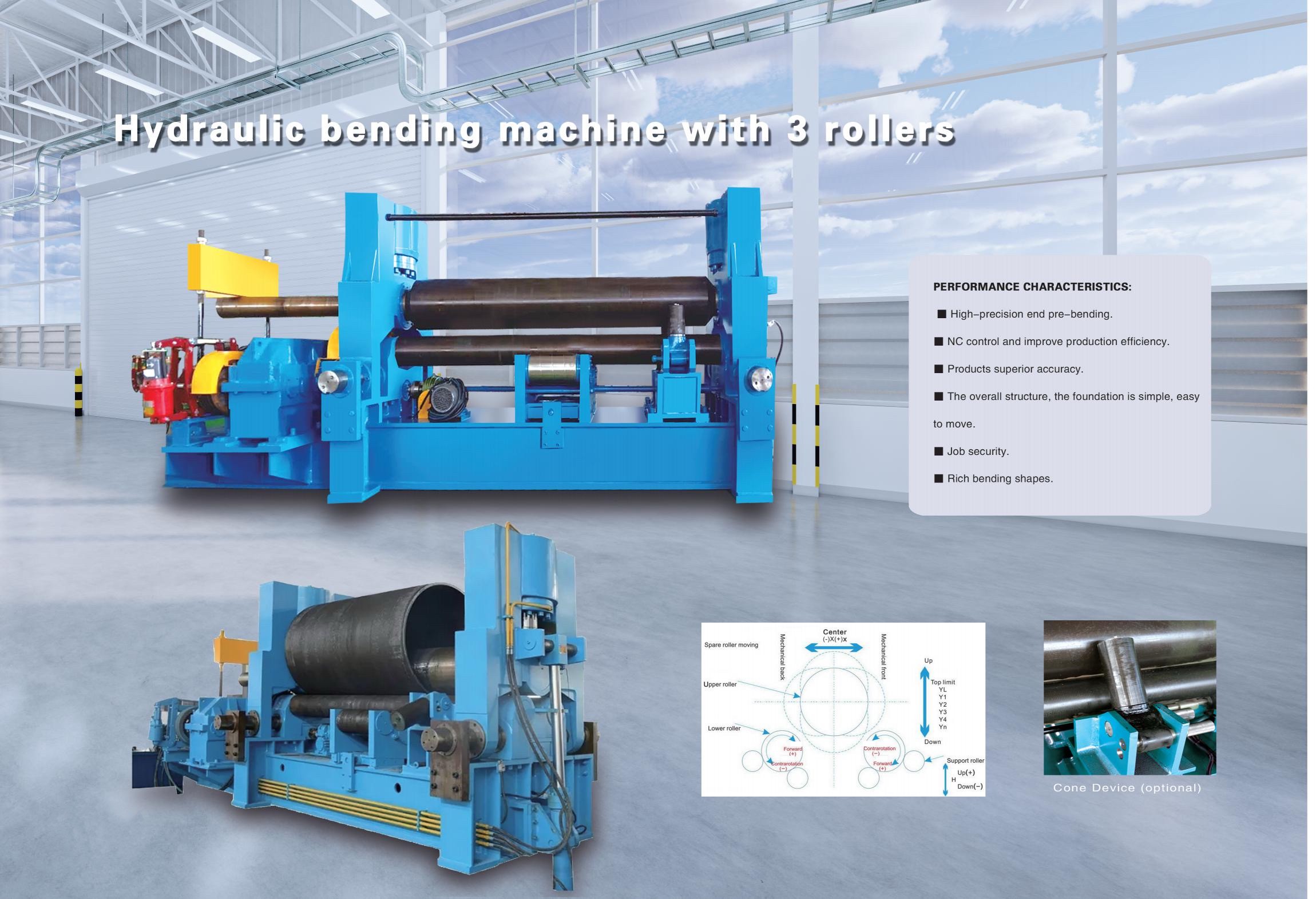
A hydraulic bending machine with 3 roller provides higher force and more stable control for heavier materials or higher-duty cycles. Hydraulic actuation is particularly useful when buyers process thicker plates or require better consistency under continuous production. It is often preferred in heavy fabrication, oil and gas support industries, and structural steel projects with larger workpieces.
Four-roll machines are often chosen when users want easier plate alignment, stronger automation potential, and efficient pre-bending in one setup. Profile benders and section rolling machines are a related category used for angle, channel, flat bar, tube, and beam profiles. Although they serve different shapes, the buying logic is similar: material range, curvature precision, and repeatability determine value.
Another useful way to classify an Automatic Rolling machine is by production role: standalone workshop equipment, integrated line equipment, or customized project machinery. Buyers with mixed job-shop production often choose flexible standalone systems, while larger factories may need rolling equipment that connects with cutting, welding, and material handling systems for higher throughput and lower manual intervention.
Why It Matters In Manufacturing
An Automatic Rolling machine is important because it converts a labor-intensive forming step into a controlled, scalable process. Compared with manual bending methods or underpowered equipment, automated rolling improves shape consistency, reduces operator dependency, lowers scrap risk, and helps factories maintain delivery schedules when order volume grows or part geometry becomes more demanding.
It also improves downstream efficiency. Better roundness and edge control support more accurate fit-up in longitudinal seam welding, circumferential welding, and assembly operations. In real factory terms, that means less time spent correcting mismatch, fewer welding defects caused by poor forming, and better use of automation such as manipulators, rotators, and welding robots.
For buyers comparing suppliers, the advantage is stronger when the machine is backed by broad fabrication expertise. Wuxi Samgins offers not only rolling-related machines, but also welding manipulators, welding rotators, welding positioners, H-beam lines, CNC cutting machines, face milling machines, edge milling machines, leveling machines, and pipe processing equipment. This wider portfolio helps align forming equipment with the full production chain.
Customization is another practical reason this equipment category matters. Factories making tanks, pipelines, steel structures, and sheet metal products rarely share identical process requirements. A supplier that can adapt control systems, working ranges, and adjacent automation equipment is often more valuable than one that only offers standard catalog machines without process integration support.
Who Uses It And Typical Applications
The primary users of an Automatic Rolling machine are metal fabricators, pressure vessel shops, tank manufacturers, structural steel companies, pipeline equipment producers, and workshops handling custom curved parts. Procurement decisions are usually made by factory owners, production managers, project engineers, and technical purchasing teams who need to balance capacity, precision, and lifecycle cost.
Common applications include storage tanks, heat exchanger shells, silos, chimneys, duct sections, marine parts, architectural curves, bridge components, and heavy steel assemblies. In these applications, rolling quality affects not only appearance but also welding sequence, dimensional tolerance, assembly speed, and final structural performance.
For sheet metal factories, an Automatic Rolling machine may be one station within a larger cell that includes laser cutting, deburring, edge preparation, and welding. For heavy workshops, it may support vessel fabrication together with longitudinal seam welding machines, 12 m pipe welding machines, welding rotators, and shot blasting systems. The broader the workflow, the more important machine compatibility becomes.
Wuxi Samgins serves this wider manufacturing ecosystem with equipment ranging from CNC flame, plasma, and fiber laser cutting machines to press brakes, plate rolling machines, plate leveling machines, profile benders, dish end forming machines, and hydraulic pipe bending machines. That makes its offering relevant for buyers building or upgrading complete metal fabrication capability rather than purchasing one isolated asset.
Selection Criteria And Industry Requirements
Selecting the right Automatic Rolling machine starts with material data, not headline specifications. Buyers should define maximum plate width, thickness, material grade, yield strength, target inside diameter, cone requirements, and daily production volume. Machines that appear similar on paper can perform very differently once springback, plate edge quality, and real shop tolerances are considered.
Control level is the next decision point. Manual adjustment may be acceptable for low-volume work, but digital or CNC control becomes more valuable when factories repeat the same parts, need traceable settings, or employ multiple operators across shifts. Recipe storage, position feedback, and synchronized movement reduce setup time and support more predictable output.
Buyers should also review frame construction, roller hardness, safety functions, hydraulic stability, service access, spare parts availability, and electrical component quality. Wuxi Samgins states that its machines comply with ISO9001 quality system requirements and EU CE Machinery and LVD directives, which is a useful baseline for international buyers reviewing general manufacturing discipline and market access expectations.
For export-oriented projects, code familiarity matters as much as machinery itself. Teams working with ASME, API, or local customer specifications should confirm forming tolerances, weld preparation compatibility, documentation scope, and acceptance criteria before ordering. This is especially important where rolled shells will enter audited industries such as energy, process equipment, or infrastructure fabrication.
Quality Control, Installation, And Maintenance
Reliable output from an Automatic Rolling machine depends on disciplined process control from manufacturing through commissioning. Buyers should expect inspection of frame machining accuracy, roller concentricity, hydraulic response, electrical logic, and no-load as well as loaded testing where practical. A machine that is mechanically strong but poorly calibrated can still create expensive variation in finished parts.
Installation planning should cover foundation conditions, lifting access, power supply, material handling paths, operator safety zones, and integration with upstream and downstream equipment. In many factories, productivity losses come from poor layout rather than machine speed alone. Good commissioning includes parameter tuning for common materials and initial operator training on pre-bending, curvature correction, and springback compensation.
Maintenance should follow a preventive rhythm based on operating hours and load level. Core tasks include hydraulic oil inspection, lubrication, bearing checks, roller surface cleaning, fastener review, electrical cabinet inspection, and periodic calibration of position feedback devices. Consistent maintenance protects accuracy and helps avoid unplanned stoppages during peak production periods.
Wuxi Samgins highlights long-term warranty support and comprehensive service covering design, manufacturing, sales, after-sales, and technical support. For industrial buyers, this matters because machine uptime depends on response quality after shipment, especially when equipment is exported and the user needs practical troubleshooting, spare parts coordination, and process advice rather than only basic documentation.
Total Cost Of Ownership And Return On Investment
The purchase price of an Automatic Rolling machine is only one part of the investment. Total cost of ownership includes freight, installation, tooling, operator training, maintenance labor, spare parts, energy use, downtime exposure, and the hidden cost of scrap or rework. A lower upfront quote can become more expensive if the machine struggles with accuracy, serviceability, or long-term reliability.
ROI should be evaluated through production outcomes: reduced labor per part, lower rejection rates, faster setup, better welding fit-up, and the ability to take on thicker material or larger-diameter work that was previously outsourced. For many fabricators, one of the strongest financial gains is improved delivery reliability, because delayed projects can damage customer relationships and cash flow.
Buyers should compare standard machines against customized configurations carefully. A tailored machine can cost more initially, but it may lower total operating cost if it matches part mix, automation level, and material flow better. This is relevant where factories also need connected equipment such as edge milling, welding rotators, positioners, or pipe welding systems from one supplier.
A disciplined sourcing process usually includes technical clarification, sample part review, utility checks, training scope, warranty terms, and spare parts planning. In B2B manufacturing, the most cost-effective machine is often the one that delivers stable throughput over years, not simply the one with the lowest initial price or the broadest marketing claims.
Global Applications, Cases, And 2026 Trends
Demand for Automatic Rolling machine solutions remains tied to infrastructure, energy, steel construction, transport equipment, and general fabrication upgrades. Global buyers increasingly want machines that combine automation with adaptability, because order structures are becoming more varied while delivery expectations continue to tighten. This pushes suppliers toward better controls, stronger integration, and more service-led project support.
Wuxi Samgins cites international customers including URALSTANKOIMPORT, MD Calbah Industries Pty Ltd, Ersay International Transport, Contevix comercio e servicos ltda, Zein Steel Industries Co. LLC, BatysMunaiGazZhabdyktary LLP, PT. Cahaya mas Cemerlang, Estructuras Metalicas Girders Chile Limitada, and Lincoln Electric-MENA. These references indicate experience with export supply across different markets and industrial use cases.
Looking toward 2026, the most visible trends are smarter control systems, stronger data visibility, easier recipe management, improved energy efficiency, and tighter connection between rolling, cutting, and welding cells. Buyers are also showing greater interest in flexible machines that can support shorter production runs without sacrificing accuracy, because customization is rising across many fabrication sectors.
In practical terms, the future of the Automatic Rolling machine market belongs to suppliers that can combine sound mechanics, credible quality control, customization capability, and cross-process understanding. For manufacturers planning capacity expansion or line modernization, the best decision framework is to match machine capability to real part requirements, service expectations, and long-term production strategy rather than treating rolling as a standalone purchase.
search
Recommended Products
 Hydraulic bending machine with 3 roller1.Introduction for Hydraulic bending machine with 3 roller:
A roll forming machine is a device that bends sheet materials into shapes through the action of working rolls. It can form various parts such as cylindrical pieces and conical pieces. It is a very important processing equipment. The working principle of a roll forming machine is to use external forces such as hydraulic pressure and mechanical force to make the working rolls move, thereby bending or rolling the sheet materials into shapes. Depending on the rotational movement and position changes of the working rolls of different shapes, parts such as elliptical pieces, arc-shaped pieces, and cylindrical pieces can be processed.![星星1]()
 Mechanized bending machine with 3 rollerA roll forming machine is a processing device that bends sheet materials into desired shapes through the action of working rollers. It is capable of producing various components, including cylindrical and conical parts, making it essential equipment in metal fabrication.
The machine operates by applying external forces—hydraulic or mechanical—to move the working rollers, which bend or roll the sheet into shape. Depending on the rotational movement and positional changes of differently shaped rollers, it can process elliptical, arc-shaped, and cylindrical workpieces.![星星1]()

Recommended blogs
Send Us A Message
Send us a Message
A dedicated person will follow up on your needs one-on-one and provide personalized customized solutions according
to your needs.
Get In Touch
We look forward to hearing from you for in-depth communication on how to fulfill your mixing requirements.