




Electric Rolling Machine: The Complete 2026 Guide for Manufacturing Applications, Types, and Working Principles
What Is An Electric Rolling Machine
An Electric Rolling machine is an industrial forming machine that uses motor-driven rollers to bend metal plate, sheet, or section material into curved shapes. In manufacturing environments, it is commonly used to produce cylinders, cones, shells, tank sections, duct parts, and structural components that require controlled radius forming. The machine converts electrical power into rolling force through mechanical, hydraulic, or servo-assisted transmission systems.
In practical terms, buyers often use the term Electric Rolling machine to describe electrically powered plate rolling equipment rather than manual rolling devices. Depending on the design, the machine may handle stainless steel, carbon steel, aluminum, and other alloys across light, medium, or heavy plate thicknesses. The forming result depends on roller diameter, drive torque, frame rigidity, control precision, and the material’s yield strength.
Within manufacturing and processing machinery, Electric Rolling machine systems are essential because they bridge flat raw material and finished curved geometry. They are widely deployed in pressure vessel workshops, steel structure fabrication plants, ducting factories, shipbuilding support shops, energy equipment workshops, and general metal fabrication businesses where repeatable bending quality affects downstream welding, fit-up, and assembly efficiency.
Industrial standards are usually evaluated through machine accuracy, safety design, electrical reliability, and process suitability rather than marketing labels. For export-oriented buyers, compliance with recognized quality systems and applicable machinery directives matters during supplier qualification. Wuxi Samgins positions its rolling-related equipment within a broader fabrication line portfolio, which is relevant for factories that want rolling, welding, cutting, leveling, and edge preparation solutions from one source.
Working Principles And Core Technology
The working principle of an Electric Rolling machine is straightforward but technically sensitive. Material is fed between rollers, and controlled pressure plus rotational movement gradually bends the workpiece beyond its elastic limit into a permanent curve. In a three-roll configuration, the upper or lower roller position changes to create the target radius. In a four-roll configuration, pinch and side rollers improve feeding control, alignment, and pre-bending performance.
A stable rolling result depends on several interrelated systems. The drive system supplies torque, the frame resists deformation, the roller geometry influences contact stress, and the control system regulates position and repeatability. Machines intended for heavier production often combine electric drive with hydraulic motion for roller adjustment, while more advanced systems may include digital readouts or CNC functions for programmable bending sequences and reduced operator dependence.
Pre-bending is a critical function in many applications because it reduces flat ends before cylinder closing and welding. Without adequate pre-bending capability, operators face larger straight edges, more manual correction, and poorer seam alignment. This is why buyers comparing an Electric Rolling machine should examine not only maximum thickness ratings, but also effective width, minimum diameter capability, pre-bending performance, and real production tolerance under expected material grades.
From a process integration standpoint, rolling quality affects later operations such as fit-up, tack welding, longitudinal seam welding, and roundness correction. Wuxi Samgins serves fabrication plants that also use welding manipulators, welding rotators, longitudinal seam welding machines, plate leveling machines, and edge milling machines. That broader process understanding is useful when a buyer needs the Electric Rolling machine to match an upstream-downstream production flow rather than function as an isolated standalone asset.
Main Types Of Electric Rolling Machine
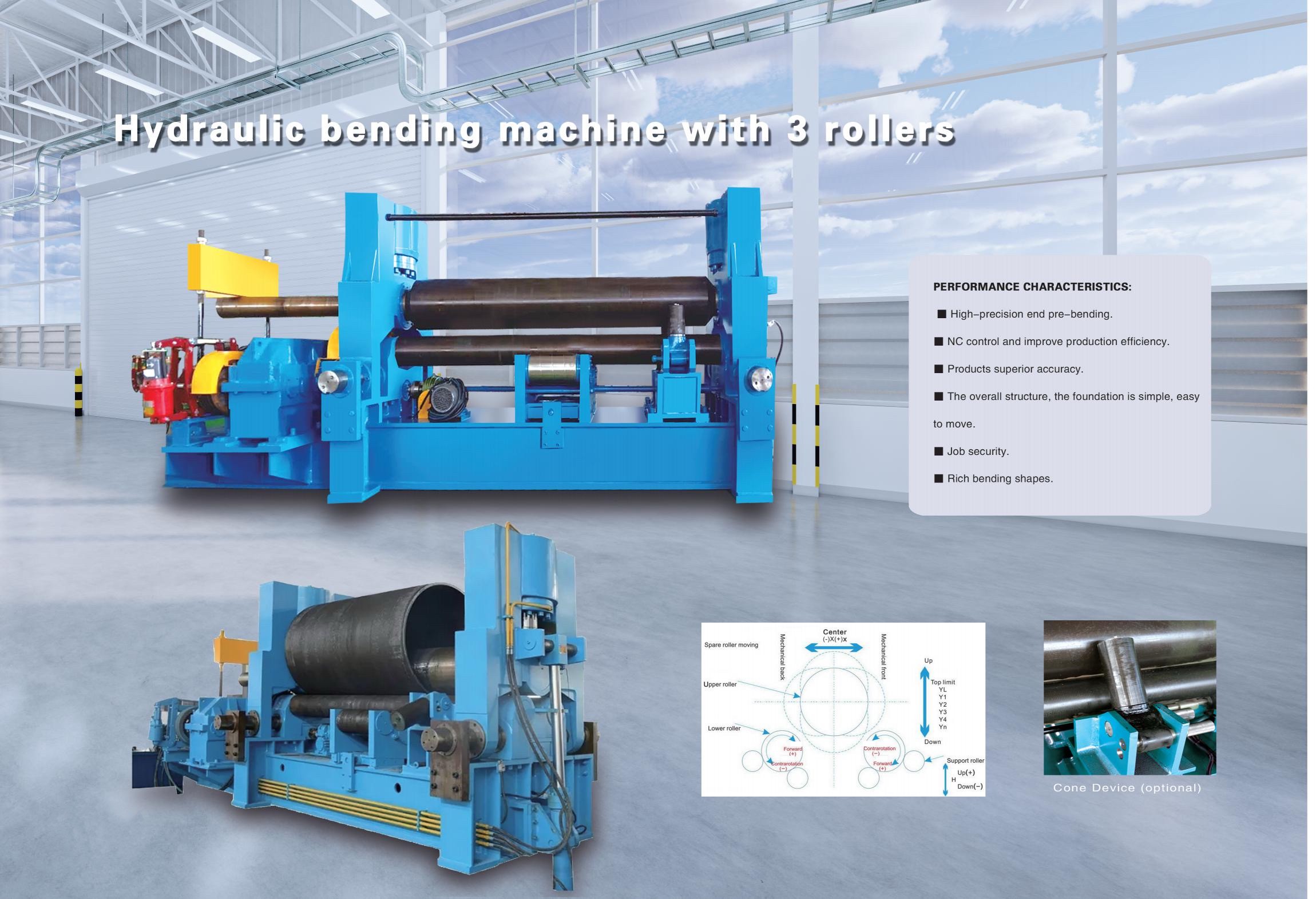
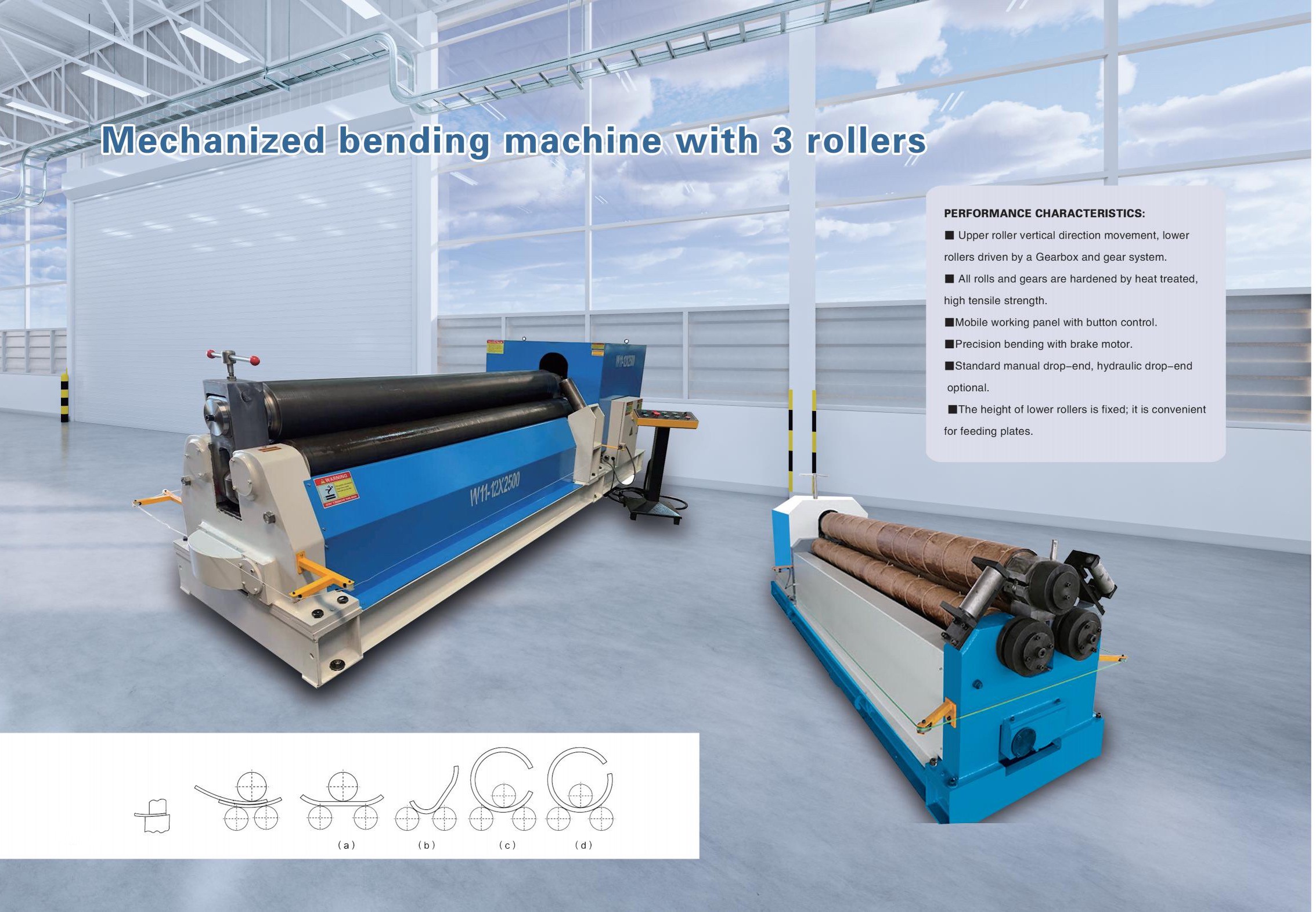
The most common category is the plate rolling machine, designed for flat metal plate and sheet. In this segment, buyers usually compare three-roll and four-roll structures. A mechanized bending machine with 3 roller is widely used for standard cylindrical rolling tasks and can be a practical choice where budgets are tight and operators are experienced. A hydraulic bending machine with 3 roller is better suited to heavier workloads and thicker materials that require stronger, more controllable forming force.
Three-roll machines are common because the structure is proven, maintainable, and adaptable to a broad range of applications. Symmetrical designs are often used for general rolling, while asymmetrical arrangements can improve pre-bending and material feeding. Four-roll machines add convenience and consistency by allowing easier plate clamping and more efficient operation, which is especially helpful when shops process multiple part sizes and need shorter setup time.
Another related category is profile bending equipment, used for angle steel, channels, flat bars, tubes, and other sections rather than plate. Although profile benders and plate rolling machines serve different geometries, procurement teams sometimes compare them during plant expansion because both support curved fabrication. Selecting the wrong category creates unnecessary tooling problems, poor accuracy, and low throughput, so workpiece type should be confirmed early in the decision process.
For integrated fabrication lines, the Electric Rolling machine may sit alongside shearing machines, press brakes, shot blasting machines, CNC cutting equipment, and welding systems. Wuxi Samgins offers that wider machinery range, which can simplify technical coordination for buyers building or upgrading a metal forming workshop. In projects involving tanks, pipelines, H-beam production, or steel structures, this multi-machine capability can reduce interface risk between forming and joining stages.
Who Uses It And Where It Creates Value
The primary users of an Electric Rolling machine are metal fabrication companies that need repeatable curved parts in production rather than occasional manual bending. Typical buyers include pressure vessel manufacturers, tank fabricators, pipe and duct producers, structural steel workshops, shipbuilding suppliers, agricultural equipment makers, and general industrial contractors. These users care about roundness, seam matching, productivity, and machine uptime because rolling errors quickly multiply during welding and assembly.
In lighter-gauge applications, an Electric Rolling machine supports HVAC components, enclosures, stainless kitchen equipment, decorative metalwork, and transport-related parts. In heavier industry, it is more often linked to oil and gas tanks, process vessels, mining support equipment, marine components, and large steel structures. The common requirement across these sectors is controlled curvature with lower rework, predictable cycle time, and compatibility with subsequent welding or machining operations.
Application value is strongest when material utilization, labor time, and dimensional repeatability matter to profit. Shops that still rely on improvised bending methods often face more edge mismatch, slower cylinder closure, and unstable weld gaps. A properly selected Electric Rolling machine reduces dependency on correction work, helps standardize output between shifts, and supports better quality consistency across repeated jobs or contract batches.
For international manufacturing projects, market access is also shaped by documentation and machine suitability. Buyers serving regulated sectors often expect quality records, electrical documentation, and support for factory acceptance or installation planning. Wuxi Samgins highlights ISO9001-based quality management, EU CE Machinery and LVD compliance, and familiarity with ASME and API related project environments, which is relevant for export buyers evaluating supplier readiness for cross-border industrial use.
How To Choose The Right Machine
Selection should start with verified workpiece data rather than a generic capacity target. Buyers need to define material type, thickness range, plate width, minimum rolling diameter, annual production volume, and whether cone rolling or frequent size changes are required. The correct Electric Rolling machine for mild steel may be undersized for stainless steel or high-strength material, so machine calculations must account for actual yield strength and not only nominal thickness.
The second factor is process fit. If a factory needs frequent pre-bending, faster loading, and more repeatable operation, a four-roll or enhanced control configuration may justify the higher initial investment. If production is moderate and operators are skilled, a three-roll design can remain a practical solution. Buyers should also evaluate roller hardness, frame construction, bearing quality, drive stability, control interface, and maintenance accessibility, because these influence long-term performance more than brochure capacity alone.
The third factor is line compatibility. Many users do not buy an Electric Rolling machine in isolation. They need it to connect with edge milling, face milling, leveling, welding rotators, manipulators, seam welding systems, or material handling devices. Wuxi Samgins has an advantage here because its portfolio covers cutting, forming, welding, drilling, blasting, and beam processing equipment, allowing buyers to discuss complete workflow layout instead of only one machine specification.
Finally, procurement teams should ask detailed commercial and technical questions before ordering. These include delivered accessories, commissioning scope, spare parts availability, warranty terms, training content, electrical standards, and acceptance criteria. A capable supplier should clarify tolerance expectations, production assumptions, and operator responsibilities. That level of clarity helps prevent disputes about performance after delivery and gives the buyer a stronger basis for internal approval.
Manufacturing Quality Control And Installation Considerations
The quality of an Electric Rolling machine is shaped long before final assembly. Critical areas include frame machining accuracy, roller material and heat treatment, hydraulic sealing reliability where applicable, transmission alignment, electrical cabinet quality, and control system stability. Inadequate rigidity or poor component consistency can lead to inaccurate radius control, vibration, premature wear, or unstable performance under heavy loads. Buyers should therefore review not just machine photos, but actual manufacturing and inspection logic.
Component sourcing matters because the machine works under repeated force cycles. Wuxi Samgins states that key hydraulic, servo, and CNC components use world-famous imported brands for precision, stability, and service life. That is commercially relevant because replacement frequency, troubleshooting time, and motion consistency all influence production reliability. For buyers operating in remote markets, using widely recognized component ecosystems may also simplify spare parts planning and local electrical support.
Installation success depends on foundation conditions, power supply readiness, operator training, and alignment checks during commissioning. Even a well-built Electric Rolling machine can underperform if it is installed on an unstable base, overloaded beyond intended capacity, or operated without proper roller setting discipline. Factories should define handling methods for large plates, create safe loading procedures, and confirm lubrication, calibration, and inspection routines before commercial production starts.
For custom projects, supplier engineering support becomes more important. Wuxi Samgins emphasizes customized heavy-duty welding rotators, long seam welding machines, and tailored welding robots, showing that it works with application-specific fabrication demands. That customization mindset can be useful when an Electric Rolling machine must match nonstandard diameters, larger plate lengths, or coordinated production cells serving tanks, pipelines, or steel structure manufacturing.
Total Cost Of Ownership And ROI Considerations
The purchase price of an Electric Rolling machine is only one part of the investment decision. Buyers should calculate total cost of ownership by including tooling, transport, installation, operator training, electrical preparation, routine maintenance, spare parts, and production downtime risk. A lower-priced machine can become more expensive over time if it requires frequent adjustment, produces excessive rework, or lacks reliable after-sales support during peak production periods.
Labor efficiency is one of the strongest ROI drivers. When a machine reduces manual correction, improves pre-bending, and shortens part setup, the savings accumulate across every batch. Scrap reduction and downstream welding efficiency also matter. Better roundness and seam fit can lower tack time, reduce filler consumption, and shorten final adjustment work. For plants with recurring cylindrical products, these indirect savings often justify investing in a more capable Electric Rolling machine rather than the lowest entry option.
Service structure should be assessed as part of cost control. Wuxi Samgins highlights long-term warranties and support across design, manufacturing, sales, after-sales, and technical service. For export buyers, that matters because delays in troubleshooting can interrupt multiple linked processes, especially if the rolling machine feeds a welding or vessel assembly line. Fast communication, clear manuals, and spare parts planning usually have greater financial impact than a small difference in initial quotation.
A practical ROI review should compare expected monthly throughput, defect reduction, labor hours saved, and machine utilization rate. Buyers should also assess whether the machine enables higher-value contracts that were previously difficult due to thickness, diameter, or quality limitations. In that sense, the right Electric Rolling machine is not just a forming device; it is a capacity upgrade that can expand product range, bid confidence, and production scheduling flexibility.
Maintenance, Global Cases, And 2026 Industry Trends
Maintenance planning should follow actual duty cycles rather than a reactive repair approach. Daily checks typically cover lubrication points, abnormal noise, roller surface condition, electrical indicators, and hydraulic status where relevant. Weekly or monthly tasks may include fastener checks, alignment verification, control inspection, and wear review of drive components. A well-maintained Electric Rolling machine generally delivers more stable radius control, fewer sudden shutdowns, and longer useful service life.
Real market adoption is visible in the diversity of international buyers that source fabrication equipment from suppliers with broad capabilities. Wuxi Samgins references customers such as URALSTANKOIMPORT, MD Calbah Industries Pty Ltd, Ersay International Transport, Zein Steel Industries Co. LLC, BatysMunaiGazZhabdyktary LLP, PT.Cahaya mas Cemerlang, Estructuras Metalicas Girders Chile Limitada, and Lincoln Electric-MENA. These names indicate experience across different regional manufacturing environments, although each project should still be judged by its own technical scope.
Looking toward 2026, the Electric Rolling machine market is moving toward better control integration, stronger demand for repeatability, and more line-level coordination with welding and cutting systems. Buyers increasingly expect digital positioning, easier recipe storage, safer handling, and compatibility with automated fabrication cells. This shift is especially visible in factories serving energy, infrastructure, and export manufacturing, where traceability and process consistency have become more important than simple manual capacity.
The long-term trend is clear: manufacturers want fewer isolated machines and more coordinated production systems. That favors suppliers that understand forming as part of a wider workflow. For buyers reviewing Electric Rolling machine options in 2026, the best decision framework combines technical fit, quality assurance, lifecycle cost, and supplier support depth. In that context, Wuxi Samgins is most relevant to customers seeking not only rolling equipment, but also connected fabrication machinery for a complete manufacturing process.
search
Recommended Products
 Hydraulic bending machine with 3 roller1.Introduction for Hydraulic bending machine with 3 roller:
A roll forming machine is a device that bends sheet materials into shapes through the action of working rolls. It can form various parts such as cylindrical pieces and conical pieces. It is a very important processing equipment. The working principle of a roll forming machine is to use external forces such as hydraulic pressure and mechanical force to make the working rolls move, thereby bending or rolling the sheet materials into shapes. Depending on the rotational movement and position changes of the working rolls of different shapes, parts such as elliptical pieces, arc-shaped pieces, and cylindrical pieces can be processed.![星星1]()
 Mechanized bending machine with 3 rollerA roll forming machine is a processing device that bends sheet materials into desired shapes through the action of working rollers. It is capable of producing various components, including cylindrical and conical parts, making it essential equipment in metal fabrication.
The machine operates by applying external forces—hydraulic or mechanical—to move the working rollers, which bend or roll the sheet into shape. Depending on the rotational movement and positional changes of differently shaped rollers, it can process elliptical, arc-shaped, and cylindrical workpieces.![星星1]()

Recommended blogs
Send Us A Message
Send us a Message
A dedicated person will follow up on your needs one-on-one and provide personalized customized solutions according
to your needs.
Get In Touch
We look forward to hearing from you for in-depth communication on how to fulfill your mixing requirements.