




Edge Milling Machines Explained: When Are They Needed for Weld Preparation?
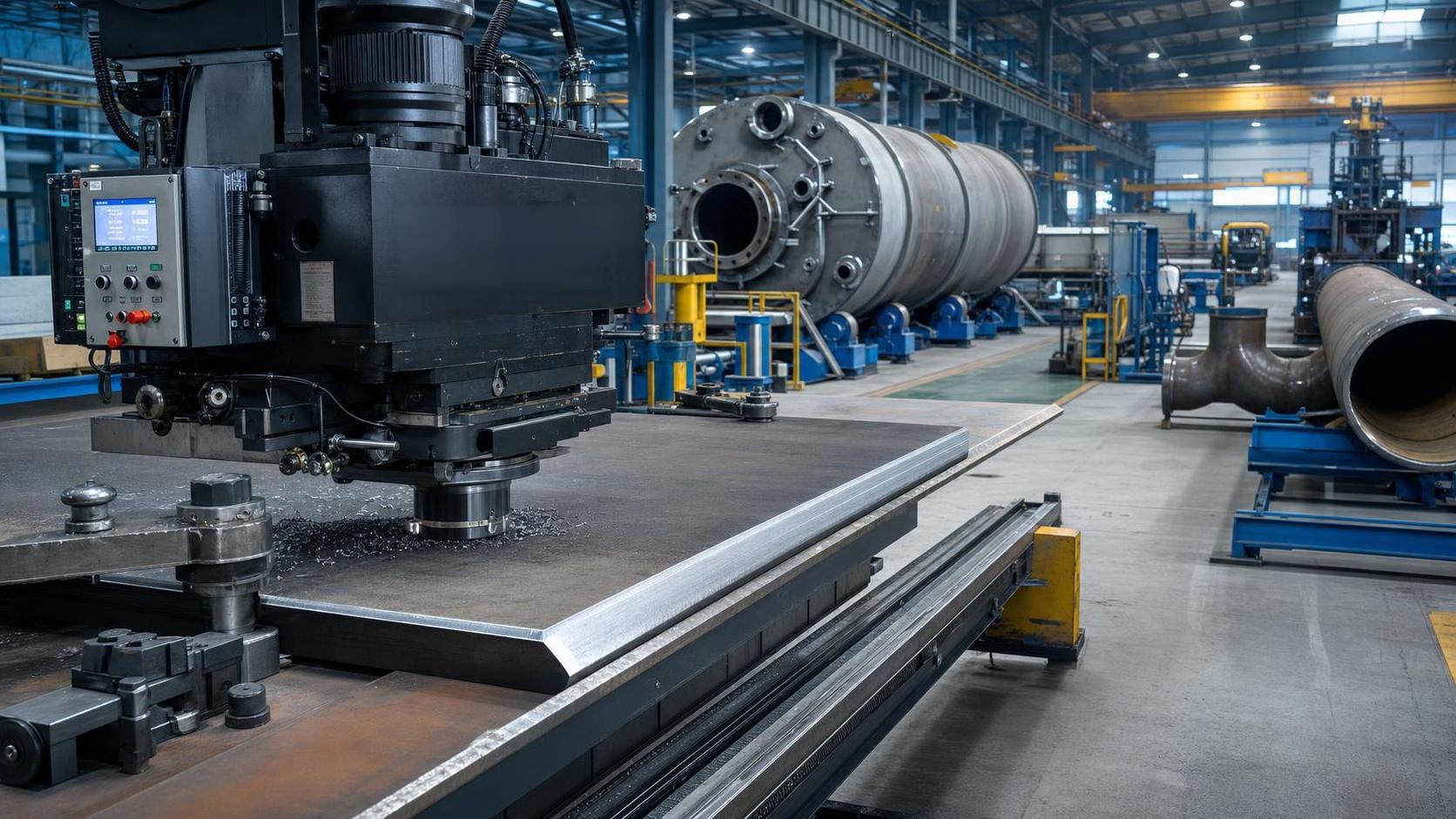
Edge milling machines sit at a critical point between cutting and welding. When weld preparation demands exact bevel geometry, clean edges, and repeatable fit-up, manual grinding or thermal edge preparation often stops being enough. In pressure vessel work, shipbuilding, bridge fabrication, and thick-plate processing, that difference directly affects weld quality, repair rates, and production rhythm.
What edge milling machines actually do
In practical terms, edge milling machines remove material from the plate edge to create a controlled weld groove.
That groove may be a straight bevel, double bevel, U-shape, or compound profile, depending on welding procedure requirements.
The key advantage is consistency. The machine produces the same angle, root face, and surface finish across long workpieces.
For heavy fabrication, consistency matters more than simple edge removal. Welders need predictable joint geometry, not just a prepared edge.
When they become necessary for weld preparation
Edge milling machines are usually needed when the weld joint cannot tolerate large dimensional variation.
This is common with thicker plates, multi-pass welds, and structures exposed to pressure, fatigue, or inspection standards.
They are also justified when rework from poor edge quality costs more than machine setup time.
Typical triggers include high bevel accuracy requirements, long straight edges, difficult materials, and repeat batch production.
- Plate thickness that makes manual beveling slow or inconsistent
- Joint designs that require accurate root land and bevel angle
- Welding procedures subject to NDT, pressure codes, or strict fabrication tolerance
- Production runs where repeatability matters more than flexible handwork
- Materials where thermal cutting leaves a heat-affected zone or rough edge
Why the industry pays attention to this step
Weld preparation is often treated as a supporting process, but it controls many downstream results.
A poor bevel can increase filler consumption, arc instability, distortion risk, and welder adjustment time.
An accurate bevel improves joint access and helps maintain penetration targets throughout the seam.
For technical evaluation, the real question is not whether edge milling machines remove metal efficiently. It is whether they stabilize the entire welding process.
That is why edge milling machines remain relevant even where laser, plasma, and automated welding lines are already in place.
Compared with other preparation methods
Where edge milling machines create the most value
Their value is strongest where welding quality is expensive to recover after the fact.
Pressure vessel production is a clear example. Groove accuracy affects penetration, inspection outcomes, and repair frequency.
Shipyards also rely on accurate beveling because long plate seams magnify small dimensional errors.
In structural steel fabrication, edge milling machines help maintain fit-up on thick members where manual correction becomes time-consuming.
Pipe and rolled-shell manufacturing is another useful context. Plate edges prepared correctly before forming support more stable seam welding afterward.
That connection is easy to see in automated pipe lines using 12 meter Pipe inside and outside seam welding machine systems.
When carbon steel or stainless steel pipes are produced in batches, consistent bevels help the longitudinal seam process run with fewer interruptions.
For pipe diameters from 400mm to 1500mm and thickness from 6mm to 20mm, upstream edge quality can strongly influence welding smoothness and monitoring results.
What to evaluate beyond basic specifications
Machine travel and maximum plate length matter, but they are only the starting point.
A more useful evaluation looks at how the equipment fits real production conditions.
Bevel capability
Check the angle range, profile flexibility, and whether the machine handles single and double-sided beveling efficiently.
If the product mix includes multiple joint forms, setup change time becomes important.
Clamping and rigidity
Plate movement during cutting reduces dimensional accuracy. A rigid bed and stable clamping system are not optional on thicker workpieces.
Surface finish and dimensional repeatability
Good edge milling machines should deliver repeatable geometry across the entire workpiece, not just at the first measured section.
That repeatability affects fit-up, tack welding, and root pass stability.
Integration with the line
Evaluate loading direction, material handling, and how prepared parts move into rolling, assembly, or welding stations.
An accurate machine can still become a bottleneck if transfer time is poorly planned.
Business context matters as much as machine data
A sound decision depends on production structure, not only on technical capability.
Low-mix, high-volume fabrication often supports investment in dedicated edge milling machines sooner than mixed custom work does.
However, custom heavy fabrication may still justify them when weld rejection costs are high.
This is where supplier experience becomes relevant. Wuxi Samgins International Trade Co.,Ltd has worked across welding equipment, CNC cutting systems, milling solutions, lathes, laser machines, and H-beam production lines.
That broader manufacturing background helps when a project needs process matching rather than isolated machine selection.
Its export experience across Southeast Asia, Europe, the Americas, and Oceania also suggests familiarity with varied plant layouts and compliance expectations.
ISO9001-oriented production control and CE-aligned design are especially relevant where documentation, repeatability, and machine safety influence approval.
A practical checklist for selection
Before comparing quotes, it helps to define the preparation problem in measurable terms.
- Required bevel angle tolerance and root face tolerance
- Material range, including carbon steel and stainless steel
- Plate thickness range and maximum edge length
- Expected batch size and daily throughput
- Current rework sources in fit-up and welding
- Need for integration with rolling, robotic welding, or seam monitoring
- Operator adjustment method, maintenance access, and tooling availability
This approach keeps the evaluation focused on process performance instead of catalog comparison.
How to move from interest to a sound decision
Edge milling machines are needed when weld preparation must be controlled, repeatable, and economical across demanding fabrication work.
Their real value shows up in fewer fit-up problems, steadier welding, and less correction after inspection.
The next step is to map bevel requirements to actual production constraints, then compare machine capability with downstream welding needs.
Where pipe, vessel, or thick-plate workflows are involved, reviewing edge preparation together with forming and automated seam welding usually gives the clearest answer.
search
Products Navigation
Send Us A Message