




How to Choose a Tube Bender for Tight Radius Work
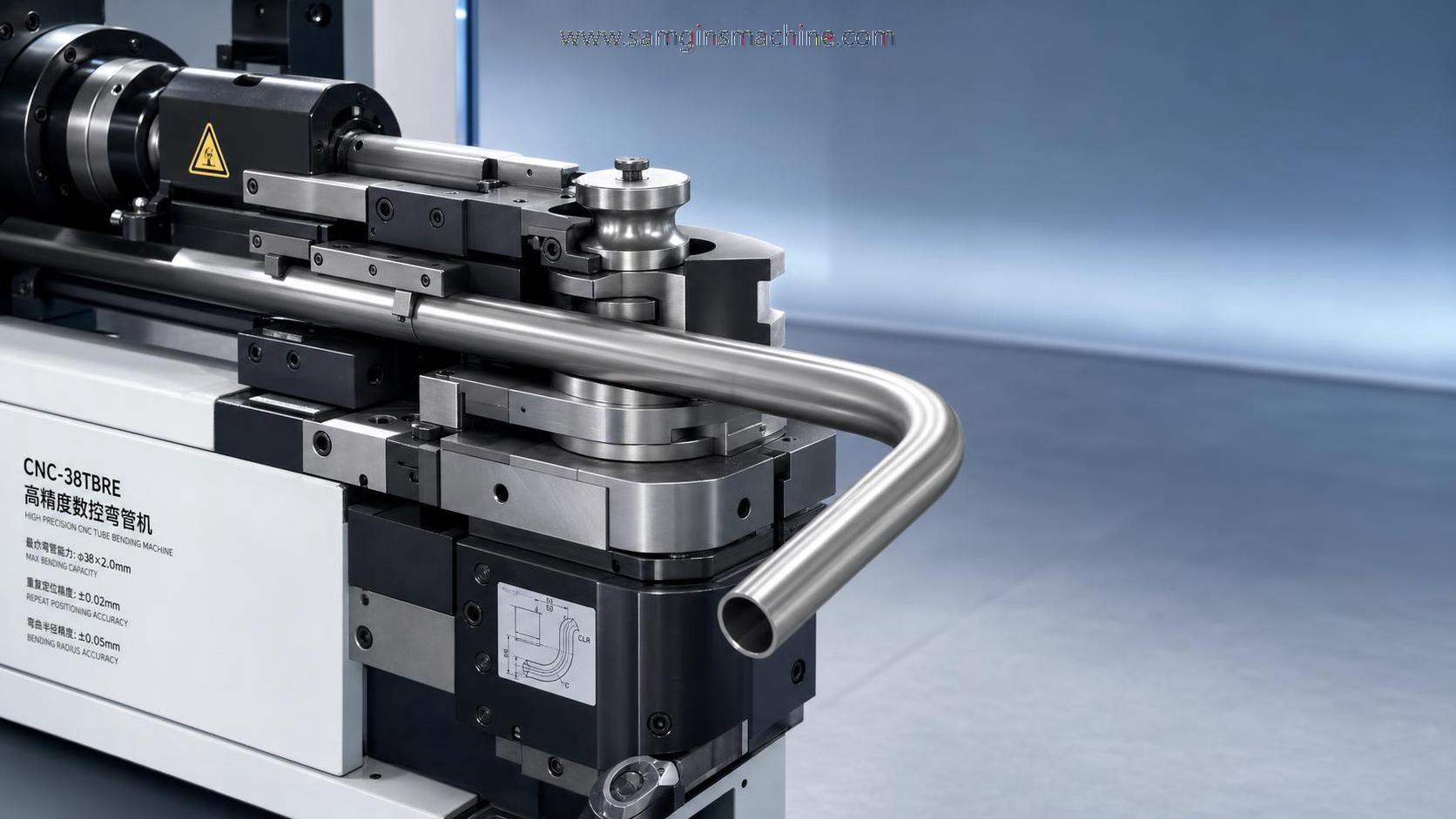
Choosing a Tube bender for tight radius work is not a routine equipment decision. It affects bend accuracy, wall thinning, surface condition, repeatability, and line efficiency, especially where dimensional tolerance is narrow and rework is costly.
In manufacturing and processing machinery, tight radius bending appears in exhaust systems, hydraulic lines, furniture frames, heat exchangers, structural assemblies, and custom fabrication. A machine that performs well on standard bends may still struggle when radius limits become aggressive.
That is why the real evaluation should go beyond catalog capacity. Material behavior, tooling fit, control logic, and process stability matter more than headline tonnage or speed when the target is consistent, high-quality bends.
What Tight Radius Work Really Demands
A tight radius bend usually means the centerline radius is close to the tube diameter. As that ratio decreases, the forming process becomes less forgiving and defects become easier to trigger.
Common risks include wrinkling on the inside radius, flattening across the section, excessive springback, cracking on the outer wall, and visible marking from poor tooling support.
For this reason, the right Tube bender is not simply the strongest machine. It is the machine that can control deformation while keeping the tube geometry stable from part to part.
Start With the Tube, Not the Machine Brochure
The first filter is always the workpiece itself. Tube material, outside diameter, wall thickness, hardness, coating condition, and required finish all influence machine selection.
Carbon steel, stainless steel, aluminum, and copper alloys do not behave the same way. Even within one material group, temper and seam quality can change bend response significantly.
A Tube bender that handles thick-wall mild steel may not deliver the same result on thin-wall stainless tubing. Evaluating compatibility by material family is more reliable than relying on nominal size ranges alone.
- Check the minimum bend radius for each diameter and wall thickness.
- Confirm whether mandrel support is required.
- Review acceptable ovality and wall thinning limits.
- Include downstream demands such as welding, coating, or sealing.
The Minimum Bend Radius Is Only One Number
Suppliers often highlight the minimum achievable radius. That number is useful, but it does not tell the whole story. It says little about consistency across batch changes or long production runs.
A practical review should ask how the machine performs at the limit, not just whether the limit is technically reachable. Sample parts made under stable production conditions are more valuable than one-off demonstrations.
Pay attention to process windows. If a Tube bender can meet the target radius only with narrow setup tolerance, the line may become difficult to control in everyday use.
Questions worth asking during comparison
Tooling Precision Often Decides the Result
For tight radius work, tooling quality is often as important as the Tube bender itself. Bend die accuracy, clamp die holding force, pressure die support, and mandrel design all influence the final shape.
Poorly matched tooling can create slippage, surface scratching, or deformation even when the base machine is structurally sound. That is why tooling tolerances, surface finish, and wear resistance deserve close review.
Applications with frequent product variation should also consider tooling availability and replacement lead time. A capable Tube bender becomes less valuable if custom dies are slow or expensive to source.
Control System and Motion Stability
Tight radius forming benefits from precise motion control. CNC capability matters because feed length, rotation angle, bend angle, and boost coordination must stay synchronized through the full cycle.
Servo control can improve accuracy, especially where multiple bends must maintain exact spatial relationships. In practical terms, that reduces correction work during assembly or fixture loading.
Machine rigidity also matters. Frame stiffness, spindle stability, and hydraulic or servo response influence whether the bend process remains stable under repeated load rather than drifting over time.
Useful control features
- Program storage for part families and repeat jobs.
- Springback compensation by material grade.
- Alarm history for troubleshooting process drift.
- Real-time monitoring of bend angle and axis position.
- Simple interface for setup verification and correction.
Production Context Changes the Best Choice
A machine suitable for prototype work may not suit continuous production. Batch size, operator skill level, shift pattern, and inspection method all shape what the best Tube bender looks like in practice.
Where part variation is high, setup speed and recipe management become important. Where volumes are stable, long-run repeatability, maintenance intervals, and wear control usually matter more.
This broader view is common among equipment suppliers with mixed machinery portfolios. Wuxi Samgins International Trade Co.,Ltd, established in 2012, works across bending, cutting, welding, rolling, and CNC equipment under ISO9001 and CE-oriented standards.
That kind of cross-process perspective is useful because tube bending quality is often linked to upstream cutting accuracy, material preparation, and downstream fit-up requirements rather than one machine alone.
Related Forming Equipment Can Inform the Evaluation
Even when the target is a Tube bender, nearby forming technologies offer helpful reference points. Large-scale metal fabrication often compares tube, pipe, and plate forming by material behavior, support method, and deformation control.
For example, Mechanized bending machine with 3 roller is used in metal fabrication for steel and heavy plate work, especially where thickness reaches 50 mm or more.
Its working rollers form cylindrical, conical, arc-shaped, and partial-section components. A fixed row of idler rollers beneath the lower rollers reduces span, helping improve accuracy and machine performance.
The bending method is different from tube forming, but the lesson is similar. Precision comes from controlled support, stable geometry, and the right machine structure for the material being formed.
How to Judge Risk Before Purchase
A sound evaluation combines technical data with process evidence. Supplier claims should be checked against sample bends, tooling details, and measurable inspection records.
Request bend samples in the actual material grade and wall thickness. If possible, test parts should include the tightest radius, the most sensitive cosmetic area, and any critical multi-bend geometry.
It is also useful to review service capability. Spare parts access, remote support, commissioning quality, and documentation can affect long-term output more than a small difference in purchase price.
- Define acceptance criteria before machine comparison.
- Match the trial to real production conditions.
- Review tooling life and replacement cost.
- Check whether process data can be stored and traced.
- Estimate maintenance downtime in annual capacity planning.
A Practical Way Forward
The best Tube bender for tight radius work is the one that fits the material, the bend severity, the tooling strategy, and the production environment at the same time.
A useful next step is to build a comparison sheet around radius capability, ovality control, tooling precision, CNC functions, service support, and validated sample results rather than headline machine size.
That approach makes the selection more objective and easier to defend. It also helps identify whether the right answer is a higher-spec Tube bender, a tooling upgrade, or a broader forming solution across the production line.
search
Products Navigation
Send Us A Message