




What Can a Profile Bender Do? Common Materials, Shapes, and Industrial Uses
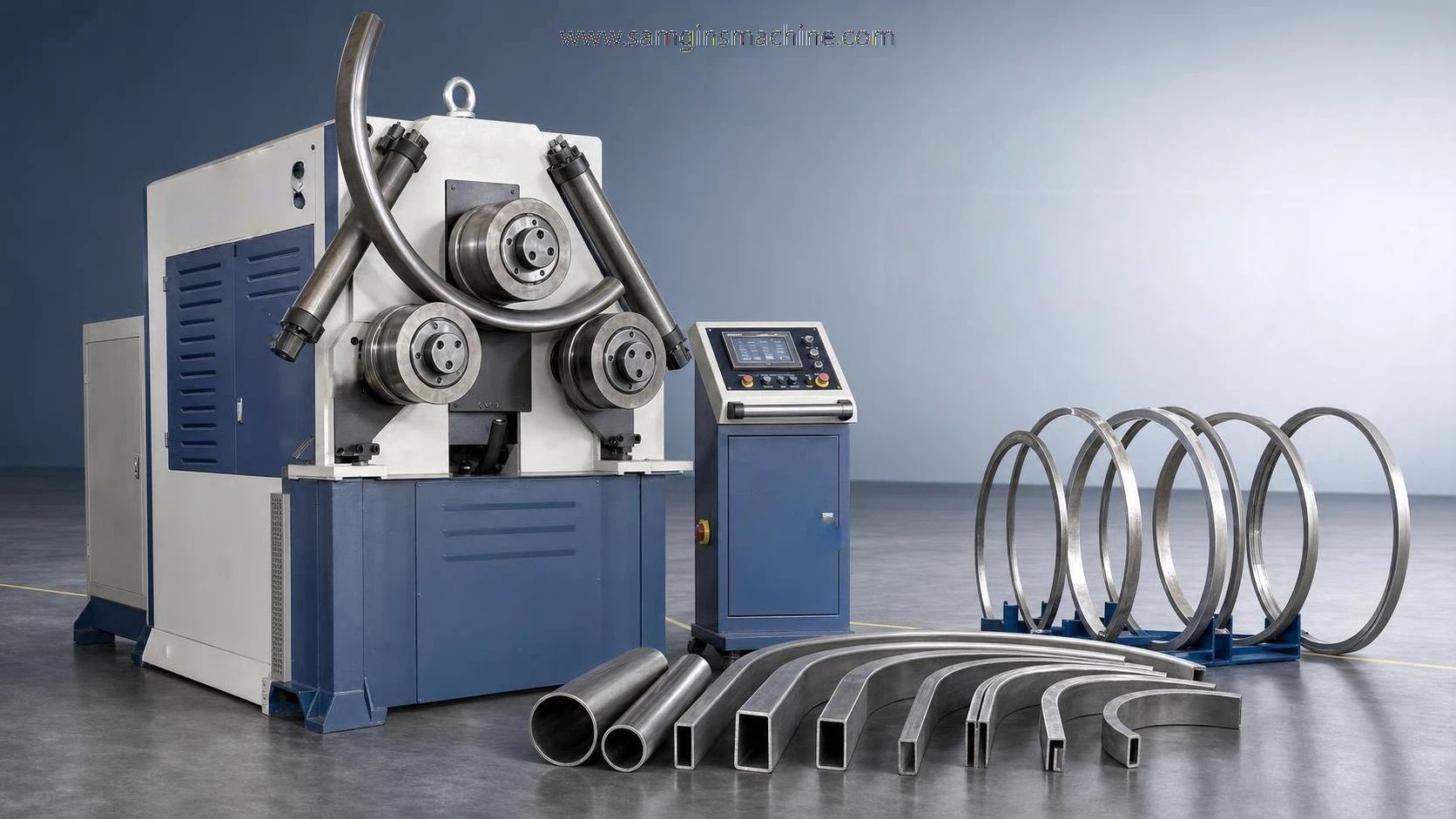
What does a profile bender actually do?
A profile bender is a forming machine that curves metal sections into controlled radii without cutting and rejoining the material.
In practical terms, it handles tubes, pipes, flat bars, angles, channels, and similar profiles used in fabrication lines.
That matters because curved parts appear everywhere, from frames and guards to structural supports and pressure-related assemblies.
A good profile bender does more than make a bend.
It helps control repeatability, reduces manual correction, and keeps deformation within an acceptable range for downstream work.
The usual forming method relies on rollers.
The material passes through driven rolls, and pressure is adjusted until the desired curve is reached.
Compared with improvised bending methods, this gives cleaner geometry and more stable batch production.
For companies working across bending, cutting, welding, and finishing, that consistency is often the real advantage.
Wuxi Samgins International Trade Co., Ltd has long focused on this kind of metalworking equipment integration.
Its broader product range, built around ISO9001 management and CE-oriented standards, reflects how profile bending fits larger fabrication workflows.
Which materials can a profile bender handle well?
The short answer is most common metal profiles, but performance depends on section shape, wall thickness, temper, and required radius.
Carbon steel is the most common material for a profile bender.
It bends predictably and suits construction components, machine bases, guards, brackets, and support rings.
Stainless steel is also widely processed.
It demands tighter control because springback is stronger, and surface marking is less acceptable in many jobs.
Aluminum profiles are easier to deform, yet they scratch more easily and may distort if roll pressure is poorly set.
Some profile bender setups can also work with copper, brass, or special alloys.
Even then, the material is only part of the decision.
The section itself often determines whether a bend is straightforward or problematic.
- Round tube and pipe usually bend smoothly with the right tooling and support.
- Square and rectangular tubes need more attention to corner collapse and wall flattening.
- Angle iron can twist if the feed path is not controlled.
- Channels and beams require stronger machines and accurate roll alignment.
- Flat bars can bend the easy way or the hard way, which changes required force significantly.
A common mistake is asking only, “Can this profile bender process stainless steel?”
A better question is whether it can process that exact section size, thickness, and radius without unacceptable distortion.
What shapes can a profile bender create in real production?
Most people first think of simple arcs, and that is still the most frequent use.
But a profile bender can usually form a wider range of parts when the machine, tooling, and material are matched properly.
Common outputs include large-radius curves, full rings, partial rings, spiral forms, and curved frames.
Some applications need matching left and right bends for symmetrical assemblies.
Others need repeatable arc segments that will later be welded into tanks, supports, or machine enclosures.
Shape accuracy depends on more than the target drawing.
Operators need to account for springback, entry straight length, material memory, and roll position correction during trial runs.
This is why experienced workshops often create a sample first, then lock the settings for the batch.
The table below gives a practical way to judge what a profile bender is expected to do.
Where is a profile bender most often used?
Industrial use is broader than many first-time researchers expect.
A profile bender appears in construction steelwork, transport equipment, general fabrication, pipeline support production, and agricultural machinery.
It is also common in architectural metalwork where curved railings, frames, and decorative structural parts must be repeated consistently.
In heavier manufacturing, curved sections often move directly into welding cells, assembly stations, or machining steps.
That is where equipment planning becomes more connected.
For example, bent rings or cylindrical sections may later need controlled rotation during seam welding.
In that workflow, a support system such as Bolt adjusting welding rotator can fit naturally after bending.
Its load range, from 2T to 800T across models like XHGK-2 to XHGK-800, suits cylindrical fabrication at very different scales.
That is especially relevant in pressure vessel work, large-diameter pipe welding, and heavy-duty workshops.
A profile bender, then, is rarely an isolated purchase.
More often, it is one station inside a forming and welding chain that includes cutting, handling, fitting, rotation, and finishing.
How do you choose the right profile bender without overspending?
Machine selection usually goes wrong when the radius is discussed, but the full production condition is ignored.
A useful starting point is to define five things clearly.
- Material grade and hardness
- Section shape and dimensions
- Target inside or centerline radius
- Tolerance and appearance requirements
- Batch size and production rhythm
If the work changes frequently, setup flexibility matters more than maximum force alone.
If the same part repeats daily, automation and preset repeatability become more valuable.
Need-to-know details include roll diameter, shaft strength, drive type, vertical or horizontal layout, and control method.
For some lines, the question is not only whether the profile bender can make the curve.
It is whether the part exits ready for welding, drilling, coating, or assembly without rework.
This is one reason suppliers with experience across CNC cutting, plate rolling, welding automation, and bending equipment can offer more useful matching advice.
What problems show up most often during profile bending?
Several issues appear repeatedly, and most can be prevented before full production starts.
Springback is the most familiar one.
The profile seems correct during forming, then relaxes after release and misses the target radius.
Surface marks are another concern, especially with stainless steel, aluminum, or visible architectural parts.
Thin-wall sections may flatten, while asymmetrical profiles may twist out of plane.
End straightness can also create confusion.
Some sections cannot be bent cleanly from the very first millimeter, so trimming may be necessary.
A few checks usually prevent expensive surprises:
- Run a sample with the actual material lot, not only catalog values.
- Confirm whether cosmetic surface quality matters as much as geometry.
- Measure springback after release, not only during rolling.
- Check whether later welding heat will change the final shape.
- Match handling equipment to part length and weight before bending starts.
In integrated fabrication, even rotation speed at the welding stage can matter afterward.
For cylindrical assemblies, the second use of a Bolt adjusting welding rotator may help maintain stable weld positioning through VFD speed control.
So, when is a profile bender the right investment?
A profile bender becomes the right choice when curved profiles are frequent enough that manual forming slows delivery or weakens consistency.
It is also a strong fit when parts must match from batch to batch and feed reliably into later fabrication steps.
The best buying decision usually comes from mapping the whole route of the part.
Start with material, section, and radius.
Then check tolerance, production volume, operator skill, and what happens after bending.
If the bent section will be assembled into cylinders, frames, or welded structures, evaluate those linked stations at the same time.
That broader view usually leads to a better machine choice than comparing price tags alone.
In short, a profile bender is not only about making metal curve.
It is about producing usable curved parts with predictable quality, manageable cost, and fewer downstream corrections.
The next practical step is to list your exact profiles, required radii, annual quantities, and post-bending operations, then compare machines against that real workload.
search
Products Navigation
Send Us A Message