




Flame Cutting Machine Quality Issues and How to Reduce Edge Hardening
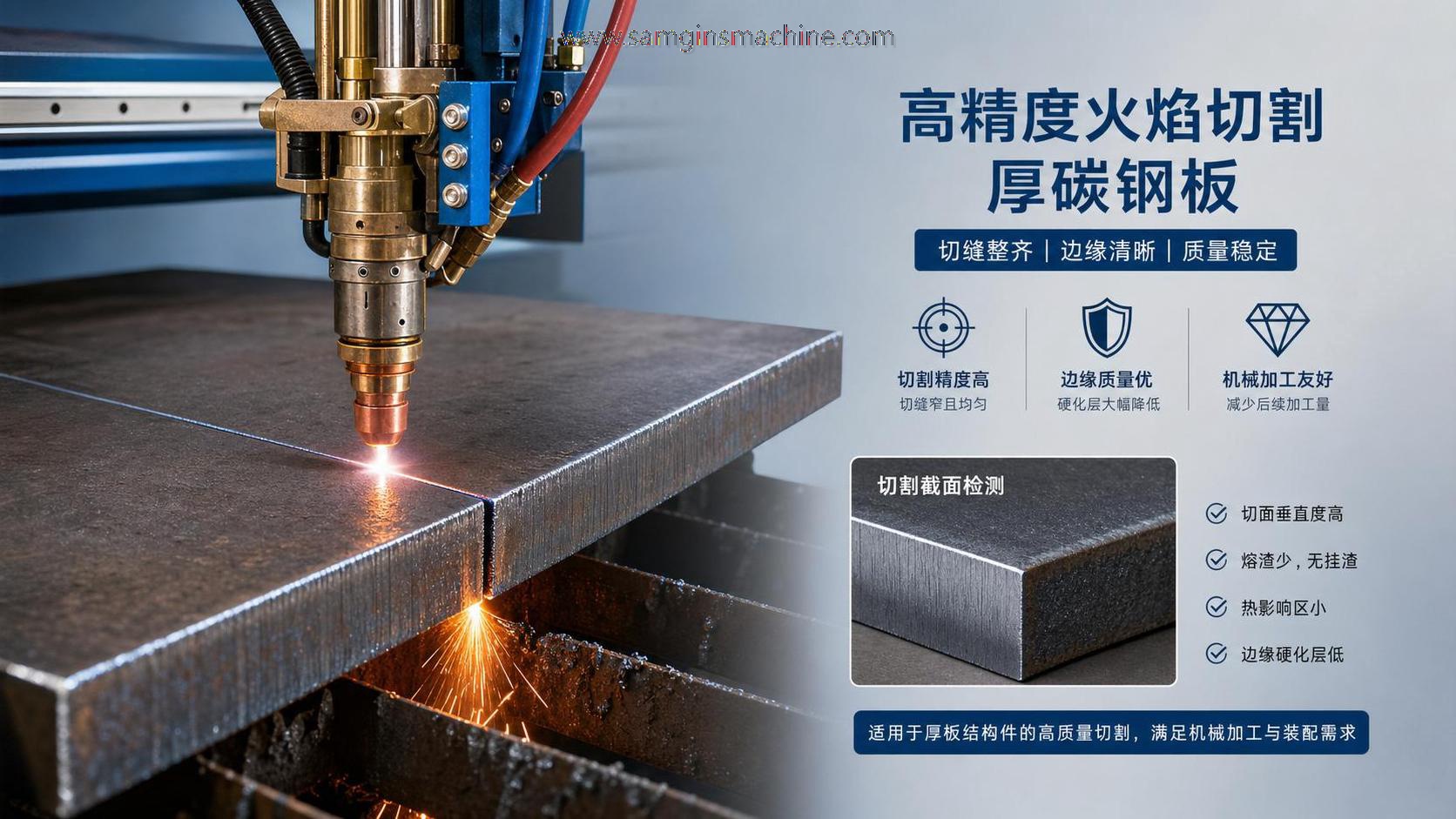
Flame Cutting Machine Quality Issues and How to Reduce Edge Hardening
In daily fabrication, a Flame cutting machine is valued for speed, low operating cost, and flexibility on thick carbon steel plates.
The trouble begins when cut edges turn too hard, rough, or inconsistent.
That affects welding, drilling, machining, and even safety during handling.
More practical concerns usually follow: rework increases, consumables are wasted, and downstream dimensional control becomes harder.
In real workshops, edge hardening is rarely caused by one factor alone.
It is usually linked to steel composition, heat input, oxygen quality, travel speed, and operator settings working together.
For companies supplying global projects, stable cutting quality matters even more.
Wuxi Samgins International Trade Co., Ltd has long focused on mechanical equipment built under ISO9001 management and EU CE standards.
That background reflects a simple reality: process control is what turns machine capacity into reliable production quality.
Why does a Flame cutting machine create hard edges in the first place?
A hardened edge forms when the cut zone heats rapidly and then cools too fast.
This thermal cycle can change the microstructure near the cut face.
On medium and high carbon steels, that change is more obvious.
The result may be a brittle surface layer, reduced machinability, and cracking risk during forming or welding.
The common assumption is that the Flame cutting machine itself is the problem.
More often, the real issue is mismatch between material grade and cutting parameters.
For example, when oxygen purity drops or nozzle condition worsens, the cut becomes less stable.
Operators may then slow down excessively or raise heat input, which can deepen the heat affected zone.
Plate thickness also matters.
Thin sections can cool very quickly, while thick sections may hold heat unevenly if preheat is not managed well.
A quick way to judge the likely cause
Before changing everything, it helps to compare visible symptoms with likely process errors.
Which settings usually damage cut quality most?
Three variables deserve attention first: preheat flame, cutting oxygen, and travel speed.
If preheat is too strong, the top edge rounds off and the heat affected zone grows.
If it is too weak, piercing becomes unstable and the cut front loses direction.
Cutting oxygen must be clean, dry, and supplied at the correct pressure.
A small pressure deviation can change kerf shape and oxidation efficiency.
Travel speed is where many quality problems become visible.
Too slow, and the plate absorbs excess heat.
Too fast, and the cut lags, leaving attached slag and uneven penetration.
Torch height should not be ignored either.
An incorrect standoff distance disturbs the oxygen jet and makes the Flame cutting machine less predictable.
- Check nozzle wear at the start of each shift.
- Confirm gas pressure with calibrated gauges.
- Match speed tables to actual plate thickness, not only machine defaults.
- Record successful settings by material grade for repeat jobs.
Can material choice make edge hardening worse even with a good Flame cutting machine?
Yes, and this is often underestimated.
A well-maintained Flame cutting machine cannot fully compensate for unsuitable material chemistry.
Steels with higher carbon equivalent tend to harden more easily after thermal cutting.
That includes some structural steels, wear-resistant grades, and alloy plates used for demanding service conditions.
In practical terms, the same cutting setup may work well on one plate batch and fail on another.
This is why incoming material traceability matters.
Heat number, chemical composition, thickness tolerance, and surface condition should be reviewed before production starts.
If parts will later be threaded, bent, or fatigue-loaded, edge condition becomes even more important.
That is also where process selection across the full line becomes relevant.
For example, when threaded parts are produced after cutting, cold-forming methods may preserve material structure better than chip-cutting methods.
A solution such as Z28-150 thread rolling machine is useful in that context because thread rolling forms threads without cutting away material.
That process supports carbon steel, alloy steel, and non-ferrous workpieces, and helps maintain surface integrity in batch production.
What actually helps reduce edge hardening on the shop floor?
The most effective improvement is usually a controlled combination of material review and thermal control.
A single adjustment rarely solves the problem completely.
Start by confirming whether the plate requires preheating.
Preheating reduces the cooling rate and lowers the chance of forming a very hard edge layer.
The required temperature depends on grade, thickness, and ambient conditions.
Next, stabilize the cut front.
Consistent speed, correct nozzle size, and proper torch alignment keep heat input more uniform.
When possible, avoid unnecessary pauses during long cuts.
Stop-start marks often create localized overheating and hardness spikes.
Post-cut cooling should also be considered.
Rapid cooling from water, cold drafts, or direct contact with chilled surfaces can worsen hardening.
In more demanding applications, a simple hardness check along the cut edge provides useful feedback.
That turns quality discussions from guesswork into measurable control.
A practical reduction checklist
- Review carbon equivalent before cutting critical plates.
- Use preheat where the material grade requires it.
- Keep oxygen purity high and gas lines dry.
- Replace damaged nozzles before quality drifts appear.
- Avoid over-slow cutting used only to “play safe.”
- Check edge hardness when parts are headed for welding or machining.
When is the issue no longer just cosmetic?
This becomes serious when the cut edge affects later operations or service life.
If drilling tools wear too fast, weld toes crack, or bend lines split, edge hardening is no longer a surface appearance issue.
It has become a process risk.
A useful rule is to separate defects into two groups.
Once downstream failures appear, the Flame cutting machine should be evaluated together with material controls and follow-up operations.
That broader view usually saves more cost than repeated local adjustments.
How should a stable prevention plan be built?
A reliable plan is usually simple, documented, and tied to measurable checkpoints.
Begin with parameter standards by plate grade and thickness.
Then define acceptance criteria for edge appearance, slag level, dimensional accuracy, and hardness where required.
It also helps to link cutting control with later forming steps.
For parts entering thread production, cold-forming equipment can reduce additional damage to the workpiece surface.
In that type of line, the second use of Z28-150 thread rolling machine may be worth reviewing.
Its 180KN rolling pressure, multiple spindle speeds, and manual, semi-automatic, or automatic modes suit small to medium batch work.
More importantly, it reflects a process idea that also applies to flame cutting: protect material performance while meeting output targets.
In the end, a Flame cutting machine performs well when process data is reviewed routinely, not only after defects appear.
A sensible next step is to sort jobs by steel grade, thickness, and downstream use, then build cutting rules around those three factors.
That approach makes quality control more predictable, lowers rework, and reduces the chance that hardened edges become a hidden production risk.
search
Products Navigation
Send Us A Message