




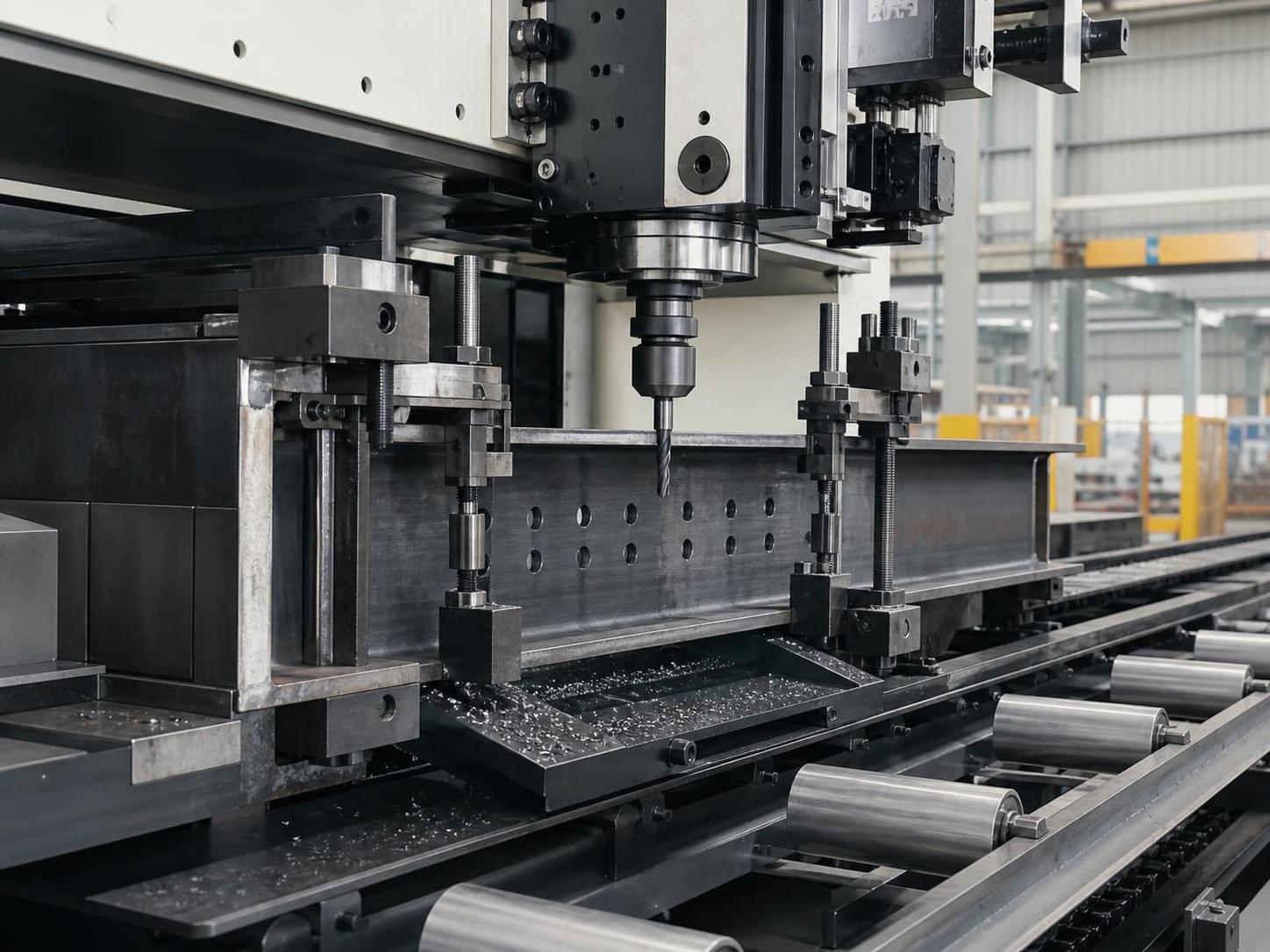
How a Beam Drilling Machine Improves Hole Accuracy in H-Beam and Channel Processing
In steel structure fabrication, hole location errors usually do not look serious at the drilling stage. The problem often shows up later, when H-beams or channels reach fit-up, bolting, or assembly. At that point, even a small deviation can slow the whole line, force rework, and create unnecessary arguments between design, production, and installation teams.
A beam drilling machine is often brought into the discussion when manual marking, conventional drilling, or unstable setup methods start causing repeated alignment problems. If you are trying to improve hole accuracy without turning every part into a special inspection job, the useful question is not just whether the machine can drill faster, but how it helps control the entire accuracy chain from positioning to final verification.
Why hole accuracy becomes a recurring problem in beam processing
Many workshops first notice the issue through symptoms rather than measurements. Bolt holes do not line up smoothly. Assemblers need pry bars or local correction. Parts that look acceptable on the table become difficult to join during erection. In H-beam and channel processing, this usually happens because hole accuracy depends on more than spindle performance alone.
Common causes include inconsistent datum selection, manual layout variation, beam web or flange positioning errors, tool wear, vibration during drilling, and poor handling between processes. Long workpieces make the problem more obvious because even slight movement at one end can affect the relative position of several holes. Channels can also be tricky because open sections are easier to clamp unevenly if the support method is not well controlled.
What makes this frustrating is that teams often focus on the drill bit first, while the actual source of error may be the feeding system, the reference edge, or the way the operator loads material. That is why a beam drilling machine matters: it helps standardize positioning and repeatability across the full process, not only the cutting action.
What poor accuracy affects beyond the hole itself
Hole deviation is rarely an isolated defect. In practical fabrication work, it usually triggers a chain reaction. First, fit-up slows down because operators need to check whether the mismatch comes from the beam, the plate, or the hole pattern. Then the production schedule becomes harder to predict, because rework does not happen in a clean sequence. It interrupts welding, handling, and inspection.
There is also a quality management problem. If one batch shows variable hole positions, inspectors may need to increase checking frequency, which adds more labor without improving throughput. On projects that involve repeated beam sizes and hole groups, inconsistency is especially expensive because the line loses the main advantage of repetition.
For project managers and workshop leaders, the real value of a beam drilling machine is that it reduces process uncertainty. More accurate holes mean fewer manual corrections, smoother assembly planning, and less dependence on individual operator technique.
Before changing equipment, check where the accuracy loss actually starts
It is worth reviewing the process in sequence before deciding what to adjust. A lot of shops assume the machine is the only variable, but in beam fabrication the error path often starts earlier. Ask a few practical questions:
- Is the workpiece referenced from a consistent datum every time?
- Are H-beams and channels fully supported across their length, or are they twisting during loading?
- Is the clamping method stable enough to prevent movement while drilling?
- Are programming inputs checked against real section dimensions rather than nominal drawings alone?
- Is tool wear being noticed early, or only after visible quality problems appear?
- Are downstream teams reporting the exact mismatch location, or only saying that assembly is difficult?
This review usually makes one thing clear: stable hole accuracy comes from a controlled system. When a beam drilling machine is selected and used correctly, it supports that system by combining automatic positioning, repeatable feed control, and better consistency across long or repeated sections.
How a beam drilling machine improves accuracy in day-to-day production
The biggest improvement usually comes from repeatable positioning. Instead of relying heavily on manual marking and line interpretation, the machine uses programmed coordinates and fixed reference logic. That reduces human variation, especially when the same hole pattern is produced across multiple parts.
Another benefit is controlled feeding and drilling stability. In H-beam and channel processing, stable feed motion matters because thin sections, uneven contact, or long unsupported spans can create vibration. A suitable beam drilling machine keeps drilling conditions more consistent, which helps maintain cleaner hole geometry and better positional repeatability.
It also helps with process discipline. When drilling is integrated into a more systematic fabrication workflow, teams become better at checking inputs, confirming datums, and monitoring tool condition. This may sound basic, but many accuracy problems persist precisely because the workshop has no enforced sequence.
In factories handling multiple steel fabrication processes, this same logic often extends beyond drilling. For example, some lines combine drilling, fitting, and welding under coordinated motion control. In those cases, equipment such as the 7 axis railway type welding robot may be considered in later stages where long workpieces also need repeatable path control, automatic location, and better workflow continuity after hole preparation is complete.
A practical process for improving hole accuracy without overcomplicating the line
If you are dealing with recurring mismatch problems, a structured adjustment process is usually more effective than changing everything at once. The goal is to identify the few controls that most directly affect accuracy and make them repeatable.
- Standardize the datum rule. Decide exactly how H-beams and channels are referenced during loading and programming. The same drawing can produce different real results if operators choose different baseline edges.
- Check workpiece support over the full length. Long beams should not sag or shift during drilling. Supports need to match the section and process length, especially when hole groups are spread across the part.
- Confirm clamping consistency. Uneven clamping can slightly rotate or lift the section. That may not be obvious visually, but it can change the relative hole position enough to affect assembly.
- Review program input discipline. Make sure the operator is working from verified dimensions and that hole patterns are not being adjusted informally on the shop floor without traceable checks.
- Track tool condition as a routine, not as a reaction. A worn tool may still cut, but positional quality and hole finish can become less stable before failure is obvious.
- Inspect against the assembly need. Do not only measure single-hole dimensions. Verify spacing, edge distance, and group location in the way the part will actually be used.
- Separate loading error from machine error. If deviation appears, test repeated drilling on controlled samples before assuming the beam drilling machine itself is out of calibration.
This approach helps teams avoid the common mistake of blaming equipment for a setup problem, or blaming operators for a process design issue.
Common misunderstandings when selecting a beam drilling machine
One frequent misunderstanding is that speed automatically means accuracy. Higher throughput is useful, but only if the machine maintains stable positioning, reliable feeding, and workable loading logic for your beam sizes. A fast machine in an unstable layout will simply produce bad parts more efficiently.
Another mistake is judging the machine only by spindle specifications or brochure language. In real H-beam and channel work, the more important questions are often about referencing, motion repeatability, support arrangement, operator workflow, and how easy it is to keep settings consistent across shifts.
There is also a tendency to think drilling accuracy can be solved independently from the rest of the line. In practice, beam processing is linked. If the same workshop later moves parts into automated welding or long-length handling, coordinated equipment planning becomes relevant. For instance, a system like a 7-axis rail-mounted welding workstation may be useful where long workpieces require controlled movement after drilling, with features such as servo-driven travel, automatic location, visible machine status lights, and emergency stop provisions supporting safer and more organized downstream production.
How to judge whether your current setup is good enough
You do not always need a complete line change. In some shops, a beam drilling machine already has the necessary capability, but the surrounding process is limiting its performance. A reasonable evaluation usually includes three areas.
First, look at repeatability. If identical parts show inconsistent hole location, the issue may be setup or referencing rather than material variation. Second, look at process interruption. If operators repeatedly stop to recheck alignment or manually correct workpiece position, the line is carrying hidden instability. Third, look at downstream feedback. If fit-up teams consistently identify the same mismatch pattern, that is often enough to justify a more systematic drilling approach.
For manufacturers serving diverse international markets, consistency is often more important than maximum output on paper. That is one reason companies such as Wuxi Samgins International Trade Co.,Ltd focus on a broad range of fabrication equipment for steel processing, welding, cutting, milling, and forming. In this type of production environment, the useful decision is usually the one that improves repeatable quality across the full workflow rather than optimizing only one isolated step.
Frequently Asked Questions
Is a beam drilling machine mainly for speed, or for accuracy?
It supports both, but accuracy is often the bigger operational benefit. Speed matters less if parts still need rework or difficult assembly. The main advantage is repeatable positioning and reduced manual variation.
Why do hole problems still happen even when the drill bit is new?
Because the bit is only one factor. Loading position, datum selection, support stability, clamping, program input, and machine calibration can all affect final hole location.
Are H-beams and channels affected in the same way?
Not exactly. H-beams usually raise issues related to long-length support and web or flange reference consistency. Channels can be more sensitive to uneven clamping or section movement because of their open profile.
When should a workshop consider integrating drilling with other automated equipment?
Usually when hole preparation is no longer the only bottleneck and the next processes also require repeatable handling. In long workpiece production, linking drilling with organized welding or transfer stages can improve overall workflow stability.
What should be checked before blaming the machine for poor accuracy?
Check the datum method, support condition, clamping consistency, programming inputs, and inspection method first. Those areas often explain the problem before a machine fault does.
Conclusion
When hole accuracy problems keep returning in H-beam and channel processing, the answer is usually not a single adjustment. The better approach is to treat the beam drilling machine as part of a controlled production method: stable reference points, reliable support, correct programming, and consistent inspection. That is what turns drilling from a repeated source of downstream trouble into a predictable step in the fabrication line.
If you are comparing process options, focus on how the equipment will behave in your actual workflow, especially with long sections, repeated patterns, and linked fabrication stages. That is usually where real accuracy gains come from, and where later improvements in welding, assembly, and delivery become easier to achieve.