




What to Check Before Buying a Structural Steel Drilling Machine for Fabrication Lines
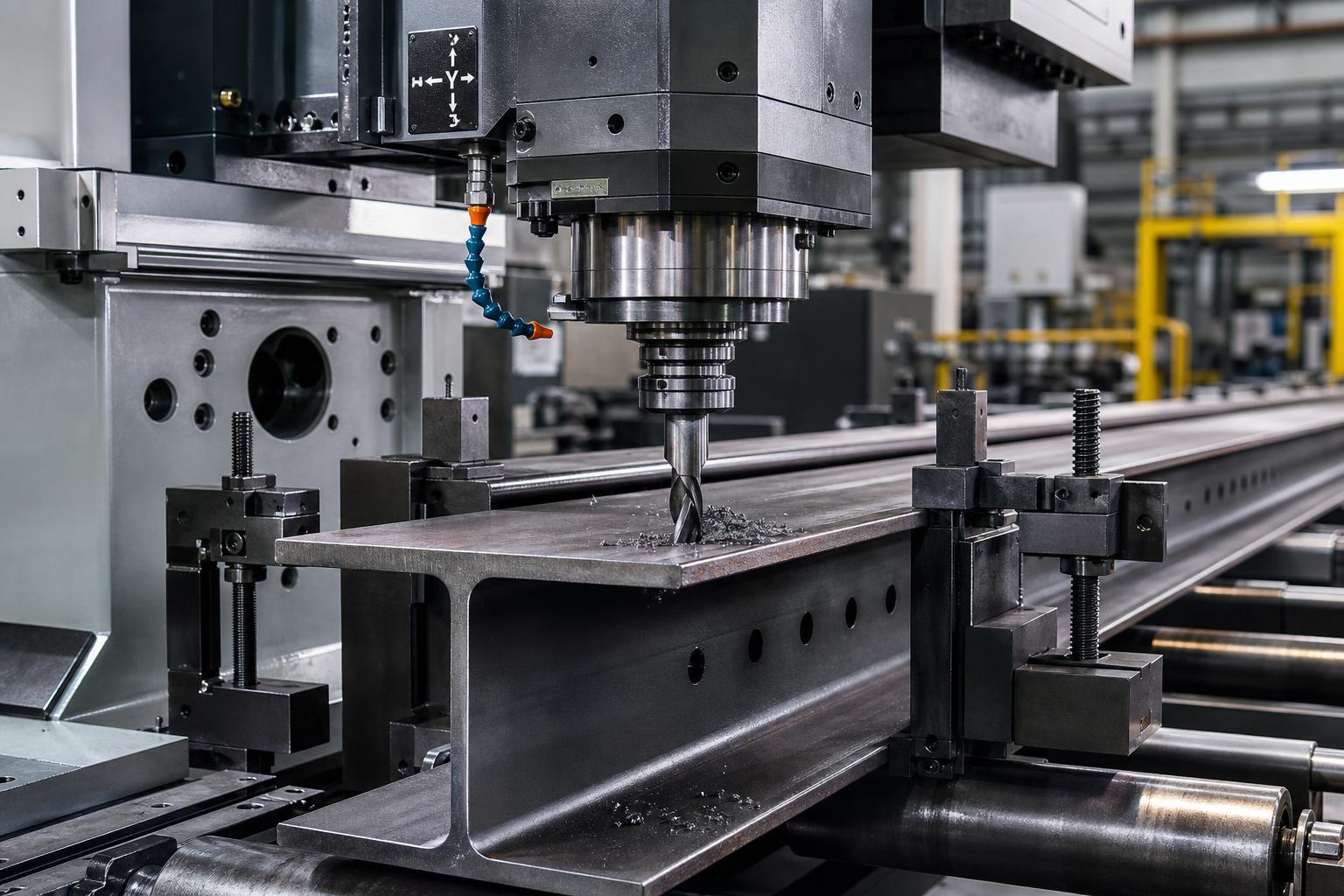
Running cost usually separates a suitable structural steel drilling machine from an expensive mistake. A lower purchase price can be offset quickly by slow positioning, frequent tool breakage, unstable hole tolerance, or extra handling between drilling, marking, and sawing stations. Before comparing quotations, it helps to define the actual workload in the fabrication line: beam size range, flange and web thickness, hole diameter range, material grade, shift length, and whether the machine will process H-beams, channels, angles, plates, or mixed profiles. Without that baseline, specifications look impressive on paper but may not match production reality.
Machine frame rigidity affects both accuracy and tool life
The first point to study is the mechanical structure. Structural steel drilling generates vibration, especially when processing thicker sections or larger hole diameters in carbon steel and alloy steel. If the frame, spindle box, guide system, or clamping arrangement lacks rigidity, the result may be visible chatter, oversize holes, accelerated insert wear, and inconsistent hole position from one workpiece to the next. A machine intended for fabrication lines should have a stable bed, dependable feeding system, and enough structural mass to resist movement during heavy drilling cycles.
Material support along the infeed and outfeed side matters as much as the drill head itself. Long beams can sag or twist if roller tables are too lightly built or if support intervals are too wide. That movement can shift the drilling point even when the CNC axis is technically accurate. When reviewing a proposal, it is worth asking how the machine maintains beam alignment across the full working length, particularly for thinner webs or asymmetrical sections that are easier to distort during clamping.
CNC control should be judged by workflow, not only by screen appearance
A modern structural steel drilling machine is often sold on CNC capability, but the real question is how easily the control fits the line’s daily work. Program import, nesting logic, manual correction, tool offset setting, alarm handling, and job switching all affect throughput. If the control can read common fabrication file formats and support repeat jobs without excessive manual data entry, setup time is likely to be lower. If every change requires lengthy intervention, the machine may become an administrative bottleneck rather than a production asset.
Axis resolution alone is not enough. Motion stability during acceleration and deceleration should also be considered, because sudden stops or uneven servo response can reduce positioning consistency. If the machine is expected to process different profile families on the same shift, ask whether the control stores parameter libraries by section type, hole pattern, and tool size. This tends to matter more in actual use than a long list of menu functions.
Drilling capacity must match the toughest routine job, not the easiest sample part
Many comparison errors happen here. A supplier may show maximum drilling diameter, but maximum diameter is only one part of usable capacity. The more useful questions are: at what material thickness, with what spindle power, under what feed rate, using which tool type, and with what hole tolerance expectation? A machine that can technically drill a large hole in a single demonstration may still perform poorly if that size appears frequently in production.
Look closely at spindle motor power, spindle speed range, feed force, and tool interface. Heavy sections often require reliable torque at lower speed, while thinner material may benefit from faster cycle times and stable chip evacuation. Through-spindle coolant, if available, can improve drilling on deeper holes and reduce thermal issues, but only if the coolant system is sized and filtered correctly. Poor filtration can shorten tool life and introduce maintenance problems of its own.
It is also useful to separate twist drilling, carbide drilling, tapping, countersinking, and marking functions. Some machines handle only drilling efficiently. Others combine several operations, which may reduce handling and improve line flow. That combination is worthwhile only when the integrated heads remain rigid and serviceable. Extra functions that slow the main drilling cycle can add complexity without much return.
Hole quality depends on clamping, datum logic, and chip control
In fabrication work, acceptable hole quality is usually defined by downstream fit-up. If bolt holes are off location, or if burrs are excessive, assembly time increases and rework may spread to welding or erection stages. This is why hole accuracy should be discussed together with the machine’s clamping method and reference system. A CNC axis can be precise, yet the finished part can still be inaccurate if the workpiece datum is unstable.
Ask how the machine references the beam, especially when section tolerances vary from batch to batch. Rolled structural sections are not perfectly uniform. Web centerline, flange width, straightness, and twist can all vary. A machine that assumes ideal stock may need frequent operator correction. A more practical system compensates for common section variation and keeps drilling coordinates tied to a repeatable reference.
Chip removal should not be treated as a small detail. Steel chips accumulating around the drill area can scratch the workpiece, affect clamp seating, and increase stoppages. In thicker material, long chips can wrap around the tool if feed and coolant conditions are poorly controlled. Conveyor design, coolant return path, and access for cleaning all influence daily uptime.
Automation level should fit the line balance
Higher automation is not automatically cheaper in operation. If upstream loading and downstream sorting remain manual, a highly automated drilling center may spend much of its time waiting. On the other hand, when the fabrication line already includes automatic measuring, conveying, and part identification, a basic standalone drill can slow the entire sequence. The right level depends on whether the drilling station is expected to run as an isolated process or as part of a linked beam line.
Useful details include automatic section measurement, automatic tool change, powered material transfer, and part discharge logic. Each one affects labor, downtime, and cycle consistency. Automatic tool change becomes more valuable when the job mix includes frequent diameter changes. If the work is repetitive and uses only a narrow tool set, a simpler arrangement may be easier to maintain.
There is a parallel in other metalworking equipment. A compact machine such as the Z28-150 thread rolling machine, which supports manual, semi-automatic, and automatic modes, shows how mode flexibility can matter more than maximum specification alone. The same thinking applies here: the most suitable drilling machine is often the one whose automation level matches actual production rhythm rather than the one with the longest optional feature list.
Do not treat tooling and consumables as secondary costs
The machine price is visible; tooling cost usually appears later. Insert drills, solid carbide drills, coolant, filters, hydraulic components, lubrication points, and wear parts will shape the true operating budget. Before purchase, it is worth clarifying which tool standards the machine accepts and whether replacement items are tied to a narrow proprietary supply path. If standard holders and commonly available inserts can be used, long-term purchasing tends to be easier.
Tool life claims should be read carefully. Actual life depends on steel grade, oxide scale condition, clamp stability, coolant concentration, spindle runout, and operator parameter control. A realistic discussion about recommended feeds and speeds is more useful than aggressive productivity claims without process conditions attached.
Installation conditions can limit performance before production even starts
A structural steel drilling machine may require more site preparation than expected. Floor flatness, foundation strength, anchoring method, electrical supply, air pressure, coolant storage, chip discharge space, and crane access all affect installation. Long machines also need straight material flow paths and enough room for beam loading, outfeed sorting, and maintenance access on both sides. If the workshop is already crowded, the issue may not be whether the machine fits physically, but whether it can operate without forcing awkward material movement.
Transport and unloading deserve early attention as well. Overall machine dimensions, split shipment structure, package size, and component weight affect inland transport, forklift planning, and rigging at the destination. These practical items can delay commissioning if they are left until after the purchase order is confirmed.
Maintenance access matters more than brochure simplicity
Routine service should be visible in the machine layout. Check whether lubrication points, hydraulic units, filter elements, electrical cabinets, and spindle-related components can be reached without excessive disassembly. A neat enclosure may look better during inspection, but if it hides key service points, small maintenance tasks can consume unnecessary labor.
It also helps to ask how fault diagnosis is handled. Alarm history, sensor identification, axis status, and remote troubleshooting options can reduce downtime, provided they are implemented in a practical way. Spare parts planning should focus on the components most likely to stop production: servo drives, spindle-related items, hydraulic valves, sensors, control modules, and wear parts for clamping and conveying.
Compare quotations by production scope, not by headline specification
Two offers may look similar while covering very different scopes. One may include roller tables, coolant system, chip conveyor, tool holders, software functions, training, and commissioning support. Another may list the base machine only. A low quote can become expensive once those missing items are added. The cleanest way to compare is to map each proposal against the same production requirement: section range, maximum workpiece length, drilling range, number of spindles, automation content, included accessories, installation boundaries, and expected utilities.
Lead time should also be interpreted carefully. A shorter manufacturing time is useful only if the machine arrives complete, documented, and ready for commissioning. Missing drawings, delayed spare parts, or incomplete electrical preparation can erase the value of an early shipment.
Look at process fit beyond drilling alone
In fabrication lines, drilling rarely stands alone. It sits between cutting, marking, fitting, or fastening operations. That is why the machine should be reviewed as part of a broader process chain. If the next step requires clean edges for bolted assembly, burr control becomes more important. If some components later move into fastener production or workshop support processes, equipment choices elsewhere may also influence standardization. For example, facilities that also produce threaded parts in-house may be familiar with compact cold-forming equipment such as the Z28-150 thread rolling machine, where spindle speed options, feed mode, and floor-space efficiency are evaluated alongside output. The same disciplined approach helps when judging beam drilling equipment: process compatibility often decides lifecycle cost more than isolated machine data.
A structural steel drilling machine should be purchased with the full line in mind: real section sizes, actual hole patterns, support requirements, maintenance conditions, and the cost of keeping the machine running every day. Once those points are clear, supplier comparisons become narrower, more technical, and usually much easier to defend.
search
Products Navigation
Send Us A Message