




When Does a Gantry Drilling Machine Make Sense for Large Plate and Flange Work?
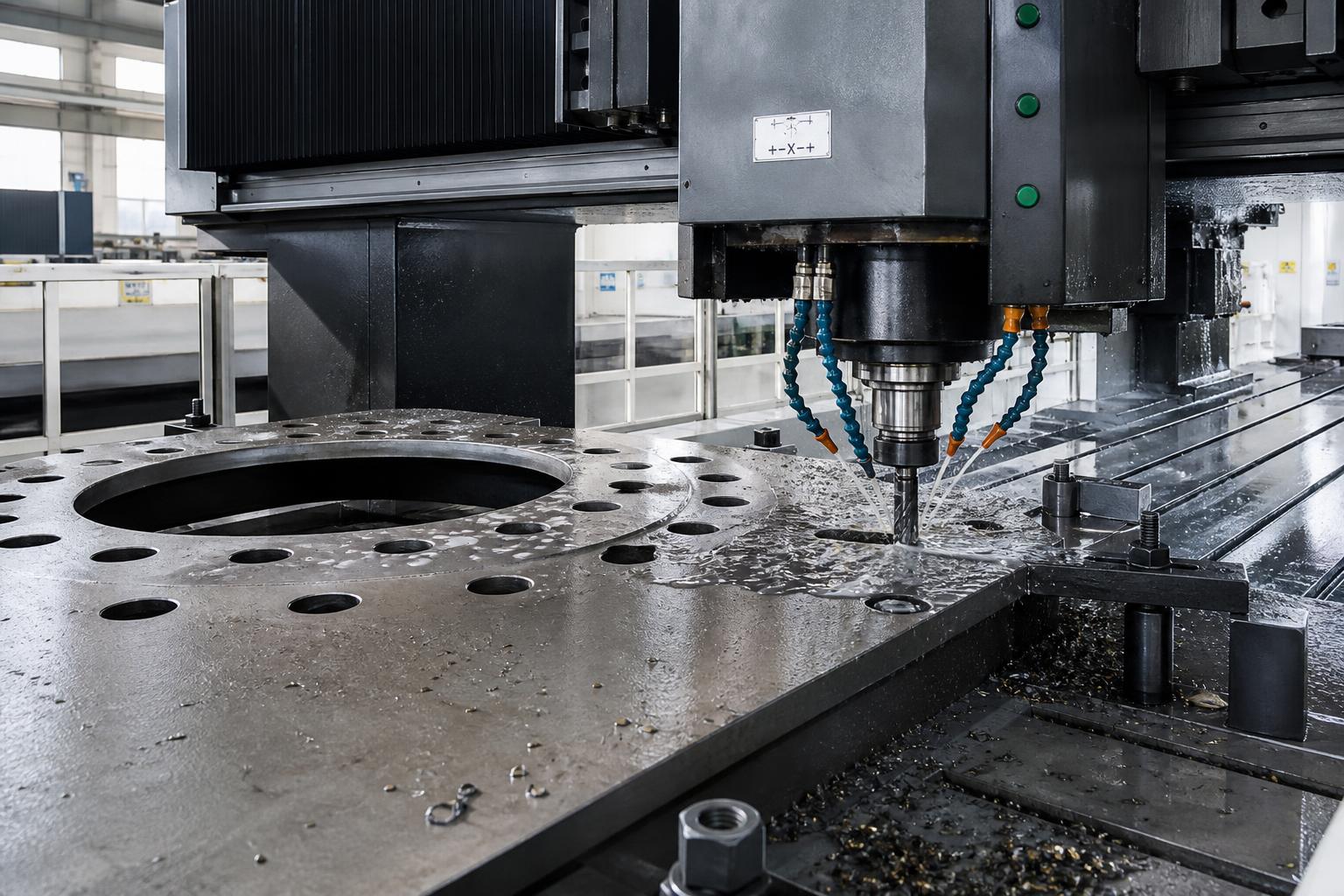
When a Gantry Layout Stops Being Optional
A gantry drilling machine starts to make sense when the workpiece is large enough that moving it repeatedly is harder than moving the spindle. That usually happens with heavy plates, large flanges, tube sheets, base frames, wind tower components, bridge parts, and thick structural sections that are awkward to reposition on a standard machining center or radial drill. If the part needs many holes across a wide area, especially on a long X-axis, the gantry format can reduce handling steps and keep hole location more consistent from one end of the workpiece to the other.
The strongest case appears when the plate or flange is physically large, but not necessarily geometrically complex. A flat workpiece with many drilled holes, tapped holes, spot faces, or countersinks often fits the gantry drilling machine well. The machine is built around coverage, rigidity, and repeatable positioning over a broad working envelope. For parts that mainly need holemaking rather than full contour milling on multiple faces, it can be a better production fit than a general-purpose machining center with limited table size.
The decision becomes clearer if the current process depends on cranes, manual layout, chain drilling, or frequent reclamping. Each of those steps introduces delay and positioning risk. On large carbon steel or stainless steel plates, even a small alignment error can accumulate when hole patterns extend across several meters. A gantry structure helps because the workpiece can stay fixed while the drilling head travels to the required positions.
Typical Work That Fits the Machine Well
Large plate processing is the most obvious application, but flange work is often the deciding factor. A flange with a dense bolt-hole circle, multiple diameters, and strict concentricity requirements can become inefficient on simpler equipment. A gantry drilling machine can process those patterns with CNC positioning instead of relying on manual indexing or templates. That matters when flange diameters increase, when hole counts rise, or when repeat orders require the same pattern over and over.
Plate thickness also changes the calculation. Thin sheet usually does not justify this machine type unless the sheet is very large and the hole count is high. Once the work shifts into heavier plate, drilling force, chip evacuation, and table support become more important. Plates with welded distortion, flame-cut edges, or residual stress from prior processes need stable clamping and enough bridge clearance to avoid setup compromises.
Some applications sit between fabrication and machining. Tube sheets, connection plates, gusset plates, and ring flanges often do not require sculpted surfaces, but they do require accurate hole position relative to edges, centerlines, or datum bores. In those cases, gantry drilling is often selected because it matches the actual task instead of forcing a large fabricated part into equipment meant for smaller blocks or prismatic components.
Where Conventional Equipment Starts to Struggle
A radial drill can still be practical for occasional large parts, but it becomes less attractive when hole counts climb or tolerances tighten. The operator may need to swing the arm, reset the part, mark out locations, and verify dimensions repeatedly. That workflow can be acceptable for repair work or very low-volume fabrication. It is less suitable for repeated production where the same flange pattern or plate grid appears every week.
Standard vertical machining centers have the opposite problem. They offer stronger CNC capability, but table size, loading limits, and travel range often become the bottleneck. Even when a large plate can physically fit, setup may consume too much time. Using multiple setups on one plate also creates another opportunity for datum transfer error. A gantry drilling machine is often justified when the part envelope consistently exceeds the comfortable range of box-type machines.
Floor-type boring and milling machines can handle very large parts, but they may be excessive if the operation is dominated by drilling rather than multi-face machining. If the spindle hours are being used mostly for holes, spot facing, and tapping on flat work, the investment may not be aligned with the process.
Accuracy Matters in a Different Way on Large Parts
For large plate and flange work, accuracy is not only about spindle precision. It is also about what happens during lifting, locating, and reclamping. A smaller machine may have fine spindle accuracy on paper, yet the full process can still drift because the part must be moved several times. A gantry drilling machine often improves practical accuracy by reducing part movement.
Hole position tolerance should be considered together with hole-to-hole consistency, bolt circle integrity, and alignment between matched parts. For flange sets, cover plates, or mirrored assemblies, the concern is usually assembly fit rather than laboratory-level measurement. If holes need to align during field installation or final bolting, repeatable CNC positioning across the entire work zone becomes more valuable than a machine chosen only by spindle speed or motor power.
Thermal behavior also deserves attention. Long plates and wide flanges can change dimension slightly with shop temperature, cutting heat, or direct sunlight near loading areas. That does not automatically require a high-end precision machine, but it does mean the setup method, datum selection, and probing routine should suit large-format work.
Holemaking Requirements That Support the Investment
The machine makes the most sense when drilling is the core operation rather than a minor step. Several production patterns usually support the choice:
- Large plates with repeating hole grids for structural fabrication, machine beds, or connection assemblies.
- Flanges with many bolt holes, often on pitch circles or segmented patterns, where manual indexing would slow output.
- Mixed operations on one setup, such as drilling, tapping, spot facing, countersinking, and occasional light milling.
- Materials such as carbon steel, stainless steel, or low-alloy steel where stable feed control and coolant delivery affect tool life and hole finish.
If the job mostly involves a few holes per part, or highly variable one-off geometries with frequent engineering changes, the return may be weaker. The same is true when the actual bottleneck is upstream, such as flame cutting, beveling, or weld correction. A large drilling machine cannot recover time lost in unrelated stages.
Material, Thickness, and Process Details
Material type changes spindle load, chip form, and tooling strategy. Carbon steel plate is usually straightforward, but thicker sections still require reliable coolant, chip removal, and rigid fixturing. Stainless steel can be less forgiving because work hardening raises the penalty for hesitation, poor feed control, or worn tools. On large stainless flanges, machine stability and uninterrupted cutting are often more important than chasing maximum speed.
Plate flatness should not be assumed. Large thermally cut parts may arrive with crown, twist, or local distortion. If the machine is chosen without enough clamping flexibility or bridge clearance, operators may spend too much time forcing plates into position. Vacuum clamping is usually less relevant for heavy fabricated steel; mechanical clamps, hydraulic fixtures, and support blocks are more common. For flange drilling, dedicated nests or locating pins may be justified when the same diameters repeat.
Tooling deserves a practical review. U-drills, indexable drills, carbide drills, and tapping heads each affect cycle time differently. A gantry drilling machine performs best when the hole package is standardized enough to support planned tooling rather than constant improvisation.
Production Flow Often Decides More Than the Nameplate
Many selection mistakes happen because attention stays on travel, spindle power, and maximum drilling diameter while the actual problem is material flow. Large parts need floor space, loading access, and a crane path that does not interfere with adjacent processes. If the machine is installed where long plates cannot approach in a straight line, handling time may erase much of the expected productivity gain.
Loading and unloading should be examined as part of the machine choice. A long worktable may require side loading, end loading, or a combination depending on the workshop layout. Some plants can support roller transfer or shuttle-style staging; others rely entirely on overhead lifting. In either case, the machine starts to pay off when the workpiece can be located once and processed with minimal intervention.
That same logic appears in pipe and vessel fabrication lines. When flange drilling is part of a broader sequence that includes rolling, fit-up, and seam welding, the best equipment decisions usually come from viewing the line as a whole. In a shop that also handles batch production of smaller-diameter pipe in carbon steel or stainless steel, a related process step might involve 12 meter Pipe inside and outside seam welding machine equipment for inside longitudinal seam welding on pipe lengths up to 12 m, with diameter coverage around 400-1500 mm and adjustable trolley movement. That does not replace a gantry drilling machine, but it shows how drilling capacity should be matched to adjacent fabrication stages rather than treated as an isolated purchase.
Signs the Machine May Be Overspecified
There are cases where a gantry drilling machine looks attractive on paper but adds unnecessary cost and footprint. One sign is low annual utilization. If oversized plate jobs appear only occasionally, subcontracting or using a radial drill plus layout fixtures may be more rational. Another sign is excessive machine capacity relative to actual holemaking needs. A very wide bridge, heavy table, and large spindle package are not automatically useful if most parts are moderate in size and can already be processed in two simple setups elsewhere.
Another common misjudgment is buying for future possibilities without a realistic part family behind them. Large machines lock in floor space, foundations in some cases, power requirements, and maintenance obligations. If future work is uncertain, modular fixturing and improved datum control on existing equipment may solve the current issue more effectively.
A third mistake is assuming all holemaking on large parts belongs on one machine. If the work includes extensive beveling, milling of thick edges, or complex machining on multiple faces, a gantry drill alone may leave secondary operations unresolved. The machine makes sense when its strengths match the actual mix of operations.
Installation and Maintenance Issues That Affect Real Output
Transport and installation can be straightforward or demanding depending on machine size. Long-bed equipment may require careful access planning from unloading area to final foundation location. Machine leveling, rail alignment, and anchoring quality have a direct effect on travel smoothness and hole position over long distances. Those issues are not minor commissioning details; on large-format equipment they are part of process capability.
Maintenance priorities are also different from smaller drilling equipment. Operators need clear routines for way covers, lubrication points, coolant cleanliness, chip management, spindle inspection, and backlash monitoring in feed systems. On large steel parts, chips can accumulate quickly, especially when drilling many holes in thick plate. Poor chip evacuation affects tool life, hole finish, and unattended running stability.
Control system usability matters if the machine handles varied plate sizes and frequent job changes. Program correction, datum setting, and alarm recovery should be simple enough that setup time does not quietly become the new bottleneck. A monitoring-oriented workflow seen on some automated pipe welding systems, including arrangements similar to the 12 meter Pipe inside and outside seam welding machine with screen-based condition monitoring and adjustable travel speed, highlights the same point: visibility and repeatability in operation are often as important as raw mechanical capacity.
Questions Worth Answering Before the Order Is Placed
A useful internal review usually revolves around the workpiece itself. How large are the typical plates and flanges, not the rare extremes? How many holes are required per part, and how often do those patterns repeat? Are the holes simple through-holes, or do they include tapping, spot facing, and counterboring? Will the machine mostly process carbon steel, or is stainless steel a regular share of the schedule? These answers shape spindle configuration, coolant approach, fixture design, and whether automatic tool changing is truly needed.
It is also worth examining the state of incoming material. If flame-cut parts arrive with variable edge quality and distortion, the drilling process may need probing, larger datum margins, or more adaptable workholding. If the workshop routinely produces long fabricated sections, bridge clearance and table accessibility may matter more than top spindle speed.
A gantry drilling machine makes sense when the part family is genuinely large, hole-intensive, and repetitive enough that fixed-part CNC drilling removes handling and layout waste. It is less compelling when the work is occasional, lightly drilled, or dominated by operations that belong on a different machine class. The right threshold is usually found in the shop floor reality of plate size, hole count, setup frequency, and how often the current process forces a heavy part to move more than the spindle does.
search
Products Navigation
Send Us A Message