




How H-Beam Machine Manufacturers Improve Welding Accuracy and Throughput
How H-Beam Machine Manufacturers Improve Welding Accuracy and Throughput
Choosing an H-beam line is rarely just about nameplate capacity. In real workshops, buyers usually discover that output depends on how well the machine holds alignment over long shifts, how stable the welding process stays when flange and web tolerances vary, and how much rework appears after assembly. That is why a capable h-beam machine manufacturer is judged less by brochure claims and more by how the line behaves when processing structural steel continuously.
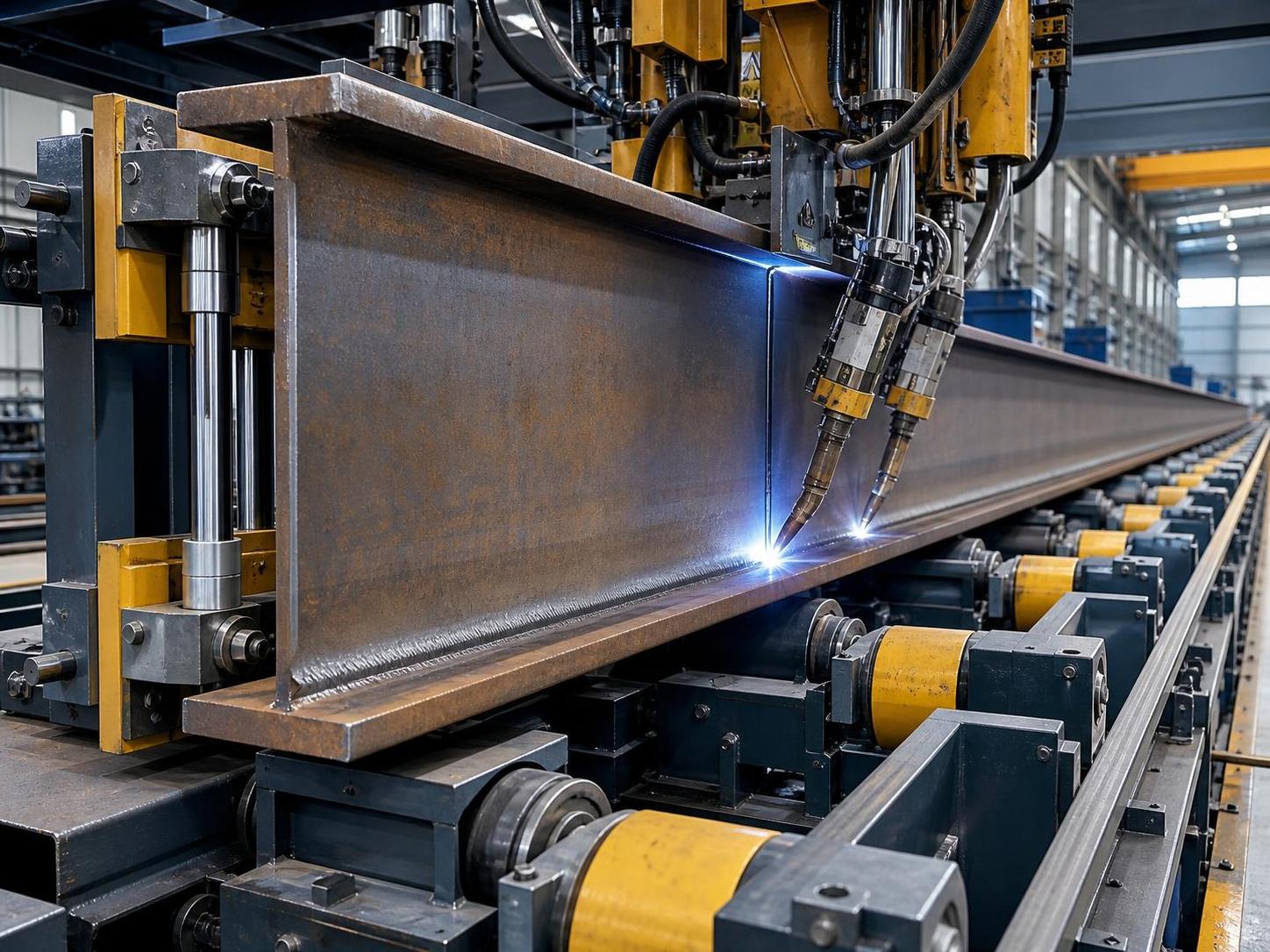
For fabricators working on steel buildings, bridges, heavy equipment frames, or general structural components, welding accuracy and throughput are tied together. Poor centering, inconsistent root gap, or heat distortion will slow production even if the machine itself moves fast. Modern manufacturers improve results by treating the H-beam line as a system: infeed, fit-up, clamping, welding, correction, and downstream finishing all affect the final pace.
Accuracy starts before the arc is struck
A common mistake during equipment evaluation is to focus only on the welding power source or travel speed. In practice, the biggest source of inconsistency often appears earlier, during web-to-flange positioning. If the workpiece enters the welding zone with uneven fit-up, no amount of parameter tuning will completely rescue the seam.
Well-designed H-beam assembly and welding machines improve this stage through rigid frames, synchronized centering systems, and reliable hydraulic or mechanical clamping. The purpose is simple: keep the web vertical, keep the flanges square, and maintain stable contact along the weld path. On heavier sections, frame rigidity matters more than many buyers expect. A machine that performs well on medium sections may show cumulative deviation when long or thick components are fed continuously.
Experienced manufacturers also pay attention to roller arrangement and guiding geometry. If conveying rollers are not aligned precisely, the beam can twist slightly before entering the welding station. That twist may be small, but over a long seam it leads to uneven leg size, arc wandering, or extra correction work later.
Automation helps, but only when it stabilizes the process
Automation is often marketed as the answer to throughput, but not all automation improves real production. The useful kind reduces variation that normally depends on operator judgment. In H-beam welding, that usually means automatic tracking, repeatable torch positioning, synchronized travel, and parameter control that stays consistent from one beam to the next.
For example, automatic seam tracking can compensate for minor variation in fit-up and keep the torch on the intended joint line. This is especially important in long structural members where manual correction becomes tiring and inconsistent. The same applies to travel speed control. A machine that can maintain smooth movement without vibration or speed fluctuation tends to produce a more uniform bead profile and more predictable penetration.
Manufacturers with broader experience in automatic welding equipment, CNC machinery, welding robots, and H-beam production lines usually approach this more realistically. They know that a fast line is not necessarily a productive one if operators have to stop frequently for adjustment. Companies such as Wuxi Samgins International Trade Co.,Ltd, established in 2012 in Wuxi and supplying equipment from CNC cutting machines to welding robots and H-beam production line systems, work in exactly this overlap between machine design and production practicality. That matters because structural steel lines rarely operate in isolation; they are connected to cutting, edge preparation, correction, and finishing equipment upstream and downstream.
Throughput is usually won in the “non-welding” time
Many buyers compare deposition rates but overlook the time spent loading, aligning, tacking, repositioning, and unloading. In a real factory, throughput is often limited by these transitions rather than pure arc-on time.
That is why stronger manufacturers improve line efficiency with details that seem unglamorous: quicker clamping response, better infeed support, simpler recipe switching for different section sizes, and easier maintenance access. If the operator needs repeated manual intervention to reset guide wheels or correct flange drift, the line may never reach its theoretical output.
Another practical point is section range. A machine optimized for a narrow product mix can perform very well, but many workshops process both standard and non-standard beam sizes. In those cases, buyers should ask not only for the nominal beam dimensions, but also how often the line needs adjustment when changing between sizes, and whether those changes can be done without disturbing welding reference positions.
Welding quality depends on heat control as much as positioning
Even with accurate fit-up, distortion control remains a major challenge. H-beams are long, and heat input accumulates. If a manufacturer does not design around this, higher speed can actually create more downstream straightening work.
A good system balances welding current, travel speed, torch angle, and cooling conditions to keep deformation manageable. The exact settings depend on material thickness, weld size, process type, and applicable project standards, so there is no honest “one setting fits all” answer. Still, reliable machines make parameter execution repeatable. Consistency is often more valuable than chasing the absolute highest speed.
This is where buyers should ask technical questions rather than just commercial ones. How stable is the torch carriage over long travel? How is the workpiece restrained? What is the expected access for maintenance on the guiding and drive systems? Can the line maintain alignment after extended use, or does it require frequent mechanical recalibration? Those questions reveal much more than a catalog sentence about precision.
Standards, build discipline, and why they still matter
For export-oriented buyers or contractors working across regions, compliance is not a side issue. Machine design and production discipline directly affect reliability, safety, and long-term supportability. When a manufacturer organizes production under ISO9001 quality management and follows EU CE-related design requirements where applicable, it usually indicates a more controlled approach to documentation, inspection, and risk management. It does not remove the need for project-level verification, but it is still a meaningful baseline.
This is particularly relevant when equipment will be shipped to Southeast Asia, Europe, the Americas, or Oceania, where user expectations on electrical configuration, guarding, manuals, and spare parts support can differ. A machine that welds well in a factory test is only part of the story. The other part is whether it can be installed, maintained, and kept productive in the buyer’s own environment.
The finishing stage quietly affects line productivity
People tend to discuss H-beam welding as if the job ends at the weld seam. It does not. Burrs, slag, spatter, oxide, and edge condition all influence painting, fit-up in later assembly, and manual finishing time. In mixed fabrication plants, manufacturers that understand the full metalworking chain often recommend auxiliary processes that reduce bottlenecks after welding.
That is also why some suppliers with broader metal finishing experience include solutions beyond structural welding itself. For small precision metal components, deburring and surface cleanup may be handled with systems such as the Customized Magnetic polishing machine. It is not an H-beam machine, of course, but it reflects a useful mindset: productivity improves when finishing operations are engineered, not left as an afterthought. In many factories, the hidden cost sits in the manual work between processes.
That finishing equipment is typically used on precision stampings, CNC parts, die-castings, springs, rail transit components, and other irregular metal parts where inner holes, gaps, right angles, or threaded areas are difficult to treat manually. With 380V power, optional motor configurations, forward/reverse and translation motion, and cycle times often measured in minutes rather than hours, it shows how auxiliary equipment can remove labor from repetitive cleanup work while protecting dimensional accuracy. Different line items may solve different problems, but the production logic is the same.
What to compare when evaluating an h-beam machine manufacturer
If the goal is a technically sound comparison, these points usually matter more than polished sales language:
- How the machine controls web and flange alignment before welding begins
- Whether the frame and conveying system remain stable with long, heavy sections
- How torch tracking and travel control deal with normal fabrication variation
- The time needed for size changeover and routine maintenance
- Electrical, safety, and documentation suitability for the destination market
- The supplier’s ability to support related upstream and downstream equipment
It is also worth asking for a discussion of what the machine does not handle well. Every design has limits. Some lines are better suited to repetitive standard sections, while others trade a little speed for more flexibility. A manufacturer willing to explain those trade-offs is usually easier to work with than one promising universal performance.
A realistic way to read performance claims
When reviewing proposals, be cautious with isolated numbers. A travel speed figure, on its own, says very little. The more useful question is whether the machine can maintain required weld quality at that speed on your section range, material condition, and joint preparation. The answer usually depends on the complete process, including cutting accuracy, edge quality, assembly consistency, operator skill, and local quality requirements.
In other words, welding accuracy and throughput are not separate targets. The better manufacturers improve both by reducing process variation, not by pushing one parameter to the limit. For buyers researching an H-beam line, that is usually the right lens: look for stable mechanics, sensible automation, disciplined manufacturing, and a supplier that understands the factory around the machine, not just the machine itself.
search
Products Navigation
Send Us A Message