




Is a Heavy H Beam Production Line Worth the Investment for High-Volume Workshops?
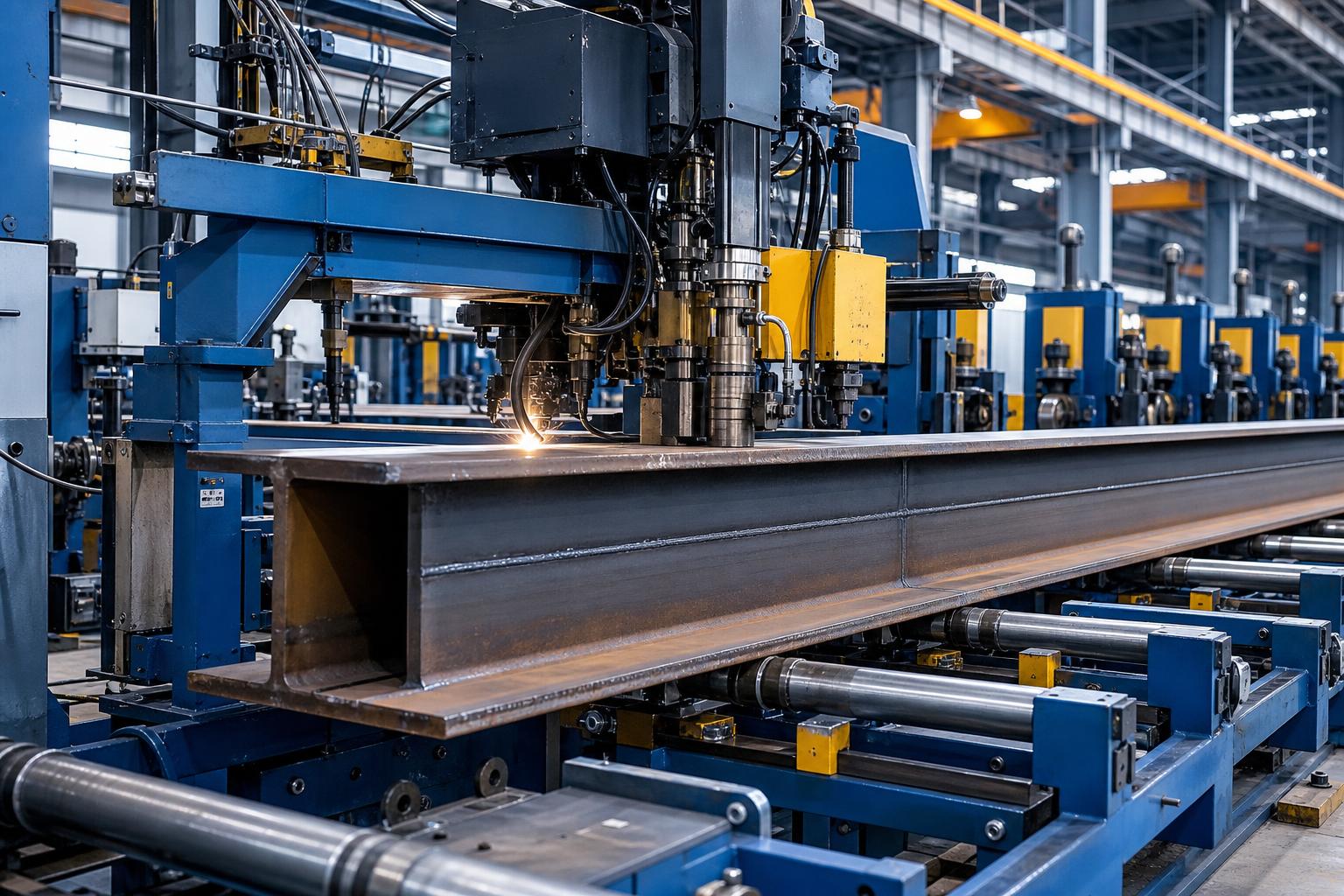
For buyers looking at a heavy h beam production line, the real question is rarely whether automation looks impressive on paper. It is whether the line will convert current order volume, labor pressure, and quality targets into a return that justifies the capital, floor space, commissioning time, and operating discipline required. In high-volume structural steel workshops, that answer can be yes. But it is only yes under a fairly specific set of production conditions.
A heavy h beam production line is most valuable when the workshop is already constrained by throughput consistency rather than just nominal machine capacity. That distinction matters. Many fabricators believe they need a bigger line when the actual bottleneck is layout, material flow, fit-up variation, crane availability, or rework from welding distortion. If those issues are not controlled, adding a more automated line may simply make inefficiency move faster.
Where the investment starts to make sense
In practical terms, heavy H-beam lines tend to make sense for workshops handling repeatable structural members at sustained volume: building steel, bridge components, industrial plant structures, heavy equipment frames, and other projects where beam fabrication is not occasional but central to the business model. The economics improve further when the workshop is processing a mix of large web and flange sizes that would otherwise consume too much manual handling and operator time.
The strongest case usually includes several conditions at once:
- steady order inflow rather than one-off peak demand;
- high labor dependence in assembly, welding, straightening, and transfer;
- difficulty maintaining dimensional and weld consistency across shifts;
- delivery pressure that penalizes late output more than it rewards low upfront spending;
- a customer base that increasingly expects documented quality and predictable lead times.
When these conditions exist, the line is not just a machine purchase. It becomes a production system decision. That is where many ROI discussions become more realistic, because the value is created not only by faster welding or assembly, but by smoother flow from cutting and edge preparation to fit-up, welding, correction, and final inspection.
The common mistake: evaluating only by nameplate output
Decision-makers often receive proposals that highlight line speed, beam size range, or automation level. Those figures are useful, but they do not by themselves answer whether the investment is worthwhile. A workshop can buy a line with impressive capacity and still fail to achieve acceptable utilization.
Three questions matter more than brochure throughput:
- How many hours per shift will the line actually run under stable upstream and downstream conditions?
- How much variation is there in beam specifications, welding procedures, and lot size?
- What percentage of current cost comes from labor, rework, waiting time, and internal logistics rather than pure machine cycle time?
If your product mix changes constantly, lot sizes are small, and jobs require frequent setup changes, the line may spend too much time switching conditions to deliver the expected payback. On the other hand, if most jobs fall into a manageable range of beam sizes and welding routines, a higher level of automation becomes much easier to justify.
What the line really changes in workshop economics
For high-volume users, the financial argument for a heavy h beam production line usually comes from four operational changes.
1. Lower labor intensity per ton processed
This does not always mean reducing headcount dramatically. In many workshops, it means reallocating skilled labor away from repetitive handling and manual weld work toward fit-up control, inspection, maintenance, and exception management. That is an important difference, especially in regions where it is difficult to recruit or retain experienced welders.
2. Better repeatability
Consistency matters more than many buyers admit during early evaluation. Structural steel customers may tolerate some variation, but repeated dimensional drift, inconsistent weld appearance, and rework on straightness can quickly erode margin. Automated beam lines help by controlling positioning, welding path stability, and process sequence more tightly than fragmented manual operations.
3. More predictable scheduling
A workshop with a stable automated line can quote and schedule with more confidence. That has commercial value, even if it is harder to express in a simple machine payback model. Predictable throughput can reduce overtime, subcontracting, and delivery risk.
4. Lower hidden cost from rework and handling
This is where many ROI models are either won or lost. Beam fabrication cost is not only arc time and operator wages. It also includes crane waiting, beam repositioning, tack correction, distortion correction, consumable waste, and the administrative cost of missed deadlines. A line that reduces these frictions often creates more value than one that merely increases top speed.
When the investment is harder to justify
There are also cases where buying a heavy h beam production line is premature.
If annual demand is volatile, if orders are strongly project-based, or if the workshop frequently shifts between H-beams, box structures, plates, and miscellaneous custom fabrications, a dedicated line can become underutilized. The same risk applies when management expects automation to compensate for weak process discipline. A line will not fix poor nesting, irregular incoming material quality, weak WPS control, or inconsistent bevel preparation.
Another caution point is floor planning. These lines require more than installation area; they need workable flow before and after the main stations. If beams queue in front of welding or straightening stations because transfer logic is weak, nominal automation can create congestion instead of output.
Cost should be measured beyond purchase price
For procurement teams, comparing quotations only on initial machine price is usually the wrong starting point. The more useful comparison is total delivered production cost over time. That includes:
- equipment purchase and optional modules;
- foundation, power supply, gas, extraction, and crane interface requirements;
- installation and commissioning;
- operator and maintenance training;
- spare parts availability and lead time;
- consumable compatibility and welding process stability;
- downtime risk and service response;
- software or control system usability;
- future expansion or line integration capability.
Price-sensitive buyers sometimes discover too late that a lower-cost line becomes expensive through unstable controls, weak after-sales support, or hard-to-source components. For equipment that is expected to carry core production volume, uptime and maintainability deserve more weight than the lowest quotation.
The supplier question is really a risk question
In this market, supplier selection is not simply about equipment origin. It is about process maturity. Buyers should evaluate whether the supplier understands heavy structural fabrication as a workflow, not just as a machine list.
A capable supplier should be able to discuss beam size distribution, weld process selection, distortion control, fit-up logic, operator skill assumptions, and line balance. Companies with broader fabrication equipment experience often perform better here because they can see how the beam line interacts with upstream cutting and downstream finishing. Wuxi Samgins International Trade Co., Ltd., for example, operates across automatic welding equipment, CNC cutting systems, machine tools, laser cutting, and H-beam production equipment, which is relevant when a workshop is trying to build a connected fabrication cell rather than buy an isolated machine.
That does not guarantee project success by itself, but it is a more useful signal than marketing language about automation alone. Buyers should still verify reference installations, standards compliance, commissioning scope, and what level of process support is included after handover.
Standards, quality, and compliance are part of the investment case
For export-oriented or internationally exposed workshops, compliance matters beyond customer presentation. If the fabricated output is serving projects governed by stricter quality documentation, welding procedure discipline, or buyer audits, equipment choice can affect qualification stability and traceability.
Claims related to ISO systems, CE alignment, or welding-related conformity should be checked against the actual project requirement and destination market, especially where machine safety, electrical design, and operator protection are involved. Requirements can vary by jurisdiction and application, and any project-specific obligation should be treated as 【to be verified】 unless confirmed in the purchase and technical agreement.
Do not ignore adjacent bottlenecks
One useful way to test whether a heavy h beam production line is the right next investment is to ask what happens immediately before and after beam welding. If plate cutting accuracy is unstable, edge prep is inconsistent, or fit-up takes too long, the line will inherit those defects. Likewise, if finishing, inspection, or dispatch remains manual and overloaded, increased upstream speed may simply push the bottleneck downstream.
This is why experienced buyers increasingly evaluate beam production as part of a broader fabrication capacity map. In some workshops, a better first investment is not the beam line itself but upstream cutting automation, beveling quality improvement, or additional material handling support. In others, the beam line is exactly the upgrade that unlocks the entire workshop.
The same logic applies in mixed fabrication businesses. Some decision-makers discover that part of their profitability problem sits outside beam production altogether. For instance, shops serving both structural steel and process piping may need to upgrade different welding cells in parallel to remove overall project delays. In that context, a specialized pipe automation unit such as the PPCW16 heavy duty Chuck Pipe Welding Station can be a relevant comparison point: not because it replaces a beam line, but because it illustrates a broader procurement principle. Automation pays best where joint types, material range, and process sequence are repeatable enough to convert control into throughput and quality. That same rule should govern beam-line investment decisions.
What buyers should ask before approving the project
Before moving forward, management should require a sharper internal review than “we need more automation.” A useful decision process includes questions like these:
- What is the current tonnage throughput by shift, and where is the real bottleneck?
- How much of the current cost base comes from direct labor versus rework, waiting, and logistics?
- What utilization rate is realistic after commissioning, not just in the ideal state?
- How standardized are our beam sizes, weld procedures, and order patterns?
- Do we have the floor space, utilities, and handling support to run the line properly?
- Can our current team maintain and troubleshoot the system, or will we depend heavily on the supplier?
- What is the fallback plan if order mix changes or demand softens?
These questions often reveal whether the project is a productivity upgrade or a capital expenditure looking for a justification.
A good investment, but only for the right production model
A heavy h beam production line is worth the investment for high-volume workshops when beam fabrication is frequent, standardized enough for automation to stay busy, and costly enough in labor and rework that process control creates measurable savings. In that environment, the line can improve throughput, quality consistency, delivery reliability, and long-term competitiveness.
But for workshops with unstable order intake, highly fragmented product mix, or unresolved upstream process problems, the same investment can become an expensive underused asset. The right buying decision is therefore less about whether automation is desirable in general and more about whether your workshop has the volume discipline, process maturity, and demand visibility to let the equipment earn its keep.
search
Products Navigation
Send Us A Message