




Common Bottlenecks in an H Beam Welding Line and How to Eliminate Them
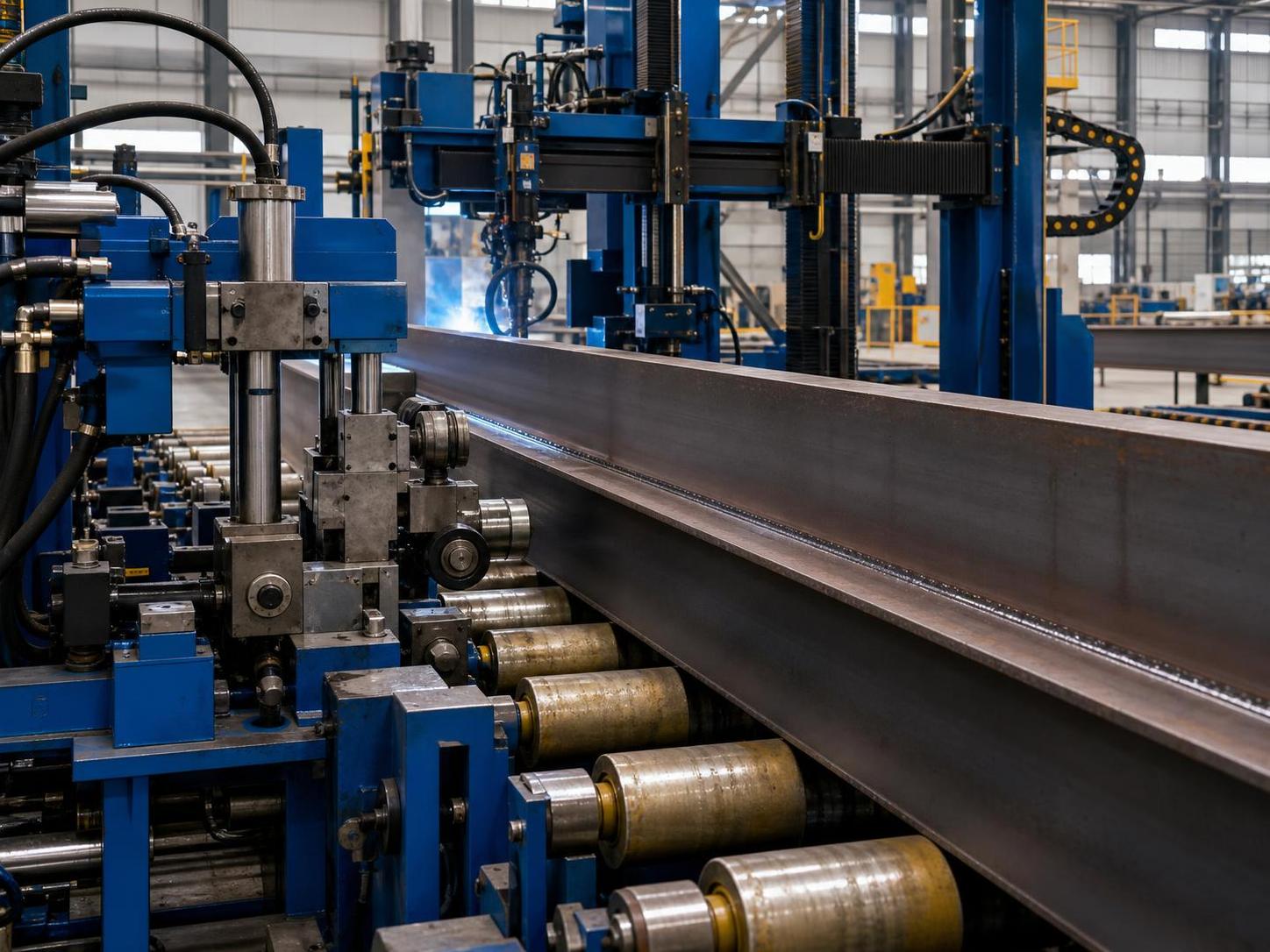
In a busy workshop, problems in an h beam welding line rarely begin with a dramatic machine failure. More often, the trouble shows up as a small delay that keeps repeating: parts waiting too long before fit-up, weld seams that need rework, operators stopping to correct alignment, or finished beams moving out slower than expected. These interruptions may look minor when viewed one by one, but over a shift they create a very visible drag on output and a lot of frustration on the floor.
Many people first notice the issue when the line feels “busy but not productive.” The roller conveyors are moving, the welding gantry is running, and material is available, yet the pace is uneven. One beam goes through smoothly, the next one requires adjustment, and after that a weld quality concern sends the piece back for correction. In an h beam welding line, bottlenecks usually come from a combination of fit-up accuracy, material handling, welding parameter stability, and coordination between stations. The good news is that these are usually manageable once the symptoms are read correctly.
When the line slows down before welding even starts
A common mistake is to focus only on the welding unit. In practice, some of the worst bottlenecks are created upstream. If flange and web parts arrive with burrs, inconsistent edge condition, poor straightness, or unclear orientation, the assembly section spends extra time compensating for problems that should have been handled earlier. The line then appears to have a welding problem, but the real issue is poor preparation.
One practical way to spot this is to watch where operators spend their time. If they are repeatedly tapping, clamping, measuring, or stopping to re-center components before tack welding, the bottleneck is not arc speed. It is preparation time. This matters because even a high-capacity line cannot stay efficient if every beam needs manual correction before the torch starts.
The most useful response is to standardize incoming part condition. That includes confirming cut quality, ensuring flange and web dimensions are within acceptable process tolerance, and keeping surfaces clean enough for stable welding. Rust, scale, oil, and heavy spatter from previous operations can all disturb arc stability later. A few minutes spent on material condition upstream can prevent much longer interruptions downstream.
Fit-up drift: the bottleneck that keeps coming back
In many workshops, the line runs well for part of the day and then starts producing inconsistent weld geometry. Operators often describe this as a “line that does not hold setup.” Usually the problem is not mysterious. It comes from gradual fit-up drift: guide rollers loosen slightly, clamping force changes, workpiece variation increases, or the centering system is no longer reacting consistently.
Typical signs include a weld seam wandering from the ideal joint center, visible mismatch between flange and web, and repeated torch position correction. Some teams respond by increasing operator attention and manual intervention. That helps temporarily, but it also creates another bottleneck because the process becomes dependent on constant correction.
A better approach is to separate the possible causes:
- Check mechanical alignment of entry guides, centering devices, and hold-down components.
- Inspect wear points that may allow side movement during beam travel.
- Verify whether part size variation is larger than the setup can absorb.
- Review tack weld consistency, because weak or uneven tack points can let the joint open or shift during travel.
If fit-up drift appears only on certain beam sizes, the root cause is often setup range rather than total machine condition. In that case, storing size-specific setup references and making them easy to follow can remove a lot of repeated adjustment.
Weld quality issues that are actually flow problems
Operators sometimes treat undercut, incomplete fusion, excessive spatter, or unstable bead appearance as isolated welding defects. But in an h beam welding line, these issues often come from unstable flow conditions rather than from the power source alone. When travel speed changes because the beam does not feed smoothly, or when workpiece height fluctuates because the assembly is inconsistent, weld quality becomes unstable even if parameters have not changed.
This is why troubleshooting should start with movement. Is the beam advancing at a steady rate? Is the gantry tracking smoothly? Are the flux recovery, wire feeding, and cable routing free from interruption? A clean-looking machine can still have small drag points that disturb consistency. Even something as ordinary as accumulated spatter near a guide area or a poorly managed cable path can become a repeat cause of downtime.
Another overlooked source of instability is heat buildup across long production periods. Contact tips, nozzles, wire feed components, and grounding points do not fail all at once. They degrade. The result is often an irregular pattern: acceptable welds at the start of the shift, increasing correction later. This is why consumable inspection should be tied to process rhythm rather than waiting for visible failure.
Uneven takt between assembly, welding, and discharge
Some lines do not have a single technical fault. They simply have poor balance between stations. Assembly may be waiting for components, welding may be waiting for fit-up, and discharge may be blocked by slow transfer or inspection handling. In this situation, the line feels congested even though no single station is always stopped.
It helps to observe the sequence from material entry to final discharge without focusing on one machine. If the welding section is idle because completed assemblies are arriving in bursts, then the bottleneck lies in the release pattern from the previous station. If welded beams are staying too long in place because discharge routes are occupied, the welding machine becomes the next waiting point.
The fix is usually operational rather than dramatic. Clear staging rules, part identification before loading, and better timing between tack assembly and final welding can make the whole line move more evenly. In many shops, this kind of coordination improves output more than changing welding parameters ever could.
When manual handling quietly becomes the main delay
Not every bottleneck is inside the main beam line. Side operations can absorb time and attention in ways that are easy to underestimate. For example, when associated tube, pipe, or support components must be prepared nearby for related fabrication work, slow bending or repeated angle correction can interfere with labor allocation and material flow around the beam area.
In that context, a machine with simple programming and repeatable motion can reduce interruptions outside the core welding station. For workshops handling mixed fabrication tasks, an NC hydraulic pipe bending machine can be a practical support tool because it uses PLC control for easier operation, stores multiple bending records, and uses servo-controlled rotation for better angle precision. That does not change the beam welding process directly, but it can reduce side-process delays where operators would otherwise spend too much time on repeated manual bending adjustments.
The point is not to add equipment without a reason. It is to notice that bottlenecks often travel across adjacent processes. If nearby fabrication work constantly pulls attention, floor space, or labor from the h beam welding line, then supporting those tasks with more predictable equipment may help restore flow.
Parameter changes made too quickly
Another common scene on the shop floor is this: weld appearance changes, an operator adjusts current or travel speed immediately, and the result gets worse or becomes inconsistent between pieces. Fast adjustments feel efficient, but they can hide the real cause. If the joint gap changed because the beam was not centered well, electrical changes may only mask the problem for a short time.
A more reliable habit is to confirm three things before changing the welding recipe: joint position, workpiece stability, and consumable condition. Only after those are ruled out should parameter adjustment become the main action. This order matters because many “welding” problems are mechanical or handling problems first.
It also helps to limit who changes core settings and under what conditions. Too many unrecorded adjustments create their own bottleneck later, because the next operator inherits a machine condition that no longer matches the standard setup. Even a simple shift log with notes about beam size, observed issue, and correction taken can prevent repeated confusion.
Missed maintenance that looks like operator error
When a line becomes inconsistent, people often blame operation technique. Sometimes that is fair, but many recurring delays are maintenance issues in disguise. Dirty sensor surfaces, worn rollers, inconsistent hydraulic response, loose fixtures, poor grounding, and contaminated flux systems can all cause behavior that looks like handling error.
This is especially true with intermittent faults. If the problem appears only occasionally, operators may start adapting around it rather than reporting it clearly. Over time, the workaround becomes normal, and the line slowly loses efficiency. That is why recurring minor symptoms deserve attention even when production can still continue.
Good maintenance practice does not need to be complicated. The useful question is simple: which parts of the line affect positioning, smooth travel, arc stability, or repeatable clamping? Those areas deserve routine inspection because they have the most direct effect on bottlenecks. Maintenance is most effective when it follows process risk, not just a calendar.
Signs that the bottleneck is in the instructions, not the machine
In some workshops, the line hardware is capable enough, but different operators use different judgments for the same task. One person accepts a fit-up condition that another would stop and correct. One adjusts torch position early; another waits until the weld appearance changes. This creates unstable output and repeated discussion at handover.
When the process depends too much on personal habit, written standards are usually too vague. The answer is not to turn every action into paperwork, but to define a few critical decision points clearly: acceptable gap range for release to welding, when to stop for alignment correction, when consumables must be changed, and which defects require immediate investigation rather than end-of-line repair.
Clear visual references near the station can help more than long documents. Operators work faster when they do not have to guess whether a condition is still acceptable.
Practical ways to remove recurring slowdowns
If you are dealing with repeated interruptions in an h beam welding line, it is usually more effective to remove one stable cause at a time than to overhaul everything at once. Start with the point where waiting is most visible. If assembly is backing up, inspect part condition and centering. If welding is producing uneven seams, inspect movement stability before touching parameters. If finished beams are not clearing quickly, look at discharge and staging discipline.
Try to compare a smooth run and a problematic run of the same beam type. That comparison often reveals more than a broad inspection. Did the troublesome piece arrive with different edge condition? Was the tack assembly weaker? Did a guide need repositioning? Was a consumable already near replacement? Small contrasts often expose the real bottleneck.
For related fabrication tasks in the same production environment, it is also worth using equipment that reduces setup hesitation and repetitive correction. A properly chosen NC hydraulic pipe bending machine may fit that role where pipe bending work is frequent, especially since its touch-screen operation, self-diagnostics, and memory for multiple records can make repeat jobs easier to manage. The value is not in replacing beam-line troubleshooting, but in reducing nearby process friction that affects overall workshop rhythm.
Most bottlenecks do not come from one dramatic flaw. They build from repeated small losses: poor preparation, drifting fit-up, unstable travel, untracked parameter changes, and maintenance items that stay just good enough to keep running. Once those losses are identified in the order they actually affect the line, the process becomes easier to control and much less tiring to operate. That is usually the point where the h beam welding line stops feeling unpredictable and starts feeling manageable again.
search
Products Navigation
Send Us A Message