




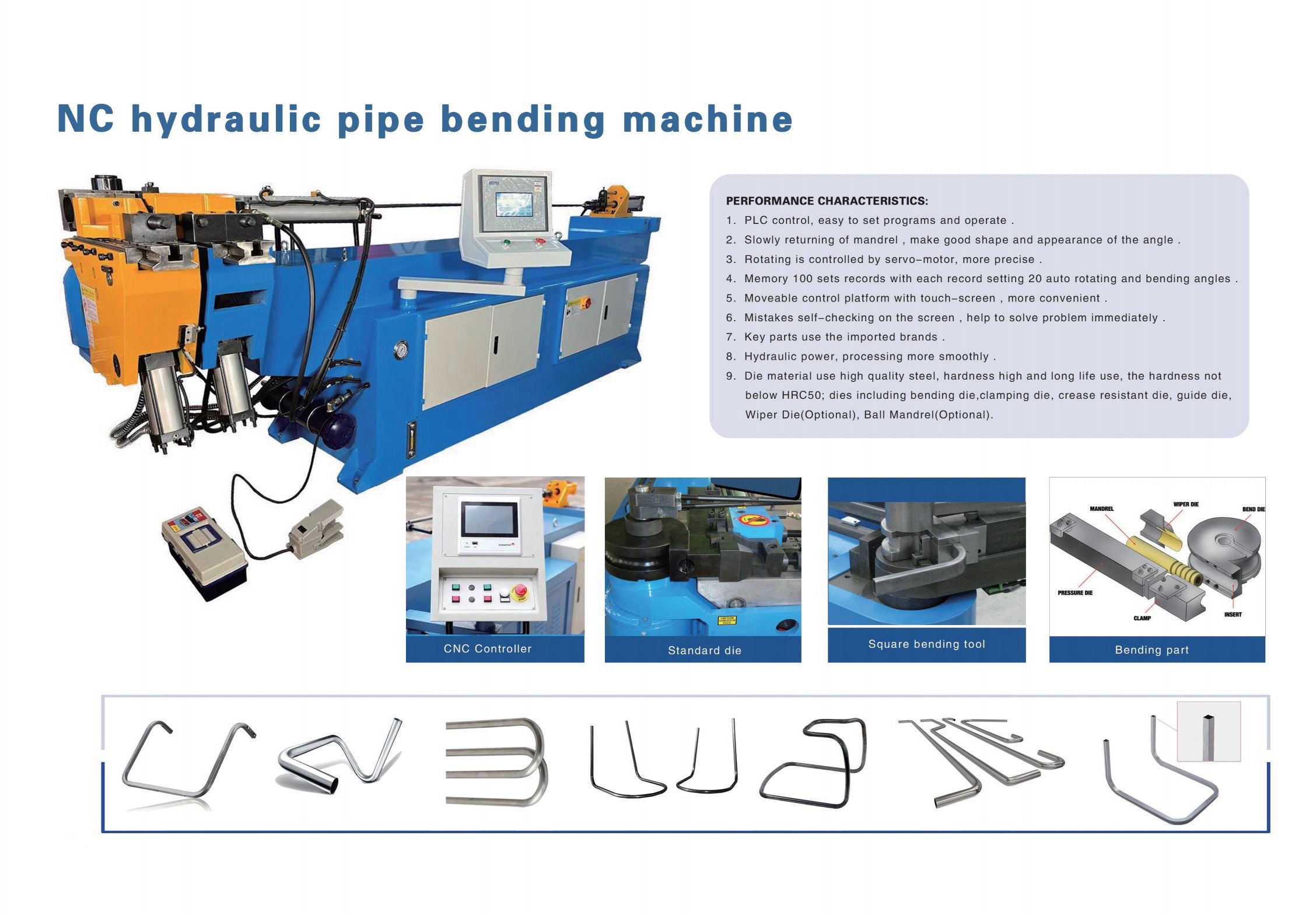
NC hydraulic pipe bending machine
Full-range Machinery & Customized Non-standard Solutions
Authorized Certificates & Independent R&D Patents
Over 10 Years Global Export & Worldwide Project Cases
Navigation

NC hydraulic pipe bending machine Description
1.Introduction for NC hydraulic pipe bending machine:
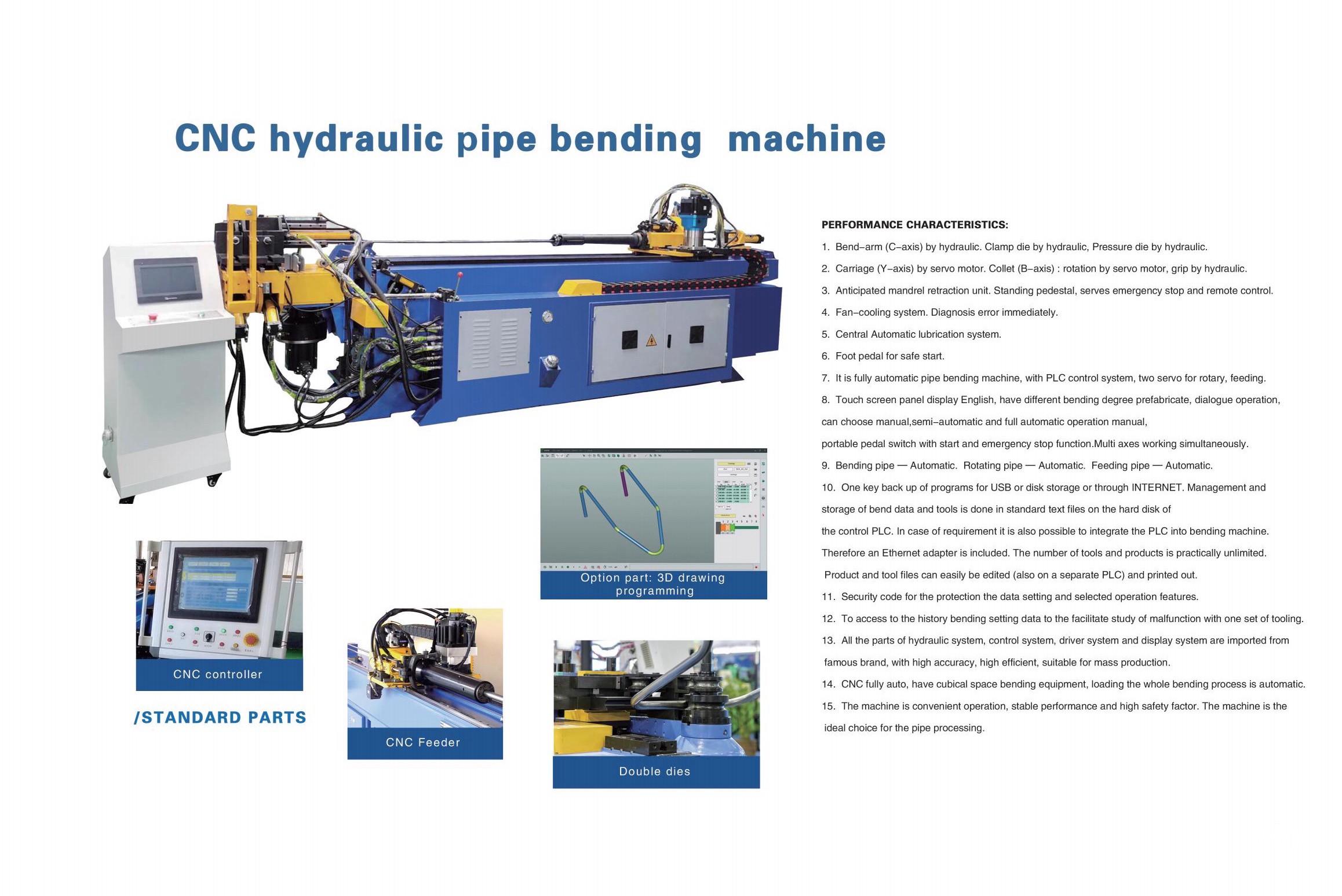
Bending machines are generally classified into CNC types, hydraulic types, and other variants. They are widely used in pipeline laying and construction across diverse industries, including power engineering, railway construction, boiler manufacturing, bridge building, shipbuilding, furniture production, and decoration. Key advantages include multi-functionality, reasonable structural design, and simple operation. This machine not only performs pipe bending but also utilizes its oil cylinder as a hydraulic jack for added versatility. Compared to CNC bending equipment, it offers lower cost and greater convenience in use, giving it a dominant position in the domestic bending machine market.
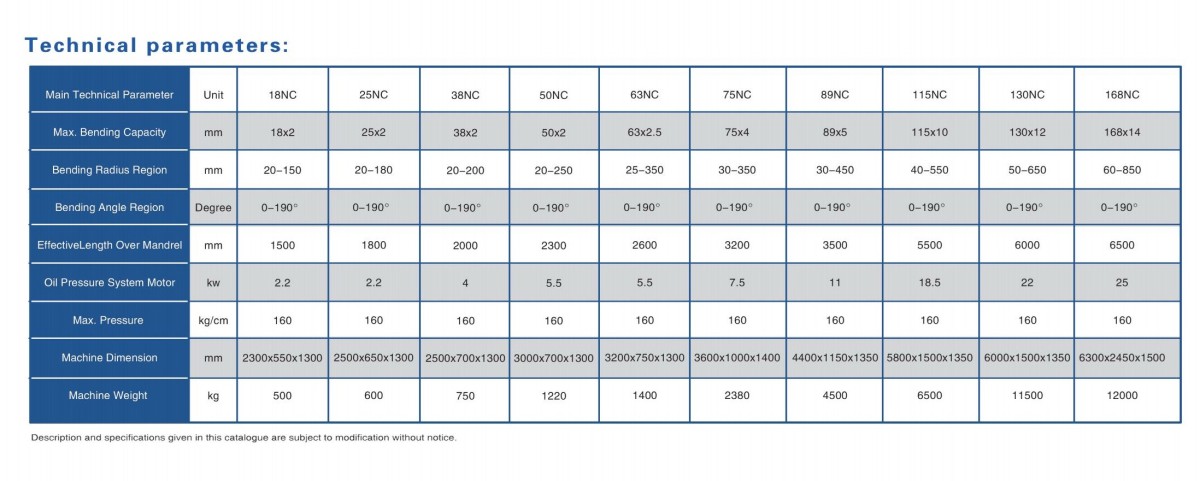
2.Technical parameter for NC hydraulic pipe bending machine
3.Characteristics for NC hydraulic pipe bending machine
3.1 PLC control system for easy programming and operation.
3.2 Slow mandrel retraction ensures good shape and appearance of the bend angle.
3.3 Rotation is controlled by a servo motor for greater precision.
3.4 Memory stores up to 100 records, each with 20 preset automatic rotation and bending angles.
3.5 Movable touch-screen control platform for added convenience. On-screen self-diagnostics help identify and resolve issues immediately.
3.6 Seven key components are sourced from imported brands.
3.8 Hydraulic power ensures smoother processing.
3.9 Dies are made of high-quality steel with hardness not below HRC50, offering high durability and long service life. Standard dies include bending die, clamping die, crease-resistant die, and guide die; wiper die and ball mandrel are available as options.
products faq
The machine can produce a wide variety of pipes, including:
Circular pipes – for water supply, gas pipelines, structural applications
Square and rectangular tubes – for construction, furniture, and machinery frames
Seamless pipes – for high-pressure oil and gas applications (manufactured by piercing billets, not welded)
Special profiles – custom shapes as per customer requirements
Most standard metal pipe mills produce ERW (electric resistance welded) pipes from steel strip.
The machine processes various materials including carbon steel, stainless steel, aluminum, and alloys. Typical thickness ranges:
Light-duty models: 0.5 – 3.0 mm
Medium-duty models: 2.0 – 12.0 mm
Heavy-duty models: up to 22 mm
The specific capacity depends on the model and material yield strength.
Production speeds vary by machine type and pipe size:
Small-diameter, thin-wall pipes – up to 120 m/min
Medium-diameter pipes – typically 30 – 60 m/min
Large-diameter, thick-wall pipes – slower, around 5 – 20 m/min
Speed also depends on material type, welding technology, and final pipe dimensions.
A typical ERW pipe mill includes:
Uncoiler – holds and feeds steel coil
Shear & welder – joins strip ends for continuous operation
Accumulator – stores strip to maintain production during coil changes
Forming section – progressive roll stands shaping flat strip into tubular form
Welding section – high-frequency ERW welding for seam sealing
Sizing section – calibrates pipe to final dimensions
Cut-off machine – cuts continuous pipe to required lengths
Control system – PLC/CNC for automation and parameter management