




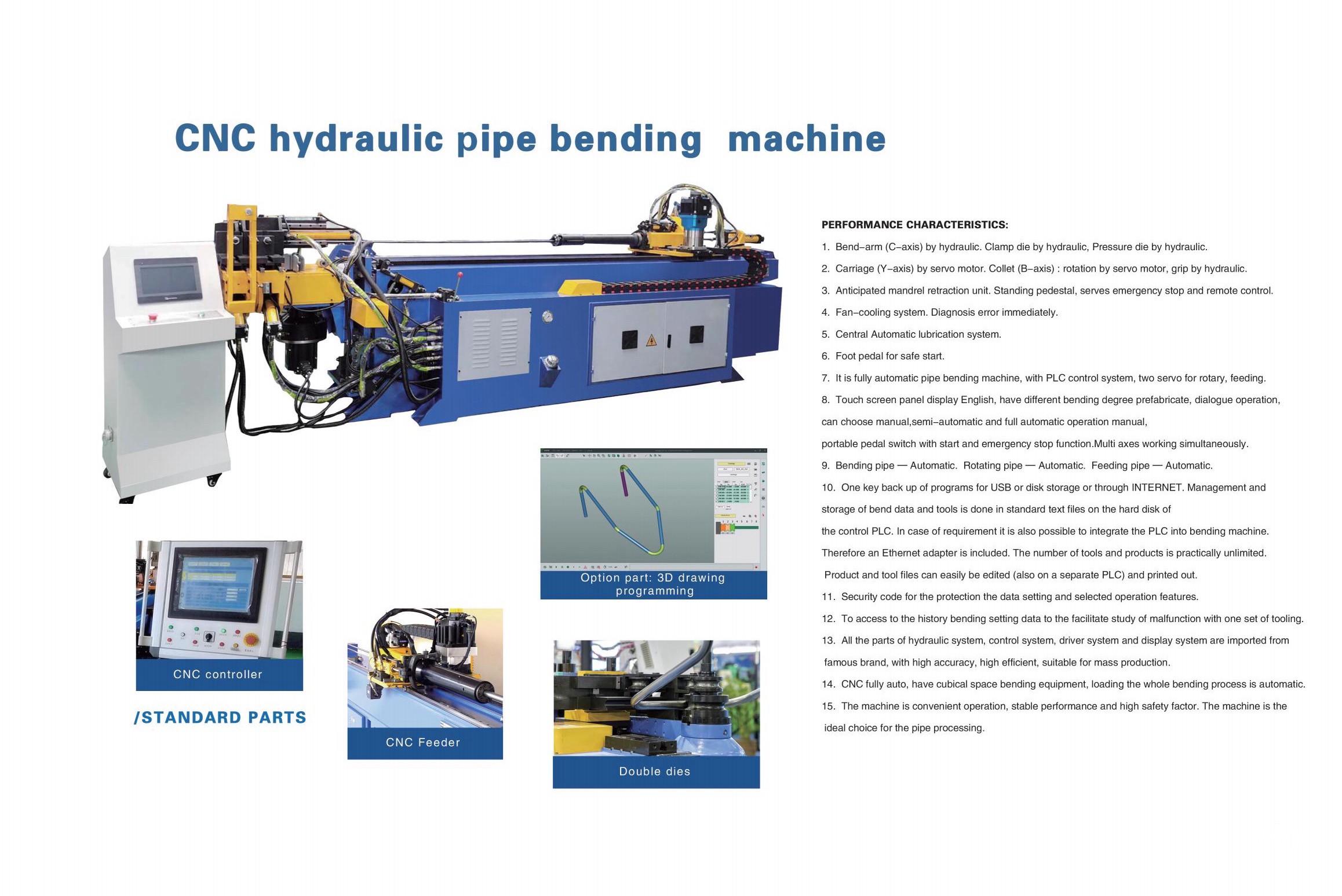
CNC hydraulic pipe bending machine
Full-range Machinery & Customized Non-standard Solutions
Authorized Certificates & Independent R&D Patents
Over 10 Years Global Export & Worldwide Project Cases
Navigation

CNC hydraulic pipe bending machine Description
1.Introduction for CNC hydraulic pipe bending machine:
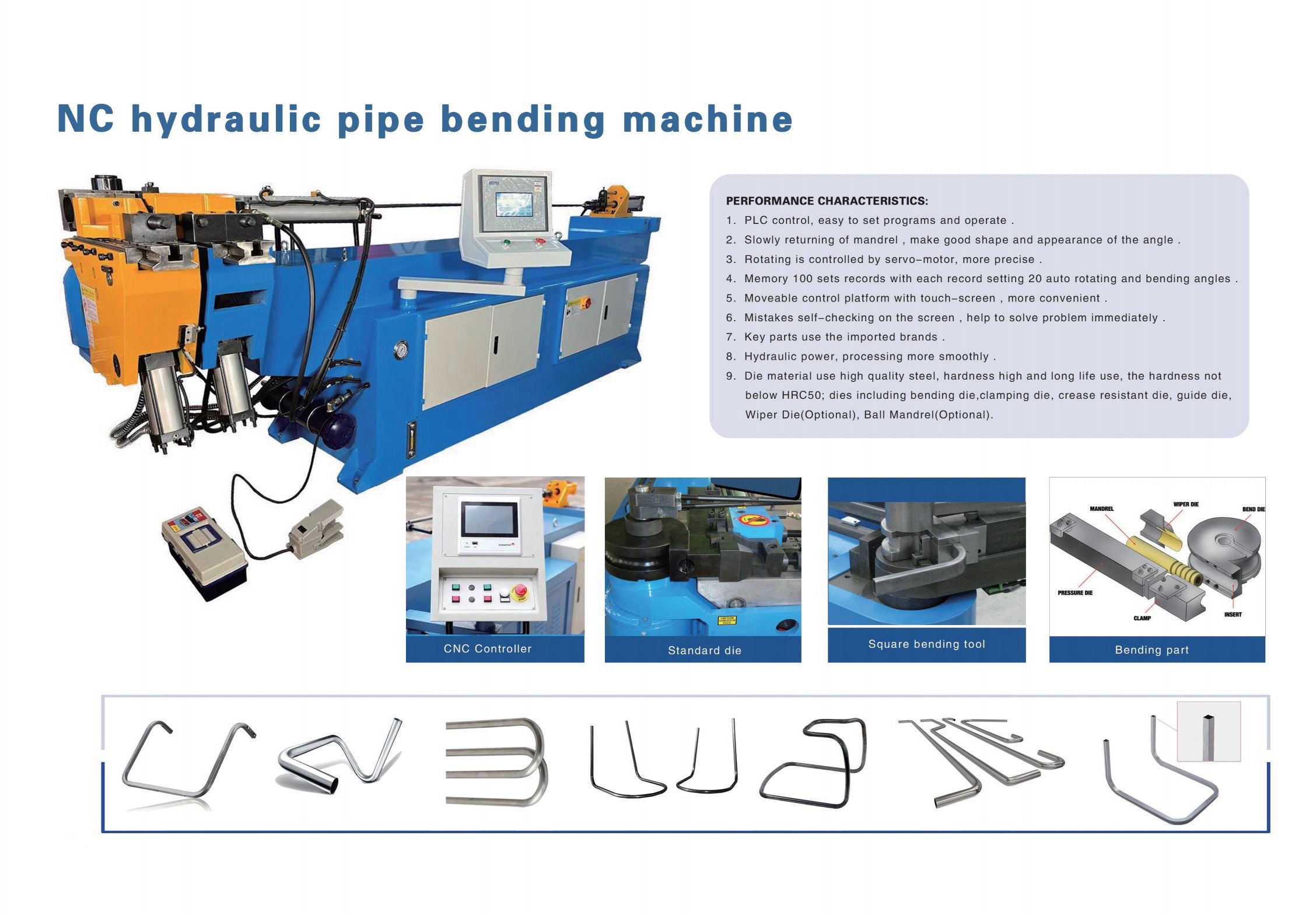
Bending machines are generally classified into CNC types, hydraulic types, and other variants. They are widely used in pipeline laying and construction across diverse industries, including power engineering, railway construction, boiler manufacturing, bridge building, shipbuilding, furniture production, and decoration. Key advantages include multi-functionality, reasonable structural design, and simple operation. This machine not only performs pipe bending but also utilizes its oil cylinder as a hydraulic jack for added versatility. Compared to CNC bending equipment, it offers lower cost and greater convenience in use, giving it a dominant position in the domestic bending machine market.
2.Technical parameter for CNC hydraulic pipe bending machine
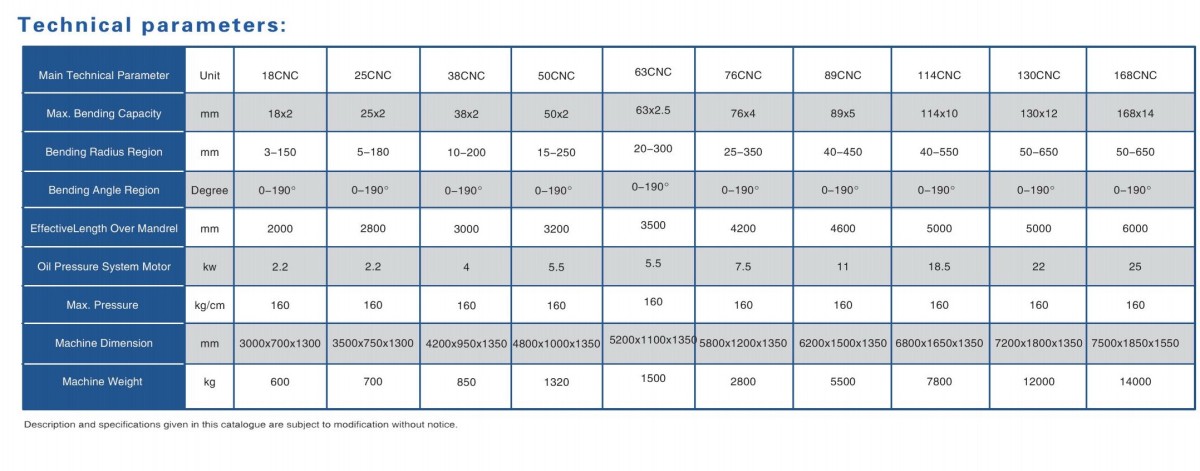
3.Characteristics for CNC hydraulic pipe bending machine
Hydraulic & Servo Drive System : The bend arm (C-axis), clamp die, and pressure die are all hydraulically operated. The carriage (Y-axis) is driven by a servo motor, while the collet (B-axis) features servo-driven rotation and hydraulic gripping.
Control & Operation : The machine is fully automatic with a PLC control system, featuring two servos for rotary and feeding movements. The touch screen panel displays in English, supports preset bending programs, and offers manual, semi-automatic, and full-automatic modes. A portable foot pedal with start and emergency stop functions ensures safe operation, with multi-axis simultaneous working. Programs can be backed up via USB, disk, or internet. Bend data and tooling information are stored as standard text files on the PLC hard disk, with practically unlimited storage capacity. The system also allows editing and printing of product and tool files. An optional helmet adapter enables PLC integration into the machine. History bending data can be accessed to facilitate malfunction diagnosis for each tooling set.
Safety & Diagnostics : An anticipated mandrel retraction unit is included, along with a standing pedestal for emergency stop and remote control. A foot pedal provides safe start capability. Security codes protect data settings and selected operation features. All hydraulic, control, drive, and display system components are imported from renowned brands, ensuring high accuracy, high efficiency, and suitability for mass production.
Cooling & Lubrication : The machine is equipped with a fan-cooling system for thermal management, intermediate diagnostic functions, and a central automatic lubricant system for reduced maintenance.
Operation & Performance : The machine offers convenient operation, stable performance, and a high safety factor, making it an ideal choice for pipe processing.
products faq
The machine can produce a wide variety of pipes, including:
Circular pipes – for water supply, gas pipelines, structural applications
Square and rectangular tubes – for construction, furniture, and machinery frames
Seamless pipes – for high-pressure oil and gas applications (manufactured by piercing billets, not welded)
Special profiles – custom shapes as per customer requirements
Most standard metal pipe mills produce ERW (electric resistance welded) pipes from steel strip.
The machine processes various materials including carbon steel, stainless steel, aluminum, and alloys. Typical thickness ranges:
Light-duty models: 0.5 – 3.0 mm
Medium-duty models: 2.0 – 12.0 mm
Heavy-duty models: up to 22 mm
The specific capacity depends on the model and material yield strength.
Production speeds vary by machine type and pipe size:
Small-diameter, thin-wall pipes – up to 120 m/min
Medium-diameter pipes – typically 30 – 60 m/min
Large-diameter, thick-wall pipes – slower, around 5 – 20 m/min
Speed also depends on material type, welding technology, and final pipe dimensions.
A typical ERW pipe mill includes:
Uncoiler – holds and feeds steel coil
Shear & welder – joins strip ends for continuous operation
Accumulator – stores strip to maintain production during coil changes
Forming section – progressive roll stands shaping flat strip into tubular form
Welding section – high-frequency ERW welding for seam sealing
Sizing section – calibrates pipe to final dimensions
Cut-off machine – cuts continuous pipe to required lengths
Control system – PLC/CNC for automation and parameter management