




What Is an H-Beam Production Line and How Does the Full Process Work?
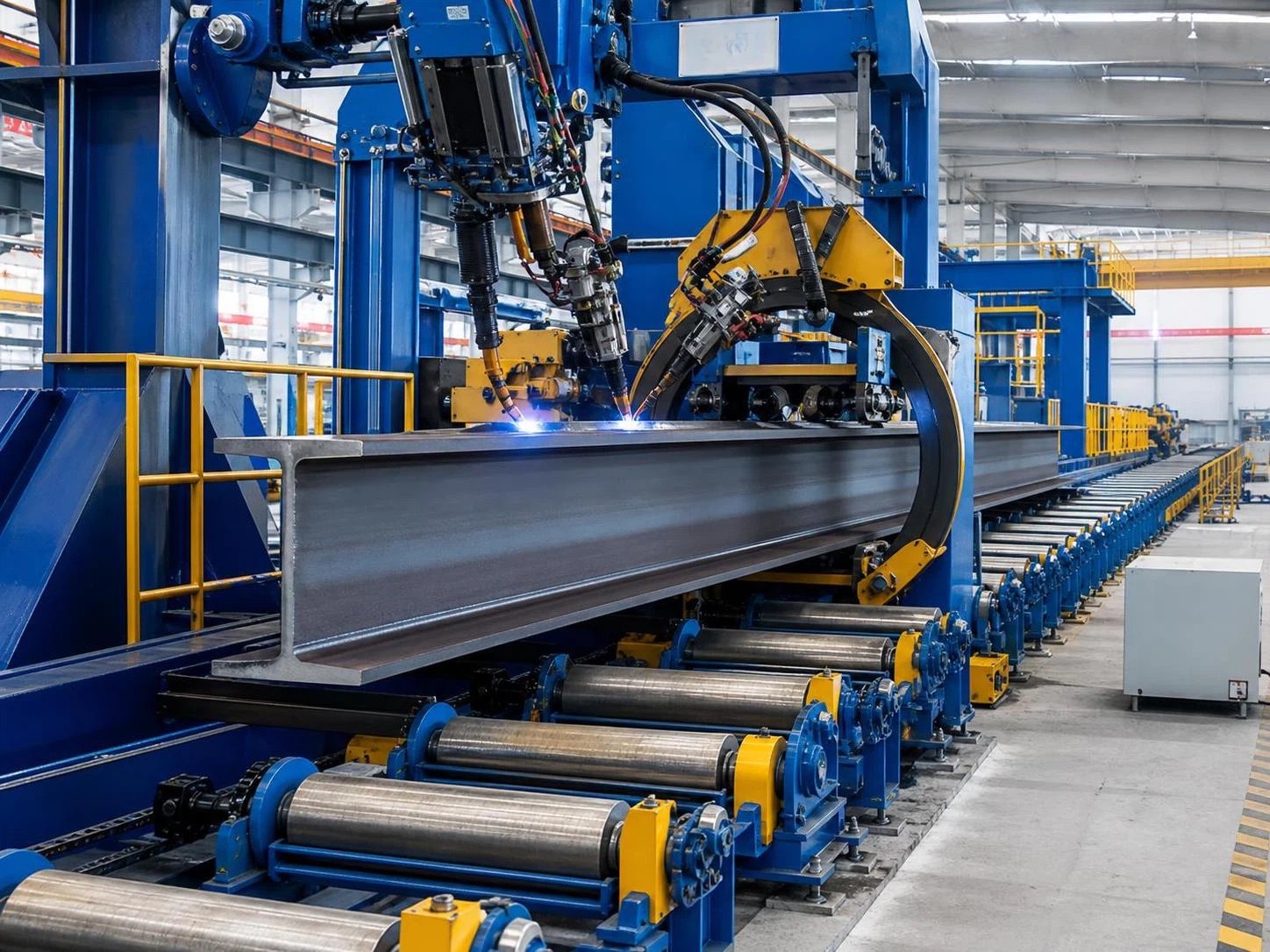
If you are researching how structural steel is manufactured, understanding an h-beam production line is a practical place to begin. H-beams are used in workshops, high-rise buildings, bridges, shipbuilding, logistics facilities, and many other heavy steel structures, so the way they are produced matters a great deal. A well-designed line is not simply a row of machines. It is a coordinated process that turns steel plate or strip into finished beams with controlled dimensions, weld quality, straightness, and surface condition.
For buyers, engineers, and industry researchers, the real question is usually not just “What machines are involved?” but “How does the full process flow, and what should I look for when evaluating a line?” The answer lies in how material moves from cutting to assembly, welding, correction, finishing, and secondary processing. Each step affects labor intensity, throughput, consistency, and final beam performance.
What an h-beam production line actually does
An h-beam production line is a manufacturing system used to produce welded H-shaped steel members from separate plates or strips. In simple terms, the web and the two flanges are prepared, aligned, assembled, welded together, straightened, and then finished according to project requirements.
Unlike hot-rolled sections, welded H-beams allow more dimensional flexibility. That is why many fabricators choose this route when they need larger sizes, customized specifications, or structural members for non-standard projects. The line may be semi-automatic or highly automated, but the purpose stays the same: to maintain stable production while reducing handling errors and unnecessary manual work.
In modern fabrication shops, the line often includes not only welding stations but also conveying systems, turnover devices, straightening units, and post-processing equipment. This broader view is important, because many production bottlenecks come from material handling rather than welding itself.
Why the process flow matters more than a machine list
People new to the sector sometimes evaluate equipment one machine at a time: a cutting machine here, a welding machine there, a straightener somewhere later in the workshop. But in real production, efficiency depends on the relationship between those machines. If beams need repeated crane lifting, temporary staging, or manual repositioning, output slows down and the risk of dimensional deviation increases.
That is why integrated solutions attract attention. For example, an Heavy automatic h beam line is designed not only for welding, but also to automatically handle conveying, turning, and moving of H-beams during the process. In many plants, that kind of automation helps minimize dependence on overhead cranes and reduces interruptions between stations.
From raw steel to finished beam: the full production process
1. Material preparation and strip cutting
The process usually starts with steel plate or strip selected according to beam design. The web and flange dimensions must match the intended section size, load requirements, and welding plan. At this stage, cutting accuracy is more important than many first-time buyers expect. If the strips are inconsistent in width or edge quality, those problems will carry forward into assembly and welding.
CNC cutting machines are commonly used to cut webs and flanges from plate. In some production settings, strip cutting is arranged as a dedicated first stage to keep downstream equipment continuously supplied. For larger beams, material handling around the cutting station also needs to be considered carefully, especially when plate thickness increases.
2. Jointing and edge processing
When required lengths exceed single plate dimensions, strip jointing becomes part of the process. This may be followed by grooving or edge preparation, depending on weld design and material thickness. Proper groove preparation supports weld penetration and reduces the chance of defects later.
This stage may seem technical and routine, but it often determines whether the welding section runs smoothly or becomes a source of rework. Poorly prepared joints can lead to unstable arc conditions, inconsistent weld bead shape, or correction work that takes longer than expected.
3. T-beam assembly
In many production layouts, the web is first combined with one flange to form a T-beam. Assembly machines or fixtures position the parts and hold them in alignment before tack welding or formal assembly welding begins. The goal is to maintain the relationship between the web centerline and the flange while keeping distortion under control from the start.
This is one of the first points where line quality becomes visible. If the assembly station lacks precision or repeatability, later welding cannot fully compensate for the initial error.
4. H-beam assembly
After the T-beam stage, the second flange is added to create the full H-section. Depending on the line design, this may happen in a dedicated H-beam assembling unit with alignment and clamping functions. Accurate centering is critical here. Even small deviations can influence symmetry, weld consistency, and final straightness.
For fabricators handling a wide beam size range, the flexibility of the assembly section matters. Some lines are built to accommodate substantial variation in beam height, width, and thickness, which is valuable for shops serving mixed project requirements rather than a single standard product.
5. Beam turning, conveying, and positioning
This is the part of the process many outsiders do not picture, yet it has a major impact on efficiency. H-beams are large, heavy, and awkward to reposition manually. During welding and correction, the beam may need to be overturned by 45 degrees, 90 degrees, or even 180 degrees so that each seam can be accessed in the proper orientation.
Advanced lines integrate beam conveying, horizontal moving, and controlled overturning between stations. This reduces waiting time and improves operator safety. It also creates a more predictable production rhythm. When evaluating an h-beam production line, this handling system deserves as much attention as the welding equipment itself.
6. Welding the beam
Once assembled and positioned, the beam moves into the welding stage. Cantilever welding machines are commonly used for this operation, especially in automated or continuous lines. Their role is to weld the joints between the web and flanges with stable travel speed and controlled weld formation.
At this point, production performance depends on several factors working together: fit-up quality from assembly, groove preparation, welding parameter control, and mechanical stability during travel. A beam that is not properly supported or aligned can develop distortion, uneven welds, or dimensional variation that later correction cannot fully eliminate.
For this reason, the best-performing lines are not simply “fast.” They are balanced. Welding speed must match assembly precision, material thickness, and downstream straightening capacity.
7. Straightening after welding
Heat input during welding naturally causes deformation, particularly on the flanges. Straightening is therefore a standard stage, not an optional extra. In many lines, one flange is straightened first, followed by the other. The objective is to bring the beam back within acceptable tolerance for shape and alignment.
This stage is especially important in heavy structural applications. A beam that looks acceptable from a distance may still be difficult to fit during fabrication or erection if straightness is poor. Reliable straightening equipment saves time not only inside the workshop but also at the installation stage later.
8. End-plate welding and secondary processing
Depending on the structural design, the beam may then move into secondary processing. This can include welding stiffened end-plates, beam sawing, face milling, and three-dimensional drilling. These operations prepare the member for connection, assembly, and final project use.
Secondary processing often determines how “finished” the production line really is. Some lines stop after welded beam output, while others continue through more advanced fabrication stages. That difference matters for buyers comparing isolated equipment against a more complete production solution.
9. Surface treatment: shot blasting and painting
Before delivery or further fabrication, beams are often cleaned by shot blasting to remove scale, rust, and surface contamination. This improves coating adhesion and gives a more uniform finish. Painting may follow, depending on storage conditions, transport time, or project specifications.
Although these steps come at the end, they are not just cosmetic. Surface treatment influences corrosion resistance, inspection clarity, and perceived product quality when beams arrive on site.
Typical size range and what it tells you
When reviewing a line, dimensional range helps you understand its intended application. A heavy automatic setup may support H-beam heights from 160 mm to 1500 mm, widths from 150 mm to 800 mm, lengths from 4000 mm to 15000 mm, web thicknesses from 6 mm to 50 mm, and flange thicknesses from 6 mm to 60 mm. That range suggests suitability for a broad span of structural steel fabrication rather than only light-duty sections.
Still, size capacity should not be viewed in isolation. A line can advertise a large range, but practical performance depends on changeover convenience, fixture adaptability, handling stability, and welding consistency across that full range.
What information researchers and buyers should pay attention to
If your goal is basic understanding, it helps to know what separates a usable line from a frustrating one. The first point is process continuity. Ask how the beam moves from one stage to the next and how much crane intervention is still required. A line that reduces manual transfer usually delivers more predictable throughput.
Next comes dimensional adaptability. If production includes different beam sizes, the line should accommodate changes without excessive setup time. Then there is weld quality control, which depends not only on the welding machine but also on assembly precision and workpiece positioning.
Straightening capacity is another practical checkpoint. Many people focus on welding because it is visually impressive, but straightening determines whether the final member meets tolerance after heat distortion. Finally, look at downstream integration. If drilling, sawing, milling, blasting, and painting are part of your actual production need, stopping the line too early may only shift bottlenecks elsewhere in the workshop.
Common misunderstandings about an h-beam production line
One common misunderstanding is that more automation automatically means the best fit. In reality, the right level of automation depends on beam size range, production volume, labor conditions, and workshop layout. Another mistake is treating the line as only a welding system. In practice, handling, turnover, and correction are just as important.
Some researchers also assume that if a line can process heavy sections, it will naturally perform well on every smaller size. That is not always true. Flexibility, stability, and efficiency across a range are what matter. The final misunderstanding is ignoring the supplier’s broader manufacturing and equipment background. Companies active in welding equipment, CNC cutting, milling, and related steel processing machinery often understand better how upstream and downstream processes connect in real workshops.
Why integrated manufacturing knowledge matters
In the manufacturing and metal processing sector, isolated machines rarely create the best production outcome. Fabricators need a connected view of cutting, welding, correction, machining, and finishing. That is one reason buyers often prefer suppliers with experience across multiple categories such as automatic welding equipment, CNC cutting machines, milling machines, lathes, welding robots, laser cutting systems, plate processing equipment, and H-beam line equipment.
For example, Wuxi Samgins International Trade Co.,Ltd works in this broader equipment field and serves customers in different international markets. From a buyer’s perspective, that matters because structural steel production is rarely solved by one machine alone. It is a workflow problem, and workflow problems require process thinking.
Final thoughts
An h-beam production line is best understood as a coordinated manufacturing path rather than a single product. Raw steel is cut, prepared, assembled into T and H sections, welded, turned, conveyed, straightened, processed, blasted, and painted. Every one of those steps influences quality, labor use, and output.
If you are comparing equipment or simply trying to understand how welded structural beams are made, focus on the full chain. Look at movement between stations, not just station specifications. Look at correction capability, not just welding speed. And look at how well the line supports the beam sizes and finishing requirements that real projects demand. That is usually where a clear, informed evaluation begins.
search
Products Navigation
Send Us A Message