




H-Beam Line Manufacturer Comparison: Key Capabilities That Affect Output and Quality
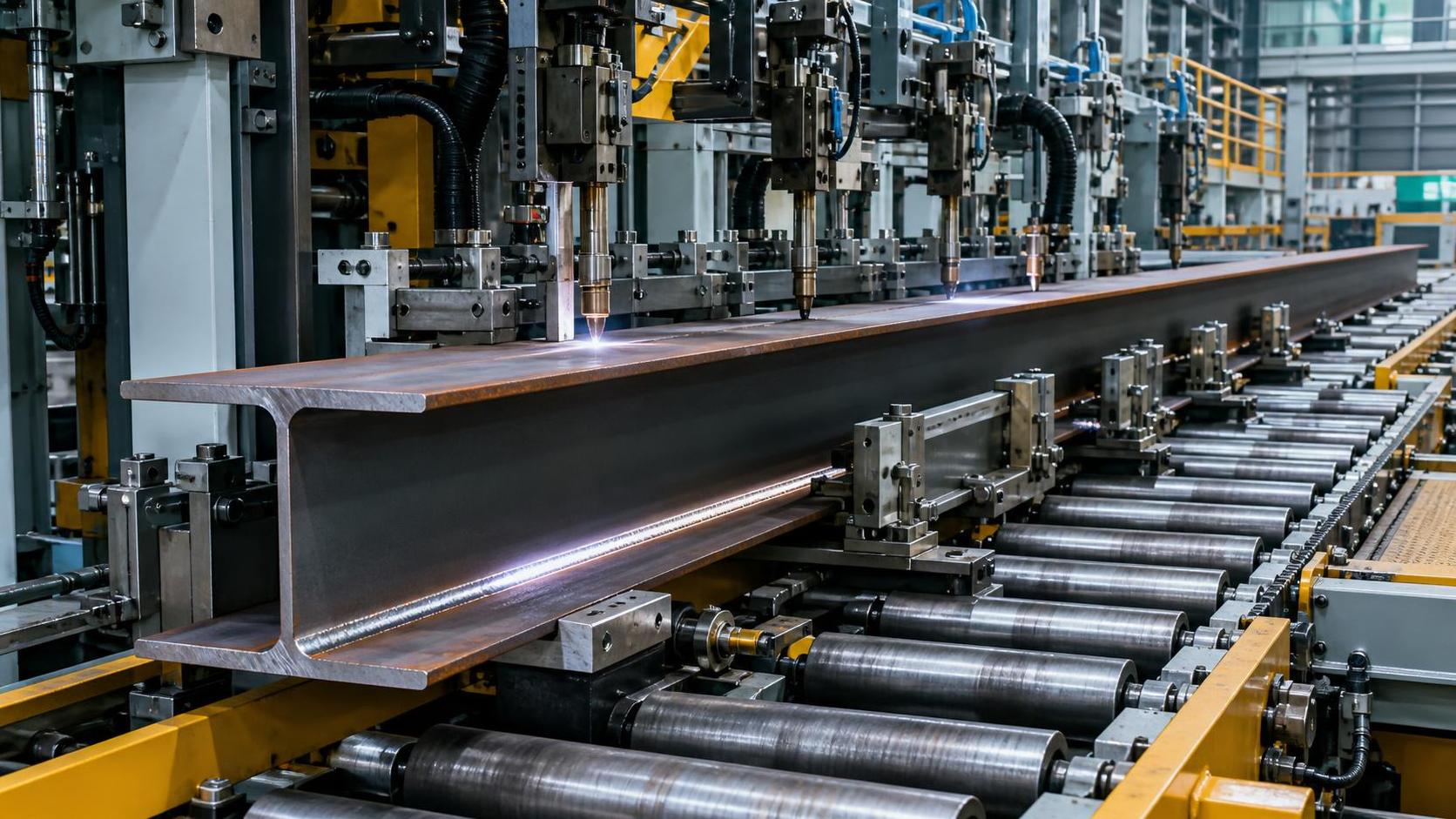
Choosing an H-beam line is rarely a matter of comparing nameplates or nominal throughput. For technical evaluators, the real question is whether a given manufacturer can deliver stable output under actual shop conditions: variable incoming plate quality, mixed section sizes, operator differences, maintenance interruptions, and downstream fit-up demands. A line that looks competitive on paper can still become a bottleneck if web-flange alignment drifts, welding recovery is frequent, or material transfer logic is poorly integrated.
That is why comparing an h-beam line manufacturer should start from process capability rather than from isolated equipment specifications. Output and quality in H-beam fabrication are determined by how accurately the line controls assembly, tack positioning, welding heat input, conveyance rhythm, and dimensional correction across the full production flow.
The most useful comparisons usually focus on six areas: process matching, assembly and alignment accuracy, welding system performance, automation architecture, mechanical robustness, and supplier execution capability. If any one of these is weak, advertised productivity becomes difficult to realize in production.
Process matching matters more than headline capacity
A common evaluation mistake is to compare maximum beam size and nominal line speed without checking the product mix the line is expected to handle. A manufacturer may quote strong output numbers based on repetitive sections, limited thickness variation, and stable upstream preparation. That tells you little about performance in a job-shop or mixed-order environment.
Technical teams should ask what percentage of expected orders fall within the line’s efficient operating window, not merely within its theoretical range. For example, a line may handle a broad beam size range, but frequent changeovers between web heights, flange widths, and thickness combinations can reduce actual utilization if adjustment points are manual or slow. The same applies when heavy sections and lighter sections share the same line. Clamping logic, centering method, and roller support stiffness all affect transition efficiency.
Manufacturers that understand production realities can usually explain where their line performs best, where output declines, and what configuration options are available for mixed production. If the supplier cannot discuss takt loss caused by product variability, the proposal may be stronger in sales language than in engineering depth.
Assembly accuracy is the first gatekeeper of weld quality
In H-beam production, welding quality problems often begin before the arc starts. Poor flange-web centering, inadequate clamping stability, or inconsistent tack placement will show up later as weld deviation, angular distortion, and straightening burden. For this reason, assembly machine capability deserves more scrutiny than many buyers give it.
Key questions include:
- How is web and flange centering achieved: mechanical referencing, hydraulic positioning, servo-assisted adjustment, or a mixed method?
- How stable is the clamping system across thickness changes?
- Can the line maintain alignment on longer beams without cumulative drift?
- How much operator intervention is needed during section changeover?
Some manufacturers quote alignment precision but do not clarify whether it is measured at setup, during trial operation, or under full production load. That distinction matters. Accuracy that cannot be maintained when the section enters welding is of limited value.
Technical evaluators should also examine fit-up repeatability. Consistent root geometry is essential for stable submerged arc welding performance. If root gap varies excessively, weld deposition becomes less predictable, rework increases, and line speed must often be reduced to protect quality. A line with moderate nominal speed but reliable fit-up may outperform a faster line that frequently pauses for correction.
Welding system capability is not just about deposition rate
Many comparisons overemphasize welding power source brand while underestimating system integration. In an H-beam line, welding quality is affected by torch tracking stability, seam guidance, beam conveyance consistency, flux recovery, welding parameter control, and synchronization between travel speed and arc conditions.
Submerged arc welding remains standard for many H-beam applications because of its productivity and penetration stability. But line performance depends heavily on how the manufacturer integrates the welding station into the broader process. A technically sound supplier should be able to explain:
- how torch position is maintained over long runs,
- how travel speed responds to section changes,
- how flux feed and recovery are managed to avoid contamination and interruption,
- how spatter, slag handling, and post-weld accessibility affect downstream cleaning and straightening.
It is also worth checking whether the control system records welding parameters for quality traceability. In export-oriented fabrication or projects with stricter QA documentation, the ability to store parameter history can be more valuable than a marginal increase in welding speed.
If the manufacturer proposes optional robotic or CNC-assisted functions, evaluators should verify whether those functions improve actual seam consistency or merely add interface complexity. Advanced controls have value when they reduce dependence on operator compensation and improve repeatability. They add less value when maintenance skills on site cannot support them.
Automation should reduce production variability, not just labor count
Automation claims are common, but technical buyers should separate visible automation from effective automation. A line can include conveyors, automatic centering, and digital controls while still suffering from frequent manual intervention at transfer points or correction stages. In practice, these interruptions are what limit output consistency.
The more useful comparison is between automation architectures. Does the manufacturer offer isolated automation modules, or a coordinated line logic that manages material movement, machine interlocks, and fault response across the process? For higher-volume operations, integrated PLC and CNC coordination can materially improve rhythm and reduce handling delays. For lower-volume, high-mix production, simpler architectures may be preferable if they shorten troubleshooting time.
Ask how the line handles common disturbances: skewed feeding, plate dimensional variation, tack mislocation, flux blockage, conveyor stoppage, and emergency recovery. Good manufacturers can describe failure modes and recovery procedures in specific terms. Weak ones will return to generic statements about “high automation.”
Compatibility with upstream and downstream equipment is equally important. An H-beam line does not operate in isolation. CNC cutting machines, edge preparation, face milling, straightening, drilling, shot blasting, and coating all affect the line’s real efficiency. In many steel structure workshops, the best result comes not from the fastest single machine but from the most balanced production flow.
This is also where adjacent forming equipment can influence line efficiency. For example, when a fabricator also produces curved structural components, stiffeners, or rolled profiles for related assemblies, integration with equipment such as a Profile bender may reduce outsourcing and improve production continuity. That is not a core H-beam line criterion, but it matters in workshops where structural fabrication extends beyond straight beam production.
Mechanical design affects long-term accuracy more than many buyers expect
Technical comparisons often focus on controls because they are easier to demonstrate. Yet long-term output and quality are often decided by more basic issues: frame rigidity, roller material, bearing arrangement, hydraulic stability, rail straightness, and wear behavior under load.
When a manufacturer has solid engineering discipline, it can usually provide meaningful detail on mechanical design choices. Evaluators should look for evidence that the line is built for sustained alignment, not merely successful commissioning. Areas worth checking include:
- rigidity of the assembly and welding frames,
- quality and hardness of rollers and drive elements,
- bearing type and accessibility for maintenance,
- hydraulic component sourcing and contamination control,
- ease of calibration after wear or component replacement.
This becomes especially important in export projects or remote installations where service response time may be longer. A mechanically tolerant line with straightforward adjustment procedures may be more valuable than a technically sophisticated line that requires frequent specialist intervention.
For shops processing asymmetric or distortion-sensitive sections in related operations, the same logic applies to ancillary forming equipment. Machines designed with controlled roller movement, digital displacement readout, and deformation management features tend to produce more predictable results over time than systems that rely heavily on operator feel alone.
Compliance and documentation are not secondary issues
For technical evaluators involved in international procurement, compliance should be reviewed as an engineering risk item, not a paperwork item. ISO9001 certification indicates a quality management framework, but it does not by itself confirm product performance. CE-related claims also need careful interpretation. For machinery sold into relevant markets, the question is whether conformity documentation, safety design, electrical integration, and technical files are complete and appropriate for the delivered configuration. Where details are unclear, the correct position is 【待核实】 rather than assumption.
Good manufacturers typically support their proposals with:
- machine drawings and layout plans,
- electrical and hydraulic schematics,
- inspection procedures,
- acceptance standards,
- operation and maintenance documentation,
- component lists with brand and origin disclosure.
Documentation quality is often a strong indicator of execution quality. If technical files are vague before contract award, after-sales engineering support may be equally weak.
Factory acceptance should test stability, not only functionality
One of the most revealing stages in manufacturer comparison is the factory acceptance test. Too often, buyers witness a short demonstration using favorable sample sections and conclude that the line is proven. A more rigorous approach is to structure acceptance around repeatability and disturbance handling.
Useful acceptance criteria may include dimensional consistency over multiple runs, welding appearance stability across section changes, recovery time after stoppage, and measurement of key tolerances after continuous operation. Technical teams should also observe how the line behaves during setup adjustment. Smooth, transparent adjustment procedures generally indicate mature engineering. Repeated manual correction during demonstration should be treated as a warning sign.
If possible, ask for references from users with a similar product mix rather than simply similar machine models. A manufacturer may have many installations, but the relevant question is performance in production conditions close to yours.
Total cost should include quality loss and utilization loss
Price comparison alone often favors the wrong supplier. For an H-beam line, total cost is strongly shaped by scrap, rework, weld repair, downtime, consumable waste, and dependence on highly skilled operators. A lower purchase price can quickly be offset by unstable production and maintenance burden.
Technical evaluators should translate machine differences into production effects:
- How much output is lost during section changeover?
- How much rework comes from alignment inconsistency?
- How much straightening load is transferred downstream?
- How sensitive is the line to operator skill variation?
- How available are spare parts and remote support?
These questions are often more decisive than nominal speed. In many fabrication businesses, dependable utilization is more profitable than peak capacity that is rarely achieved.
What usually separates stronger manufacturers from weaker ones
In practice, the better H-beam line manufacturers are not necessarily those with the longest feature lists. They are the ones that can explain process boundaries clearly, provide realistic output assumptions, document tolerances and acceptance logic, and connect machine design decisions to production outcomes. They also tend to be more candid about what needs to be standardized on the customer side: incoming material control, operator training, utility stability, and foundation conditions.
Weaker manufacturers often present all applications as equally suitable, avoid detailed discussion of mixed production constraints, and rely on generic wording around automation and quality. That is usually where technical risk enters the project.
For evaluation teams, the best comparison method is simple: follow the beam through the full process and identify where variation enters, where it is controlled, and where it is merely corrected after the fact. The manufacturer that controls variation earlier in the process will usually deliver better output, better weld quality, and lower operating cost over the life of the line.
search
Products Navigation
Send Us A Message