




What to Check Before Choosing an H-Beam Line Supplier for Steel Structure Projects
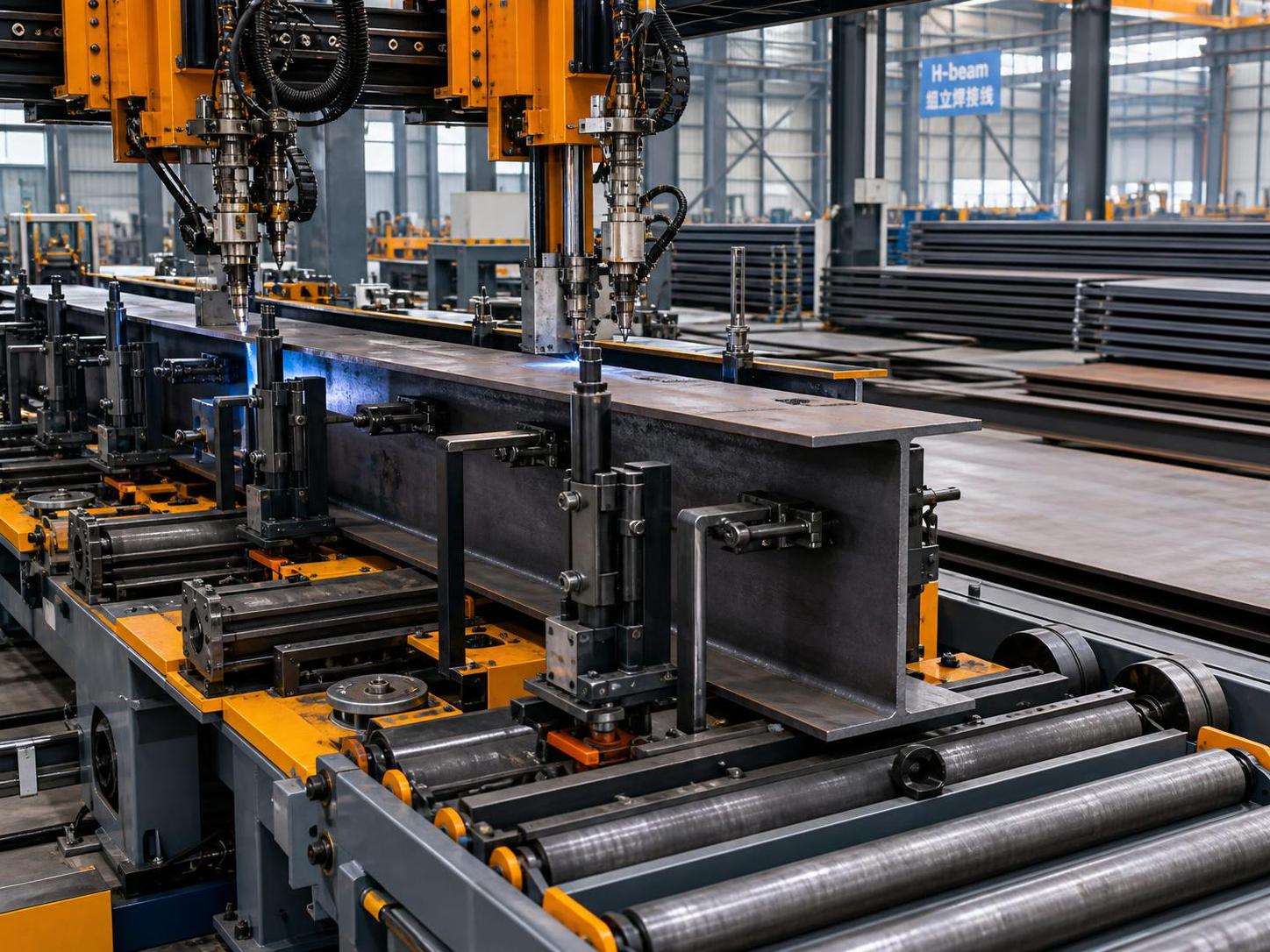
Choosing an h-beam line supplier is rarely just a procurement exercise. In steel structure projects, the line affects fabrication accuracy, welding consistency, delivery reliability, labor planning, workshop layout, and even whether a project can maintain margin under schedule pressure. For project managers, the wrong choice does not usually fail on day one. It shows up later: unstable fit-up, rework at assembly, missed milestones, unplanned consumable costs, weak commissioning support, or a line that performs well on standard sections but struggles with the actual member mix of the project.
That is why supplier evaluation has to go beyond brochure specifications. A capable supplier is not simply one that can manufacture machines; it is one that can match equipment design, process flow, control logic, installation support, and after-sales responsiveness to the realities of steel structure production.
The most useful way to assess an h-beam line supplier is to start from project risk, not equipment description.
Check whether the supplier understands your production reality, not just the machine category
Many buyer-supplier discussions begin with line speed, flange width range, web height range, and automation level. Those matter, but they are not enough. A supplier may offer a technically acceptable line and still be a poor fit if it does not understand your actual beam mix, plate grades, welding method, output rhythm, or the balance between standardization and job-shop flexibility.
Project managers should ask practical questions such as:
- What percentage of your workload is standard H-beams versus variable or non-standard sections?
- Will the line mainly serve building steel, bridge components, heavy industrial structures, or export fabrication?
- Is the production objective high-volume repetition, mixed-batch flexibility, or fast project turnover?
- How often will thickness, section size, and weld requirements change during one production cycle?
A supplier that has worked across multiple steel structure applications will usually ask for this information early. If discussions stay limited to generic capacity figures, that is often a sign of shallow engineering engagement.
Evaluate the supplier’s process integration capability
An h-beam line is not one machine. It is a process chain. Cutting, assembly, tack welding, submerged arc welding, straightening, end-face finishing, drilling or coping in some workflows, and internal logistics all influence the final result. Problems often arise not from a single machine failure but from poor coordination between upstream and downstream stations.
This is especially important when the project includes plate preparation equipment, handling systems, and digital nesting or CNC programming. For example, upstream cutting quality affects assembly fit-up and weld stability. If plate edges vary, distortion increases, and downstream correction time rises. In many workshops, the cutting stage becomes an underestimated source of waste. That is why some project teams assess whether the supplier can also support related processes, such as a Cnc flame cutting machine for carbon steel and low-carbon steel preparation, particularly where thick plate cutting economy matters and multi-torch straight cutting is part of production planning.
What matters here is not whether one supplier makes every piece of equipment in-house. What matters is whether it can take responsibility for process compatibility. Ask who defines interface dimensions, control signals, material flow logic, and cycle-time balancing. If the answer is vague, integration risk remains with you.
Do not treat output claims at face value
Quoted production capacity is one of the most misunderstood figures in line selection. Suppliers often present theoretical throughput based on ideal section sizes, uninterrupted loading, skilled operators, and stable consumable conditions. Real workshop output is lower because of section changes, material staging delays, fit-up correction, parameter adjustment, inspection pauses, and operator learning.
For project decision-making, the better question is not “What is the maximum speed?” but “What is the stable output under our actual mix?”
Ask for examples tied to similar beam sizes, thickness ranges, and welding requirements. A trustworthy supplier should be able to explain:
- Output under continuous standard production
- Output under mixed-batch conditions
- Expected downtime during section changeover
- Operator requirement per shift
- Bottlenecks in the proposed line configuration
If the supplier cannot distinguish between rated speed and effective output, the capacity estimate may not support project scheduling.
Look closely at welding and straightening stability, because that is where downstream cost appears
In steel structure fabrication, quality problems rarely stay local. Poor assembly accuracy leads to welding variation. Welding variation leads to distortion. Distortion leads to straightening burden, dimensional rework, and delays in final fit-up. This is why evaluating an h-beam line supplier should include a close review of welding process stability and straightening performance, not only machine mechanics.
Project managers should verify:
- How the supplier controls beam alignment before and during welding
- What type of clamping and centering mechanism is used
- Whether welding parameter control is manual, semi-automatic, or integrated
- How distortion is managed across different thickness combinations
- What straightening range can be achieved consistently, not theoretically
This becomes even more important for export-oriented fabricators or projects with stricter dimensional acceptance. Rework consumes more than labor; it disrupts sequence planning across the workshop.
Certification matters, but only if it reflects real manufacturing discipline
Buyers often check for ISO9001 and CE marking, which is reasonable. But these should not be treated as proof of overall supplier quality on their own. ISO9001 indicates a quality management framework, while CE-related compliance concerns applicable EU requirements for products placed on the relevant market. Neither automatically guarantees that a supplier has strong process control, sound sourcing discipline, or consistent assembly standards.
Use certifications as an entry-level filter, then go further:
- Ask how incoming components are inspected
- Review welding procedures and structural fabrication controls for machine frames
- Check electrical component brand consistency and traceability
- Confirm whether factory acceptance testing is documented
- Verify what inspection records can be shared before shipment
A supplier with robust documentation is usually easier to work with during installation, troubleshooting, and later spare parts support.
Customization is valuable, but over-customization can create maintenance risk
Most steel structure projects are not served well by a completely off-the-shelf solution. Workshop dimensions, crane conditions, local utilities, product mix, and labor skill all affect line design. Customization is often necessary. The problem is that some buyers confuse customization with engineering sophistication.
Too much customization can create a line that only the original supplier fully understands. That may seem acceptable during purchase, but it becomes a long-term risk if spare parts, controls logic, or mechanical replacements depend on non-standard designs.
The safer approach is selective customization:
- Customize around layout, handling, section range, and interface requirements
- Standardize as much as possible in drives, control systems, electrical architecture, and wear parts
- Prefer internationally recognized or regionally supportable key components where feasible
This balance matters for project managers because lifecycle operability is part of project success, even when capital expenditure is approved by another department.
After-sales support should be evaluated like a project deliverable
One of the biggest mistakes in selecting an h-beam line supplier is treating after-sales service as a secondary commercial term. In practice, installation, commissioning, training, remote diagnostics, and spare parts response often determine whether the line reaches planned capacity within the expected timeframe.
Ask concrete service questions:
- Who handles installation supervision and commissioning?
- What is the expected timeline from mechanical installation to production acceptance?
- Is operator training included, and how many days are realistic?
- Can the supplier provide remote troubleshooting across time zones?
- Which spare parts are recommended for first-year inventory?
- What are the response commitments for electrical, software, and mechanical faults?
Vague promises such as “lifetime support” are far less useful than a clear service matrix. For overseas projects especially, response speed and parts availability can be more important than a small difference in initial purchase price.
Review supplier references with the right questions
Reference lists are common, but many buyers use them poorly. The purpose of references is not to confirm that the supplier has exported before. It is to learn how the equipment performs after the contract is signed.
When possible, ask reference customers about:
- Commissioning duration versus original promise
- Actual output achieved after three to six months
- Frequency of stoppages and root causes
- Parts replacement cycle for wear items
- Supplier responsiveness during troubleshooting
- Any mismatch between proposal scope and actual site conditions
The most valuable references are not always the largest or most prestigious customers. They are the ones with similar product mix, staffing level, and project complexity.
Total cost should include process loss, not just equipment price
For project teams under budget pressure, a lower quotation can be attractive. But the financial comparison should include the hidden cost drivers that emerge during operation: rework, consumables, utility load, operator intensity, downtime, maintenance intervals, and dependency on imported parts.
Even in related upstream processes, technical choices affect total economics. For instance, flame cutting remains relevant in many heavy steel fabrication scenarios because thick carbon steel processing can be more economical than alternatives in certain thickness bands, provided accuracy and nesting are well managed. Equipment such as bilateral-drive CNC cutting systems with rack-and-pinion motion, CAD/CAM nesting, torch height control, and multi-torch capability can improve material preparation efficiency before beam assembly, but only if the chosen configuration matches the workshop’s actual production strategy rather than a generic “higher automation is better” assumption.
Project managers should therefore build a cost model that includes:
- Initial equipment and installation cost
- Foundation, utilities, and workshop modification cost
- Labor requirement per shift
- Consumables and energy usage
- Expected maintenance and spare parts exposure
- Yield loss and rework risk
- Ramp-up time before stable production
This approach often changes which supplier appears most competitive.
Pay attention to digital compatibility and data flow
In new steel structure plants and upgrades alike, data flow is becoming part of line value. Even if a workshop is not fully digitalized, project teams increasingly expect nesting software, CNC data import, production tracking, and basic fault diagnostics to integrate with existing management systems.
The issue is not whether the supplier advertises “smart manufacturing.” The issue is whether the controls architecture supports practical use: file compatibility, operator usability, alarm clarity, remote support access, and future expansion.
If your project may later add robotic welding, CNC drilling, automated handling, or MES connectivity, ask about communication interfaces early. Retrofits become expensive when the original control design is closed or poorly documented.
Watch for warning signs during the quotation stage
Supplier quality often reveals itself before the order is placed. Several warning signs deserve attention:
- The proposal is fast but generic, with little interest in beam range, plate thickness, or workflow
- Technical answers are mostly commercial language without engineering detail
- Delivery promises are aggressive but unsupported by production planning
- Key component brands change frequently between revisions
- No clear acceptance criteria are defined for FAT or SAT
- Customization is offered freely without discussing maintenance implications
A serious h-beam line supplier usually asks difficult questions. That is a good sign, not a sales obstacle.
The best supplier decision is the one that reduces execution uncertainty
For steel structure projects, equipment selection should support one central objective: predictable execution. That means predictable quality, predictable output, predictable commissioning, and predictable support. The supplier that looks strongest on paper is not always the one that best protects the project schedule.
In practice, project managers should favor suppliers that can demonstrate three things clearly: they understand the actual fabrication scenario, they can prove process stability with comparable applications, and they can support the line after delivery with documented service capability.
That is the standard worth using. Not the lowest quote, not the highest automation claim, and not the broadest product catalog. When the line becomes the backbone of beam production, supplier selection is really a decision about operational risk. The closer your evaluation stays to that reality, the better the outcome will be.
search
Products Navigation
Send Us A Message