




How to Compare a CNC Hydraulic Swing Beam Shear Provider on Service and Lead Time
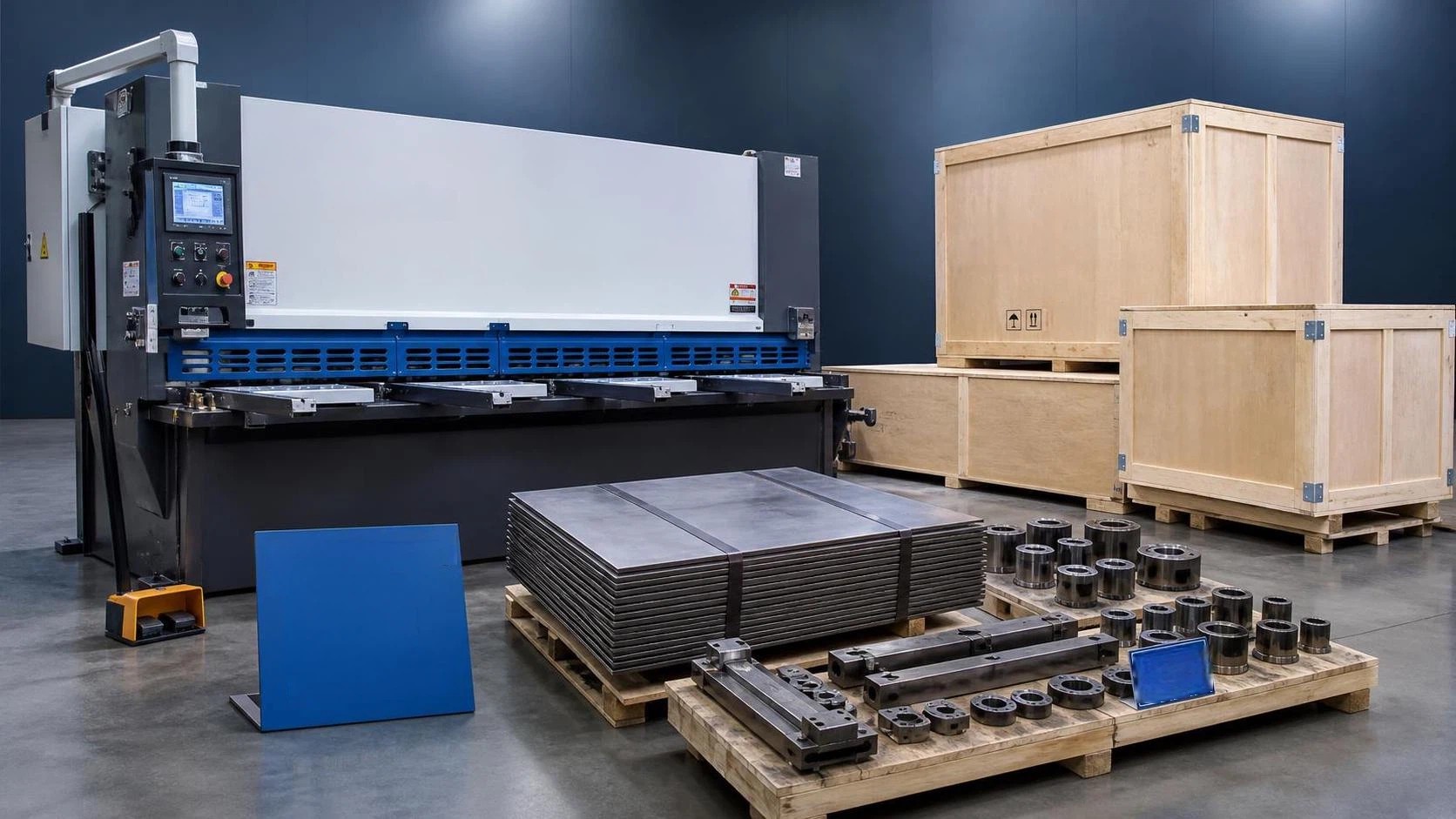
How to Compare a CNC Hydraulic Swing Beam Shear Provider on Service and Lead Time
Choosing a cnc hydraulic swing beam shear provider is rarely just a machine comparison exercise. On paper, several suppliers may offer similar cutting thickness, blade length, control systems, and hydraulic configurations. In practice, the difference often shows up much later: when drawings need clarification, when a delivery date starts slipping, when electrical standards vary by market, or when a spare part is needed quickly enough to avoid production loss.
For companies evaluating shearing equipment for fabrication, sheet metal processing, or broader steelworking operations, service and lead time are not soft factors. They directly affect installation planning, labor scheduling, commissioning risk, and the speed at which a new machine starts producing sellable parts. A lower purchase price can easily be offset by delayed shipment, weak documentation, or poor after-sales response.
That is why supplier assessment should go beyond the catalog. A serious review asks how the provider manages engineering communication, production organization, quality control, export handling, and long-term support. Those are the areas that separate a supplier that can quote a machine from one that can actually deliver a usable solution.
Lead time is not just a date on the quotation
Many buyers treat lead time as a single figure: 30 days, 45 days, 60 days. That number matters, but it does not tell you much by itself. A more useful question is what the lead time includes. Does it begin after deposit receipt and final drawing approval? Does it cover only factory completion, or also export packing and port delivery? Is the machine built from a stable bill of materials, or does the provider depend on uncertain outsourced components?
A capable cnc hydraulic swing beam shear provider should be able to explain its process in stages. Even if exact timing depends on configuration, buyers should expect reasonable clarity around technical confirmation, procurement of key parts, fabrication, assembly, testing, inspection, and shipping preparation. If the answer remains vague after several discussions, that is usually a warning sign.
It also helps to understand whether the supplier is used to handling customized projects or mainly standard models. Customization is not a problem by itself, but every added option—different voltage, special throat depth, upgraded CNC, safety additions, or local compliance items—can extend lead time. Reliable providers say this early instead of hiding it to make the quotation look attractive.
Service quality starts before the order is placed
Pre-sales communication is often the best preview of post-sales behavior. If a supplier takes days to answer basic technical questions, sends generic replies, or avoids discussing application details, it is risky to assume service will improve after payment.
Useful evaluation points include how the provider handles material questions, cutting accuracy expectations, duty cycle concerns, blade selection, and operator environment. For example, a buyer processing thin stainless sheets may have very different concerns from one cutting mild steel plates in heavier fabrication. The supplier does not need to oversell expertise, but it should ask the right questions and point out where machine configuration affects output quality and maintenance needs.
This is where companies with broader machinery experience can be easier to work with. Wuxi Samgins International Trade Co.,Ltd, established in 2012 in Wuxi, Jiangsu Province, works across multiple categories including shearing machines, bending machines, CNC cutting equipment, welding robots, milling machines, lathes, deburring equipment, and H-beam production line systems. That kind of product range does not automatically make one supplier better, but it often means the team understands how a shear fits into an entire fabrication workflow rather than treating it as an isolated unit.
How to check whether a quoted delivery promise is realistic
A practical buyer will try to verify delivery capacity instead of relying on verbal assurance. There are a few straightforward ways to do that.
This last point matters more than many buyers expect. A supplier that has shipped to Southeast Asia, Europe, North and South America, and Oceania is more likely to understand that lead time can be affected by documentation, electrical adaptation, packaging expectations, and destination-specific review steps. That does not guarantee smooth execution, but it reduces the chance of basic export mistakes.
Quality systems affect service speed too
When buyers hear ISO9001 or CE, they often think only about compliance. In reality, quality management also influences service responsiveness and delivery reliability. A provider that organizes production and design under ISO9001 processes is usually better positioned to control revisions, inspection records, and documentation flow. Likewise, familiarity with EU CE standards can help when projects need clearer safety documentation or when buyers want fewer surprises during installation and acceptance.
Still, certifications should not end the conversation. Ask how they are applied to the machine you are buying. Are inspection records available? Is the electrical documentation complete? Are manuals prepared in usable English? If a supplier references standards but cannot support them with project documents, the benefit is limited.
A good provider understands that service is partly administrative discipline. Missing labels, incomplete packing lists, weak manuals, or unclear spare parts references all create delays after the machine leaves the factory.
After-sales support should be evaluated in operational terms
“We offer good after-sales service” is too vague to be useful. Buyers should translate support claims into operational questions. Who handles troubleshooting? What information is needed for diagnosis? Are electrical schematics and hydraulic diagrams included? Which wear parts are recommended for initial stocking? How are replacement blades, seals, switches, or control-related parts supplied if the machine is exported overseas?
For a cnc hydraulic swing beam shear provider, after-sales quality often comes down to response structure rather than promises. If the service team can identify a problem from photos, videos, alarm descriptions, and machine serial details, downtime can be shortened considerably. If every issue requires repeated back-and-forth because records are poor or communication is fragmented, even a minor fault becomes expensive.
It is also worth checking whether the supplier supports only single machines or understands integrated production environments. In steel fabrication, a shear may sit upstream of bending, welding, drilling, or beam processing. A supplier familiar with connected equipment often gives more practical advice on workflow, handling, and capacity matching.
That broader view can be seen in production line equipment as well. For example, a provider involved with systems such as Heavy automatic h beam line is dealing with coordinated material flow, turning, conveying, welding, straightening, and secondary processing rather than one standalone machine. In that line, H-beam dimensions can range from 160-1500 mm in height, 150-800 mm in width, and 4000-15000 mm in length, with web thickness of 6-50 mm and flange thickness of 6-60 mm. That does not make the supplier automatically right for every shear project, but it suggests experience with delivery planning and support in more complex fabrication settings.
Watch for hidden lead-time risks during technical clarification
Some of the biggest delays are created before production starts. They come from incomplete technical definition. Buyers should confirm at least the cutting material range, thickness range, effective working length, backgauge expectations, power supply, control language, safety requirements, and any destination-specific standards. If pit installation, foundation preparation, or special unloading conditions apply, those should be discussed early as well.
Another common issue is assuming all machines are configured equally. Two shears may look similar in quotation format but differ significantly in hydraulic components, control brand, blade quality, safety arrangement, or operator interface. Those differences affect not just price, but spare parts availability and future service response.
If your internal approval process is slow, be careful with long negotiation cycles. Component availability can change, and suppliers may need to recheck delivery dates after final configuration is frozen. That is normal. What matters is whether updates are transparent.
A simple comparison approach that works better than price ranking alone
When several offers are close, use a weighted review instead of choosing the lowest number. Price should remain part of the decision, but not the only one. In many projects, the more useful comparison is this:
- How complete and relevant was the technical response?
- How clearly was lead time defined, including assumptions?
- How credible is the supplier’s export and documentation capability?
- What evidence is there of organized quality control and standards awareness?
- How practical is the after-sales support model for your location and team?
- Can the provider support your broader fabrication process if future expansion is likely?
This approach usually produces a better long-term decision than comparing only machine tonnage, blade length, and unit price.
In the end, the right cnc hydraulic swing beam shear provider is the one that can explain what it will deliver, when it can deliver it, and how it will support the machine after startup—without relying on vague language. If you are narrowing a shortlist, ask each supplier to walk through the full path from technical confirmation to shipment, commissioning support, and spare parts handling. The answers will often tell you more than the brochure ever could.
search
Products Navigation
Send Us A Message