




What Buyers Should Ask a CNC Guillotine Shear Supplier Before Requesting a Quote
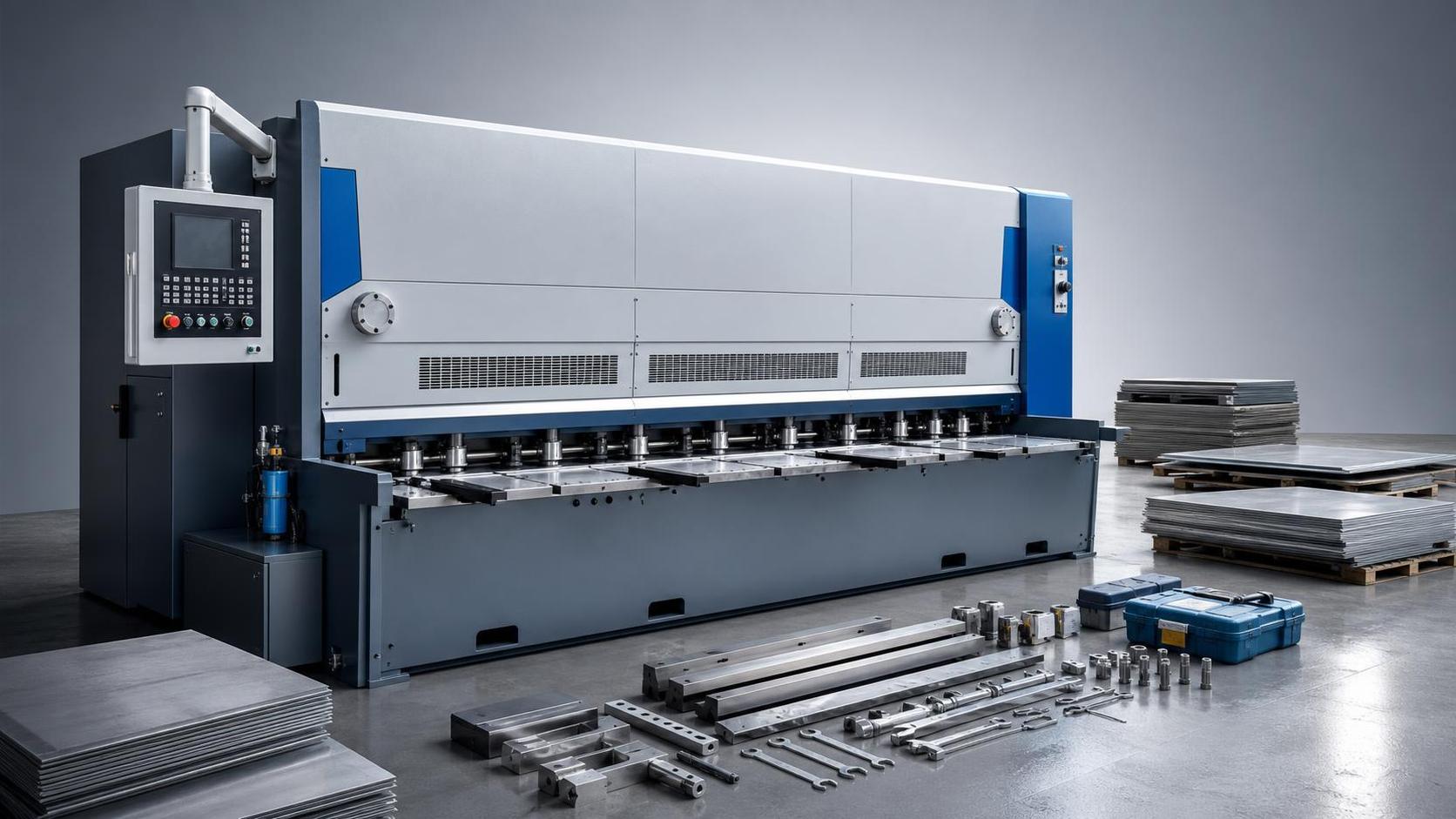
What Buyers Should Ask a CNC Guillotine Shear Supplier Before Requesting a Quote
Price matters, but on a cnc guillotine shear, the cheapest quote can easily become the most expensive machine on the floor. Buyers usually discover that later, when the machine cannot hold tolerance on thicker plate, replacement blades take too long to arrive, or the control system is awkward enough to slow down every shift. A useful quote request should do more than ask for a number. It should force the supplier to show whether they understand your material, your throughput, your safety requirements, and the way your workshop actually runs.
That is especially true for procurement teams buying across borders. A supplier may look strong on paper, but if they cannot answer practical questions about cutting range, controls, service parts, or compliance, the risk moves directly to the buyer. Companies that work across broader fabrication lines tend to understand this better. In Wuxi, for example, many established machinery exporters are not dealing with shears alone; they also handle welding equipment, CNC cutting systems, bending machines, rolling machines, deburring equipment, and H-beam line machinery. That wider exposure usually shows up in the quality of their answers, because they see how a shear fits into production instead of treating it as an isolated product.
Start with the material, not the model
One of the first questions to ask is simple: “What material and thickness is this machine rated to cut in real production conditions?” Not in a brochure headline, but in actual use.
Suppliers sometimes present maximum cutting capacity as if it applies to every grade of steel. It does not. Mild steel, stainless steel, high-tensile plate, and aluminum behave differently, and a cnc guillotine shear that cuts one material comfortably may struggle with another at the same nominal thickness. If your workshop processes mixed materials, ask the supplier to separate the answers by material type and by cutting length. Capacity at full width is a better decision metric than an isolated maximum number.
It is also worth asking what plate condition the capacity assumes. Burr-heavy plate, warped sheets, or material with scale can affect cut quality and machine load. A serious supplier will not dodge this. They will usually ask follow-up questions of their own.
Ask how the machine holds cut quality over time
A shear may be able to cut a sheet today and still be a poor buy. The better question is whether it can keep producing acceptable edges after months of routine use.
Ask the supplier about blade material, blade life expectations under your workload, blade clearance adjustment, and frame rigidity. If the answer stays vague, that is a warning sign. Cut quality on a guillotine shear depends heavily on correct blade gap, alignment, hold-down stability, and the condition of the blades themselves. If your parts go on to bending, welding, or visible assemblies, edge condition matters because downstream defects often begin with poor shearing.
A practical question procurement teams often miss is this: “What signs tell us the machine is no longer set correctly, and what can operators adjust without calling service?” That gets you closer to real ownership cost than asking only about the initial warranty.
Do not overlook the control system
Many buying decisions are still made around tonnage, blade length, and motor power. Those are important, but the control system determines how efficiently the machine gets used. Ask which CNC controller is supplied, what functions are standard, how backgauge programming works, whether job memory is included, and how easy it is to train a new operator.
For short-run, mixed-batch production, a poor interface wastes time all day. For repetitive work, unreliable backgauge movement is even worse, because it quietly creates scrap. If the supplier can provide videos of the interface in operation, or a clear explanation of routine setup steps, that is more useful than glossy catalog language.
Ask whether electrical components and controller documentation are available in English and whether remote troubleshooting is possible. In export projects, this matters more than buyers sometimes expect. A machine can be mechanically sound and still become difficult to support if documentation is incomplete.
Safety and compliance should be specific
If a supplier says the machine follows CE standards, ask what that includes. It is reasonable to confirm guarding, emergency stop layout, electrical protection, and operating documentation. If the machine will be installed in Europe or in a plant with strict internal audit rules, these details should be clarified before quotation, not after deposit.
Some manufacturers in China, including firms around Jiangsu with export experience, organize production under ISO9001 systems and build to EU CE requirements for relevant projects. That can be useful, but buyers should still request the exact scope of supply and compliance documents for the machine being quoted. A general company statement is not the same as project documentation.
Pin down what is included in the quote
A quote for a cnc guillotine shear can look competitive simply because key items are excluded. Ask for a line-by-line scope: standard tooling, spare blades if offered, backgauge range, front support arms, sheet support system, electrical standard, voltage, operator manual, installation guidance, and commissioning terms.
This is where experienced suppliers stand out. They tend to ask about your plant voltage, sheet size, export destination, and loading conditions before pricing. They know that freight packaging, customs documentation, and service planning affect the real landed cost just as much as the machine base price.
Spare parts and after-sales support are part of the machine cost
A common mistake is treating after-sales support as a secondary issue. In reality, for imported machinery it is part of the purchasing decision from day one. Ask what wear parts are normally stocked, which parts are proprietary, how fast replacements can be shipped, and whether local service partners exist in your region.
Also ask what support is available remotely. For many buyers, especially those outside the supplier’s home market, fast troubleshooting by video, wiring diagrams, and clear parts identification can save more downtime than a broad but vague warranty statement.
Suppliers with experience exporting to Southeast Asia, Europe, the Americas, or Oceania often have a more realistic view of this. They understand the machine does not stop being their problem once it leaves the port. That attitude is usually visible in how they answer service questions before you buy.
Lead time should be discussed in production terms
Instead of asking only, “What is your delivery time?”, ask what stages are included: production, inspection, packing, inland transport, and export documentation. If you need factory acceptance checks or third-party inspection, say so early. Otherwise the quoted lead time may not match the time you can actually start production.
This becomes even more important if the shear is part of a larger line. A fabrication shop may buy a shear together with press brakes, deburring equipment, or beam-processing systems. In those situations, schedule alignment matters as much as individual machine lead time. A supplier familiar with broader line equipment usually understands these dependencies. The same company discussing a guillotine shear may also be supplying welding robots or heavy handling systems such as an H beam Chain turnover machine for H-beam production, where synchronized delivery and commissioning directly affect the line start-up plan.
Ask how the supplier matches the machine to your workflow
A good supplier does not just ask for thickness and width. They ask how parts flow after cutting, who will operate the machine, what tolerances are critical, and whether material handling is manual or assisted. That is not sales talk; it changes the right machine choice.
For example, if large sheets are being fed by one operator, front support design and ease of positioning may matter more than a headline speed figure. If the machine feeds a welding line, consistency may be more valuable than maximum theoretical capacity. In heavy fabrication environments, handling and positioning often decide real productivity. That is why manufacturers involved in structural steel or long-workpiece systems pay close attention to movement control, stability, and operator safety. The engineering logic behind a chain-driven turnover unit with synchronized flipping, remote operation, and controlled handling of long sections is different from a shear, of course, but the purchasing lesson is the same: ask how the machine behaves inside the whole process, not just on a spec sheet.
A few questions separate serious suppliers from traders with limited depth
You do not need an overly long questionnaire. But a few direct questions reveal a lot:
- What materials and thicknesses do you recommend this model for in daily operation, not just at maximum rating?
- What controller is included, and can you show the programming flow for routine jobs?
- What wear parts should be purchased with the machine?
- What documents will be provided for installation, maintenance, and electrical troubleshooting?
- What safety configuration is included for the target market?
- What assumptions are built into the quoted lead time and packing method?
If the answers are clear, technical, and consistent, the quote will mean something. If they are evasive, generic, or copied from a catalog, you are not really comparing suppliers yet.
The best time to uncover a weak supplier is before the quotation stage, not after the machine reaches your workshop. A cnc guillotine shear is not just a metal-cutting asset; it is a production commitment. Ask the questions that expose long-term fit, and the price discussion becomes much more honest.
search
Products Navigation
Send Us A Message