




Why Blade Gap Matters in a CNC Hydraulic Guillotine Shear for Stainless Steel
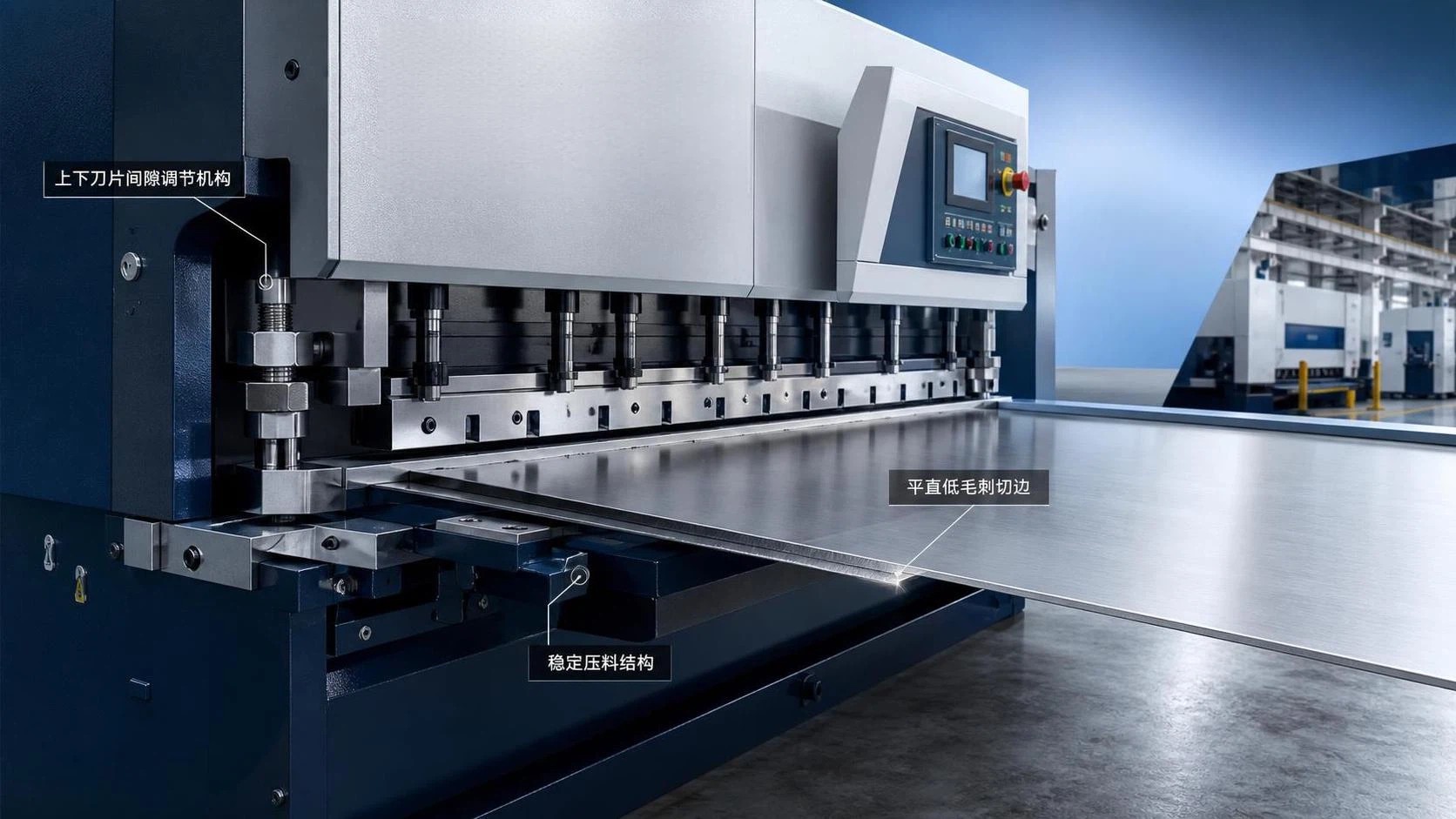
Why Blade Gap Matters in a CNC Hydraulic Guillotine Shear for Stainless Steel
In stainless steel cutting, blade gap is a decisive factor in the performance of a cnc hydraulic guillotine shear. For technical evaluation work, this is not a minor setup detail. Clearance directly affects cut edge quality, sheet deformation, burr level, noise, blade life, and the machine’s ability to repeat the same result over long production runs. If the gap is wrong, even a rigid frame, good hydraulics, and a stable backgauge will not fully compensate.
That matters even more with stainless steel because it does not behave like mild steel in the shear zone. It is generally tougher, more prone to work hardening, and less forgiving when process parameters drift. A machine that cuts carbon steel acceptably may still produce poor edges on stainless if blade clearance adjustment is crude, inconsistent, or too dependent on operator experience.
What blade gap actually changes at the cut
When the upper blade descends, the material first deforms, then fractures. The distance between upper and lower blades influences where that fracture starts and how cleanly it propagates through the sheet thickness. On stainless steel, the “right” gap helps create a controlled balance between sheared surface and fracture surface. Too small, and the machine may force the material excessively, increasing heat, drag, and blade loading. Too large, and the fracture becomes rougher, burrs increase, twist can worsen, and dimensional consistency may suffer.
This is why evaluators often notice that blade gap problems show up as a collection of symptoms rather than one obvious failure. The edge may look acceptable from a distance, but downstream welding, bending, polishing, or assembly starts to expose the inconsistency. In stainless fabrication, those secondary operations usually make cutting quality more visible, not less.
Why stainless steel is less tolerant of poor clearance
Austenitic stainless grades, in particular, tend to resist clean separation if the setup is not matched to thickness and material condition. Sheets with protective film, polished finish, or stricter cosmetic requirements make the issue sharper. An oversized gap can leave heavier burrs and a more uneven fracture band. An undersized gap can mark the surface, accelerate edge galling, or increase the chance of local distortion.
In practical terms, the correct setting is usually related to sheet thickness and material properties, but technical teams should be careful with generic percentage rules. Many suppliers mention clearance as a proportion of thickness, which is a useful starting point, not a universal answer. Blade geometry, machine rigidity, hold-down performance, rake angle, sheet flatness, and the stainless grade itself all influence the final result. So when comparing machines, the real question is not whether a recommended blade gap exists. It is whether the machine can reach, hold, and repeat that setting reliably in production.
Common problems that point to the wrong blade gap
If you are reviewing a machine for stainless applications, several issues often indicate that clearance control deserves closer attention:
- Visible burr increase as thickness changes
- More sheet twist or bowing than expected
- Premature blade wear, edge chipping, or frequent regrinding
- Large variation between first-piece and steady-state quality
- Different results depending on operator skill, even on the same material
- Noticeable deterioration when switching from carbon steel to stainless steel
These are not always caused by blade gap alone, but in many shop-floor assessments, clearance is one of the first parameters worth checking because it interacts with so many others.
What technical evaluators should verify on the machine
For a cnc hydraulic guillotine shear, the evaluation should go beyond brochure language such as “easy adjustment” or “high precision.” What matters is how the blade gap is adjusted and how stable that adjustment remains after repeated cycles.
A few points are worth verifying during comparison:
- Whether clearance is manual, motorized, or CNC-controlled
- Whether the displayed value corresponds reliably to actual blade position
- How quickly operators can switch settings between different thicknesses
- Whether the frame and blade carrier maintain parallelism under load
- How the machine behaves on thin stainless versus thicker plate
- Whether test cuts show consistent burr and edge straightness across the full cutting width
In other words, the adjustment mechanism matters, but structural integrity matters just as much. A machine can offer numerical input on the control screen and still perform poorly if mechanical wear, uneven blade seating, or insufficient rigidity changes the real gap during operation.
Blade gap is tied to cost, not just quality
Technical teams usually start with part quality, but finance and production will eventually feel the effects too. Poor clearance increases blade maintenance, raises scrap risk, slows setup, and may add manual deburring before welding or forming. Stainless steel makes that more expensive because the material itself costs more and post-processing often takes longer.
That is why a stable shearing process should be seen as part of the whole fabrication route. In many factories, shearing is only the first step before edge prep, forming, or welding. If the cut edge is unstable, the next machine inherits the problem. For applications such as container manufacturing, shipbuilding, or special vehicle production, this process chain view becomes especially important. Shops that also handle bevel preparation often prefer equipment combinations that reduce handwork between stages. In that context, a dedicated solution such as the CNC Square & Pipe Beveling Machine can make sense after cutting, especially where square, rectangular, or round tubes in carbon steel, stainless steel, or aluminum need one-pass bevel formation rather than secondary grinding.
What a good evaluation process looks like
A meaningful assessment usually includes more than one sample cut. If possible, use the actual stainless thickness range you process most often, not only the easiest material. Thin sheets can reveal marking and flatness issues, while thicker plates expose load stability and fracture behavior. It is also worth checking the machine after multiple cuts, because some systems perform well on the first demonstration piece but drift once heat, vibration, and repeated clamping are involved.
Pay attention to the edge from several angles: burr height, straightness, deformation near the hold-down zone, and consistency across width. If the material will be bent later, examine whether the edge condition could trigger cracking or cosmetic rejection. If it will be welded, think about how much cleanup is required before fit-up. These are practical indicators that often matter more than broad claims about “high efficiency.”
Supplier capability also affects blade gap performance
Even when buyers focus on the machine itself, supplier depth still matters. A shear used for stainless steel usually requires better pre-sales parameter matching, clearer setup guidance, and more realistic discussion of material range. Wuxi Samgins International Trade Co.,Ltd, based in Wuxi and about 30 minutes from Shanghai by high-speed rail, works across a broad range of fabrication equipment including shearing machines, bending machines, laser cutting machines, milling machines, deburring systems, welding equipment, robots, and H-beam production line equipment. That broader equipment exposure can be useful during evaluation because stainless processing decisions are rarely isolated to one machine.
The company states that production and design are organized in line with ISO9001 quality system certification and EU CE standards, and its equipment has been exported to Southeast Asia, Europe, North and South America, and Oceania. For technical review, the value of this is not in a marketing sentence. It is that documentation, design consistency, and export experience often make it easier to confirm configuration details, safety expectations, and project-specific options before purchase.
The same logic applies when stainless fabrication extends beyond shearing. If the project also includes beveling after cut-to-length operations, it helps to compare how upstream shearing quality affects downstream edge preparation. For example, a beveling system with adjustable processing speed from 0 to 1500 mm/min, surface finish around Ra3.2–6.3, and one-pass formation of straight, inclined, U-, V-, and K-shaped bevels may reduce later rework, but only if incoming cut quality is already controlled. Process matching matters more than buying machines one by one.
A mistake buyers still make
One common mistake is treating blade gap as an operator issue instead of a machine capability issue. Skilled operators do make a difference, but stainless steel production should not depend on constant manual compensation. If a machine is hard to adjust, easy to misread, or mechanically unstable, the process will remain fragile no matter who runs it.
Another mistake is evaluating only maximum cutting thickness. A machine may meet nominal thickness requirements and still struggle to deliver stable results on the actual mix of polished stainless, thin sheet, or frequent specification changes seen in production. That is why the adjustment range, responsiveness, and repeatability of blade clearance deserve as much attention as the headline tonnage or stroke data.
For stainless steel, blade gap is where theory meets shop-floor reality. If your evaluation process includes real material, repeated cuts, and a close look at how the cnc hydraulic guillotine shear maintains clearance over time, you will get a much clearer picture of whether the machine fits the job. Before making a final decision, it is usually worth confirming the stainless grade range, thickness mix, expected burr limits, downstream process requirements, and whether any custom configuration is needed for edge quality targets.
search
Products Navigation
Send Us A Message