




How to Evaluate a Guillotine Shear Hydraulic Metal Sheet Cutting Machine for OEM Production
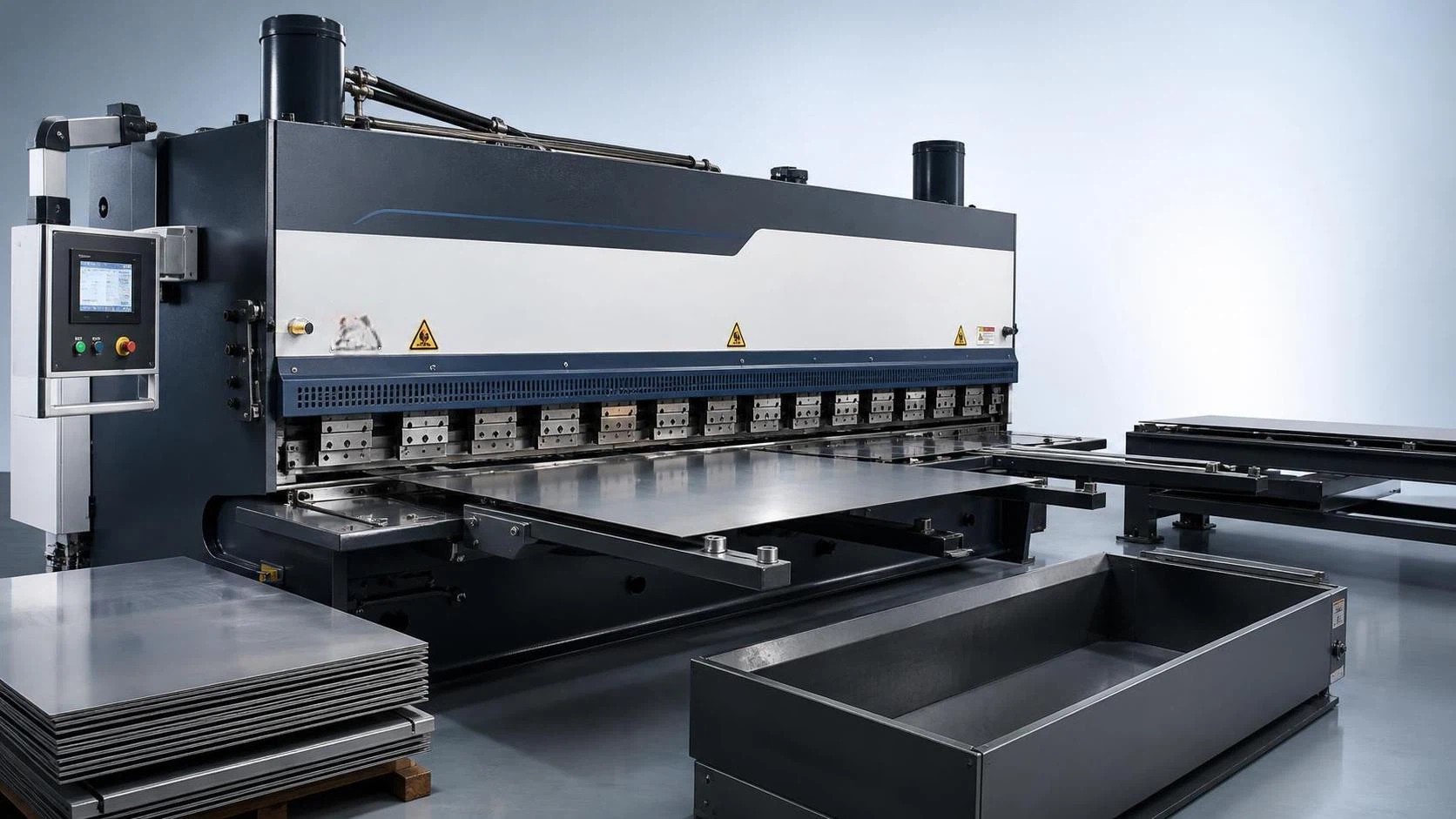
Selecting a guillotine shear hydraulic metal sheet cutting machine for OEM production starts with the cut itself: whether the machine can hold a stable shearing angle, keep blade clearance consistent across the working width, and repeat that condition over long production runs. A low purchase price has little meaning if the machine produces taper, burrs, twist, or edge deformation that later disrupt bending, welding, coating, or assembly. In OEM work, the shear is often an upstream process, so small errors here can multiply through the rest of the line.
The first evaluation point is material range in real production terms, not only the maximum thickness printed in a catalog. A machine that shears mild steel at one thickness may behave very differently when cutting stainless steel, aluminum, coated sheet, or high-strength plate. Sheet width, yield strength, protective film, surface finish requirements, and part geometry all affect the result. If the workload includes thin reflective sheet for visible panels, edge quality and scratch control may matter more than raw tonnage. If the line processes mixed materials in short batches, setup repeatability becomes more important than theoretical maximum capacity.
Cutting Accuracy Must Be Judged at the Edge, Not the Nameplate
A guillotine shear hydraulic metal sheet cutting machine should be assessed for straightness, squareness, dimensional repeatability, and edge condition under realistic loading. Test pieces should include narrow strips, full-width sheets, and short blanks cut near both sides of the machine. Some machines hold tolerance well in the center but drift near the ends because of frame deflection, guide wear, or uneven blade gap. Measuring only one sample can hide this problem.
Edge inspection should go beyond visual appearance. Look for burr height, rollover, fracture zone proportion, and any sign of localized tearing. Thin sheet may show wave or twist after cutting if hold-down force is uneven. Thicker material may reveal inconsistent fracture lines if the rake angle and blade clearance are poorly matched. In applications where blanks go directly to CNC bending, even a modest burr can affect gauge seating, bend line location, and finished angle consistency.
Blade geometry also needs attention. Ask whether the blade has multiple usable edges, what material and heat treatment are used, and how blade regrinding affects the machine’s ability to maintain clearance. Reground blades can save cost, but repeated grinding changes blade height and may require shimming or recalibration. If the machine structure does not support precise repositioning after maintenance, nominal blade quality will not translate into stable production.
Hydraulic Stability Is a Production Issue, Not a Specification Detail
The hydraulic system governs ram motion, hold-down action, and overall cut consistency. Evaluation should include start-up behavior, oil temperature sensitivity, pressure stability during repeated cycles, and the smoothness of the return stroke. A machine may cut acceptably when cold and empty, then change behavior after prolonged operation. Pressure fluctuation can show up as variable edge quality, inconsistent cut line, or abnormal noise during the stroke.
Pay attention to the hydraulic layout and service access. The location of valves, filtration units, seals, hoses, and pressure adjustment points affects maintenance time and contamination control. Poor routing can complicate inspection and increase the chance of leaks near electrical components or the work zone. It is also worth asking whether standard hydraulic components are used or whether replacements depend on highly specific parts with long lead times.
In many sheet metal workshops, ambient temperature and duty cycle change across shifts. If the machine will run with frequent short jobs, pressure recovery between strokes matters. If it will process long strips in repeated cycles, oil cooling and reservoir design may become relevant. A stable hydraulic system should support consistent shearing force without forcing excessive operator correction or slowing the line to preserve quality.
Backgauge Performance Often Determines Real Throughput
Many selection errors come from focusing on the cutting beam while overlooking the backgauge. In OEM production, blank size repeatability is often limited by the gauge system rather than the blade. The critical points are travel range, positioning accuracy, return speed, resistance to vibration, and whether the gauge fingers remain aligned during continuous motion. A fast but unstable gauge can produce alternating long and short parts, especially in thin sheet.
Controller behavior matters here. The interface should allow practical programming of repeat cuts, stepped dimensions, and job recall without excessive manual input. A control system that looks advanced but slows editing on the shop floor creates hidden inefficiency. Evaluate whether dimension entry, correction, and sequence changes can be done quickly and whether the display gives clear position feedback. If optional functions are offered, confirm which are standard and which require extra integration.
Support equipment around the gauge deserves the same scrutiny. Sheet support arms, front squaring arms, ball transfers, and rear discharge arrangements influence whether large sheets can be positioned without drag or skew. A good shear can still produce poor parts if the sheet is not supported properly before the cut.
Frame Rigidity and Mechanical Alignment Decide Long-Term Behavior
Machine rigidity is easy to underestimate because it is harder to describe than motor power or hydraulic pressure. Yet frame deflection affects blade gap uniformity, cut straightness, and wear rate. Welded structure, stress relief process, guide rail quality, and ram support design all contribute to whether the machine stays aligned after continuous use. If the shear will process wide sheets near the upper range of its capacity, rigidity becomes even more important.
Inspection should include the adjustment mechanism for blade clearance and the accessibility of alignment points. A machine that allows precise correction is easier to keep in production than one that requires extensive teardown for basic setup. Ask how often alignment usually needs to be checked under typical duty, what indicators are used during calibration, and whether maintenance records can trace changes in blade gap over time.
It is useful to compare this with adjacent forming equipment in the same production environment. For example, where a line also includes head or shell preparation equipment such as Dish end forming machine, attention is usually given to roll hardness, bearing support, hydraulic guidance, and displacement readout because those features directly affect repeatability. The same mindset should be applied to the shear: structural and motion-control details matter more than broad performance claims.
Material Handling Conditions Change the Evaluation Result
A guillotine shear hydraulic metal sheet cutting machine should be judged in the context of how sheets arrive and leave the machine. Packed sheets with oil film, plates with mill scale, protective-coated material, or blanks transferred by crane each create different risks. Surface marking from hold-down devices may be unacceptable on decorative stainless or pre-painted sheet. Heavy plates may need side support or lifting assistance to prevent unsafe loading and corner damage.
If cut parts move directly to welding or rolling, layout space around the shear should support smooth transfer. Congested discharge areas often lead to stacking damage or accidental part mixing. Where part traceability matters, confirm whether the workflow allows clear separation of different job numbers during short-batch production. A technically capable machine can still create downstream confusion if handling logistics are ignored at the evaluation stage.
Common Misjudgments During Selection
- Assuming maximum thickness equals suitable production thickness. Continuous work near the upper limit may accelerate wear, reduce cut quality, and slow cycle rhythm.
- Accepting a clean cut on one material as proof of broad capability. Stainless sheet, coated steel, and aluminum can react very differently under the same blade setting.
- Looking at controller functions without verifying operator workflow. Deep menus and unclear alarms often become a recurring production delay.
- Ignoring blade consumable planning. Blade life, sharpening interval, spare availability, and reinstallation accuracy all affect real operating cost.
- Focusing on the machine alone while neglecting power supply, foundation flatness, available lifting method, and oil cleanliness during commissioning.
Installation and Commissioning Should Be Part of the Technical Review
Transport dimensions, lifting points, and packaging method matter before the machine reaches the workshop. Large shears may require route planning through doors, floor loading checks, and crane coordination. Damage during unloading can alter alignment even if the exterior looks acceptable. Once on site, foundation condition should be confirmed because frame twist from an uneven floor can affect blade clearance and gauge accuracy.
Commissioning should verify more than basic movement. Blade gap setting, hold-down pressure, backgauge parallelism, squareness arm alignment, and emergency stop response should all be checked before the machine is released to production. Test cuts should include the actual material family used on the line, not only generic sheet from a demonstration bundle. When mixed-material production is expected, record the settings used for each grade and thickness so later troubleshooting starts from known values.
Maintenance Access Predicts Downtime Better Than Warranty Language
Routine service points should be visible and reachable. Daily cleaning around the blade area, lubrication of guides, hydraulic oil inspection, filter replacement, and gauge drive maintenance should not require unnecessary disassembly. Compact design is useful only if it does not hide the components that need regular attention. Limited access tends to delay small maintenance tasks until they become production problems.
Spare parts planning should cover blades, seals, relays, limit switches, hydraulic hoses, and gauge drive elements. Also review the machine documentation quality. Wiring diagrams, hydraulic schematics, parameter backup procedures, and adjustment instructions are part of the equipment value. If troubleshooting depends too heavily on one external technician, recovery time after failure may become unpredictable.
Production Matching Is Better Than Oversizing
A larger machine is not automatically the safer choice. Oversized shears can consume more floor space, require heavier handling arrangements, and perform poorly on thin material if hold-down distribution and blade setup are not optimized for lighter gauges. Selection should follow the dominant production window: typical sheet thickness, common width, batch pattern, target edge quality, and required daily rhythm. Reserve capacity has value, but it should not compromise the material range used most often.
When comparing offers, place the machine into a full process sequence. Consider whether the cut blank goes to punching, bending, welding, rolling, or end-forming operations; whether edge condition affects fit-up; and whether dimensional variation creates repeated adjustment elsewhere. A shear that simplifies downstream work can be technically stronger than one with a higher nominal rating but poorer cut consistency. That is usually where the real selection decision is made.
search
Products Navigation
Send Us A Message