




Guillotine Shearing Machines Explained: Which Industries and Materials Fit Best?
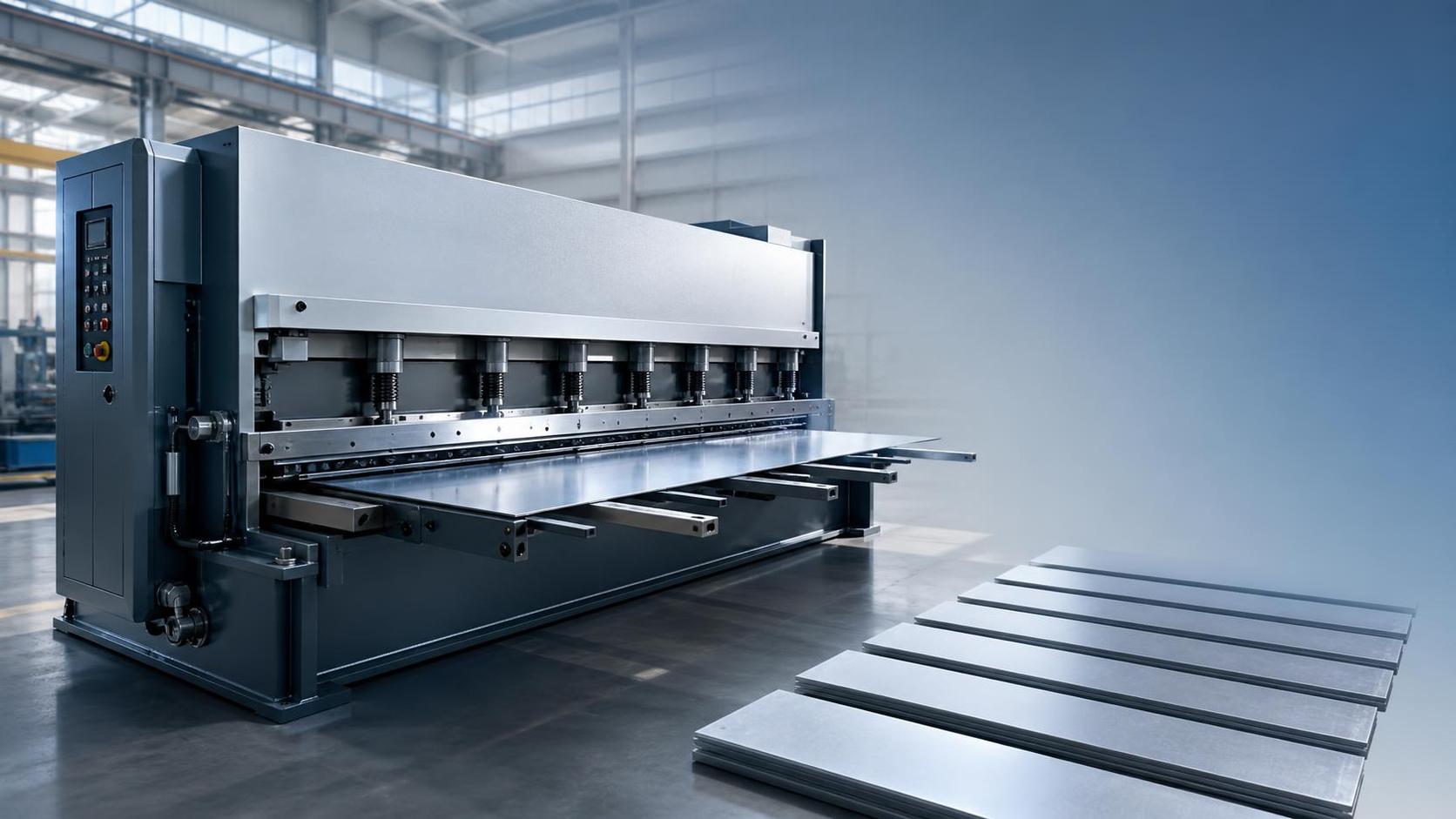
Guillotine shearing machines sit in a very practical corner of metal fabrication. They are not the most flexible cutting technology on the shop floor, and they are not the answer to every profile or thickness range. But when the job is straight-line cutting of sheet or plate at volume, they remain one of the most efficient and economical solutions available. For anyone researching the category, the key question is less “what is a guillotine shear?” and more “where does it make operational sense, and where does it not?”
The answer depends on two variables that shape almost every purchasing decision: the material being processed and the production environment in which the machine will run. A shear that performs well in a light-gauge HVAC workshop may be completely unsuitable for a heavy fabrication plant cutting thick carbon steel plate. Likewise, a machine that delivers acceptable results on mild steel may struggle to maintain edge quality on stainless or aluminum if setup, blade condition, and hold-down control are not matched to the material.
Why guillotine shearing machines still matter
In many factories, straight cutting is still a high-frequency task. Blanks need to be prepared before bending, welding, rolling, stamping, or further CNC processing. If most cuts are linear and repeatable, guillotine shearing machines often provide a lower cost per part than thermal cutting methods. They are also faster in many routine applications, produce no heat-affected zone, and avoid some of the secondary cleanup associated with other cutting methods.
That matters in businesses where throughput and material utilization are closely watched: sheet metal subcontracting, electrical cabinet production, appliance manufacturing, steel service centers, trailer and container fabrication, agricultural equipment, and general fabrication workshops. In these settings, the value of a shear is not novelty. It is consistency, speed, and low running complexity for a narrow but important class of tasks.
From an industry perspective, this is why the equipment category remains relevant even as laser cutting becomes more widespread. Laser systems are excellent for complex geometries, nesting efficiency, and mixed-part production. Guillotine shears remain competitive where cuts are straight, batch sizes are meaningful, and cycle time needs to stay low.
What a guillotine shear does best
A guillotine shear is designed to cut flat material along a straight line using an upper moving blade and a lower fixed blade. The process sounds simple, but production results depend on several machine-side factors: frame rigidity, blade geometry, clearance adjustment, backgauge accuracy, hold-down pressure, and the consistency of sheet support.
Its best-fit tasks usually include:
- cutting rectangular blanks from sheet or plate;
- trimming edges before bending or welding;
- preparing strips for downstream forming;
- high-volume cutting of standard part sizes;
- processing material where thermal distortion is undesirable.
Its limitations are equally important. A guillotine shear is not ideal for intricate contours, internal cutouts, variable-radius forms, or jobs where part geometry changes constantly. It is also not always the right choice for very thick plate, especially when downstream edge preparation requirements are strict.
Which industries are the strongest fit
The best industries for guillotine shearing machines are those where straight cuts are routine and where material preparation is a production bottleneck rather than a design challenge.
Sheet metal fabrication
This is the most obvious fit. Contract fabricators and in-house metalworking shops use shears for preparing blanks before press brake forming, punching, welding, or assembly. In shops serving construction products, cabinets, enclosures, racks, panels, and light industrial components, a guillotine shear often handles the repetitive work faster than more complex cutting equipment.
HVAC and duct manufacturing
HVAC production typically involves light- to medium-gauge galvanized steel, stainless, or aluminum sheets. Straight-line cuts dominate many workflows, so guillotine shears are a natural choice. Speed and ease of operation are often more important here than cutting versatility.
Electrical enclosures and control cabinets
Manufacturers of enclosures and switch cabinets need clean blanks with predictable dimensions. When part designs are standardized, a shear helps reduce cycle time and operator intervention. Surface condition also matters in this sector, especially before coating or finishing, so correct blade setup is essential.
Appliance and furniture manufacturing
Appliance panels, shelving, lockers, office furniture, and storage systems frequently start from flat blanks. Where the production mix includes many repeated panel sizes, guillotine shearing machines can support efficient batch processing.
Automotive suppliers and trailer fabrication
Not every automotive component is suited to shearing, but supplier tiers making brackets, covers, reinforcements, or simple formed parts may use shears for blank preparation. Trailer and transport equipment manufacturers also benefit when cutting long straight sections from carbon steel or aluminum sheet.
Steel service centers and distribution processors
For distributors that resell cut-to-size sheet or plate, shearing can be a practical way to handle standard dimensions quickly. In this environment, uptime, repeatability, and blade life often matter more than advanced programmability.
General heavy fabrication
Heavy equipment, structural component, and industrial machinery producers may use shears for plate preparation, but this is where the limits become more visible. As material thickness rises, edge deformation, machine tonnage requirements, and downstream weld-prep demands become more significant. In these applications, the shear may remain useful, but it is often only one step in a larger preparation process.
Material fit: where performance changes most
Material type has a direct effect on cut quality, blade wear, burr formation, and achievable thickness. Two machines with identical nominal capacity can behave differently depending on whether they are cutting low-carbon steel, stainless steel, or aluminum.
Carbon steel
Carbon steel is generally the most common and most forgiving material for guillotine shearing machines. It offers predictable shearing behavior and is widely processed across fabrication industries. For many buyers, machine capacity ratings are based on mild steel, so that published figure should not be assumed to apply equally to other materials.
If a plant mainly cuts carbon steel sheet or plate into rectangular blanks, a guillotine shear is often an excellent fit. This is especially true when the next operations are bending, welding, or rolling.
Stainless steel
Stainless is workable on a shear, but it demands more care. Its higher strength and work-hardening tendencies can increase blade wear and make edge quality more sensitive to blade clearance and sharpness. Surface marking can also become a concern where finish quality matters.
For buyers dealing with food equipment, architectural panels, or stainless enclosures, it is not enough to confirm that the machine “can cut stainless.” The real issue is whether it can do so repeatedly at the required thickness and finish level without causing unacceptable burr, twist, or edge strain.
Aluminum
Aluminum can shear very well, especially in thinner gauges, but its softness introduces a different set of challenges. Poor clamping or worn blades may lead to edge deformation, marking, or less stable cut quality. Aluminum processors also need to watch for handling damage, since cosmetic requirements are often stricter than in heavy steel fabrication.
In sectors such as transportation panels, light enclosures, and HVAC, guillotine shearing machines remain practical for aluminum, provided the machine setup is tuned for the alloy and thickness range being processed.
Galvanized and coated sheet
These materials are common in building products and ductwork. Shearing is often preferred because it is fast and avoids thermal effects, but coating damage and edge quality still need to be monitored. Shops that process pre-painted or coated material usually care as much about avoiding surface marks as about dimensional accuracy.
Thickness matters more than many first-time buyers expect
One common misunderstanding is to think of guillotine shearing machines as universally scalable: if the machine is larger, it will simply handle all thicker work with equal efficiency. In practice, the economics and quality profile change as thickness increases.
For thin to medium sheet, shearing is often highly efficient. As material becomes thicker, three issues grow more important:
- the force required rises sharply;
- cut edge deformation becomes harder to control;
- downstream processes may require edge preparation anyway.
That last point is especially relevant in weld-intensive industries. If thick plate edges must later receive beveling for full-penetration welds, the shear may only be the rough preparation stage. In such cases, additional equipment becomes part of the real process chain. For example, in sectors such as pressure vessels, boilers, shipbuilding, and heavy machinery, straight cutting alone is often not enough. Edge preparation may be handled by a dedicated Pipe Cutting & Beveling Machine or similar beveling system when carbon steel, stainless steel, or aluminum components require weld-ready edges at controlled angles. That kind of equipment addresses a different need from a guillotine shear: not rapid blanking, but precise bevel formation with controlled feed, angle adjustment, and surface finish.
Where guillotine shears are a weak fit
Understanding where not to use a guillotine shear is just as useful as understanding where it excels.
They are a poor match when:
- parts have complex contours or internal features;
- production frequently changes between many unique geometries;
- material thickness is near or beyond practical shear quality limits;
- edge condition must be exceptionally clean for visible surfaces or precision assemblies;
- the downstream process requires shaped bevels rather than square-cut edges.
This does not make the machine obsolete. It simply means that shops with mixed production often use shears alongside laser, plasma, sawing, milling, or beveling equipment rather than expecting one machine to do everything.
How to judge fit in real production terms
For information researchers, one of the most useful ways to evaluate guillotine shearing machines is to ignore broad marketing categories and look at the production pattern instead.
A strong fit usually looks like this:
- high share of straight cuts;
- repeatable blank sizes;
- moderate to high throughput requirements;
- limited need for profile complexity;
- material types within a predictable range;
- downstream operations that accept sheared edges.
A weaker fit usually looks like this:
- low-volume, high-mix job shop work;
- complex nested parts;
- frequent shifts between very different materials and thicknesses;
- strict cosmetic edge requirements without secondary finishing;
- fabrication routes that require beveling or machining after nearly every cut.
That is why two companies in the same broad industry can reach opposite conclusions about the same machine category. A cabinet maker and a shipyard are both metal fabricators, but their cutting logic is fundamentally different.
Common misconceptions in the market
Several misconceptions appear regularly in early-stage equipment research.
The first is that faster cutting automatically means lower cost. It often does, but only when cut quality is stable and secondary rework is limited. A fast shear that creates burrs, twist, or frequent blade-change downtime can lose its cost advantage quickly.
The second is that rated capacity tells the whole story. Capacity figures are often simplified, and actual performance depends on material strength, width, blade condition, and machine rigidity. Buyers should treat headline numbers as a starting point, not a decision point.
The third is that shearing and laser cutting are interchangeable alternatives. In some factories they overlap, but their strengths are different. The more repetitive and linear the task, the more favorable the shear becomes. The more variable and geometry-driven the task, the more likely another cutting process will dominate.
The fourth is that edge quality only matters in appearance-sensitive sectors. In reality, edge condition affects bend consistency, weld preparation, fit-up time, and even handling safety. This is one reason some heavier fabrication lines pair shearing with dedicated edge-prep equipment such as a Pipe Cutting & Beveling Machine when square cuts alone are not enough for production quality.
What to pay attention to when researching the category
Anyone trying to understand guillotine shearing machines at a market level should focus on a few practical questions.
How standardized is the production mix? The more stable the part sizes, the stronger the economic case.
What materials dominate the workload? Carbon steel, stainless, and aluminum each shift the machine requirement in different ways.
How important is downstream edge condition? If welding, coating, or cosmetic finishing is sensitive, the cut result matters more than nominal speed.
Is the machine being considered as a standalone solution or as one station in a larger line? In modern fabrication, that distinction matters. A shear may be highly effective in a process chain without being the final-form cutting solution.
For many industries, guillotine shearing machines remain a very rational investment—not because they are universal, but because they are specialized in exactly the kind of work many factories still do every day. Their best applications are straightforward: flat material, straight cuts, repeatable output, and cost-sensitive production. Once materials become harder, parts become more complex, or edges need further shaping, the decision becomes less about whether the shear works and more about how it fits into the broader manufacturing route.
search
Products Navigation
Send Us A Message