




How to Tell if a Welding Robot Is Right for Stainless Steel Welding
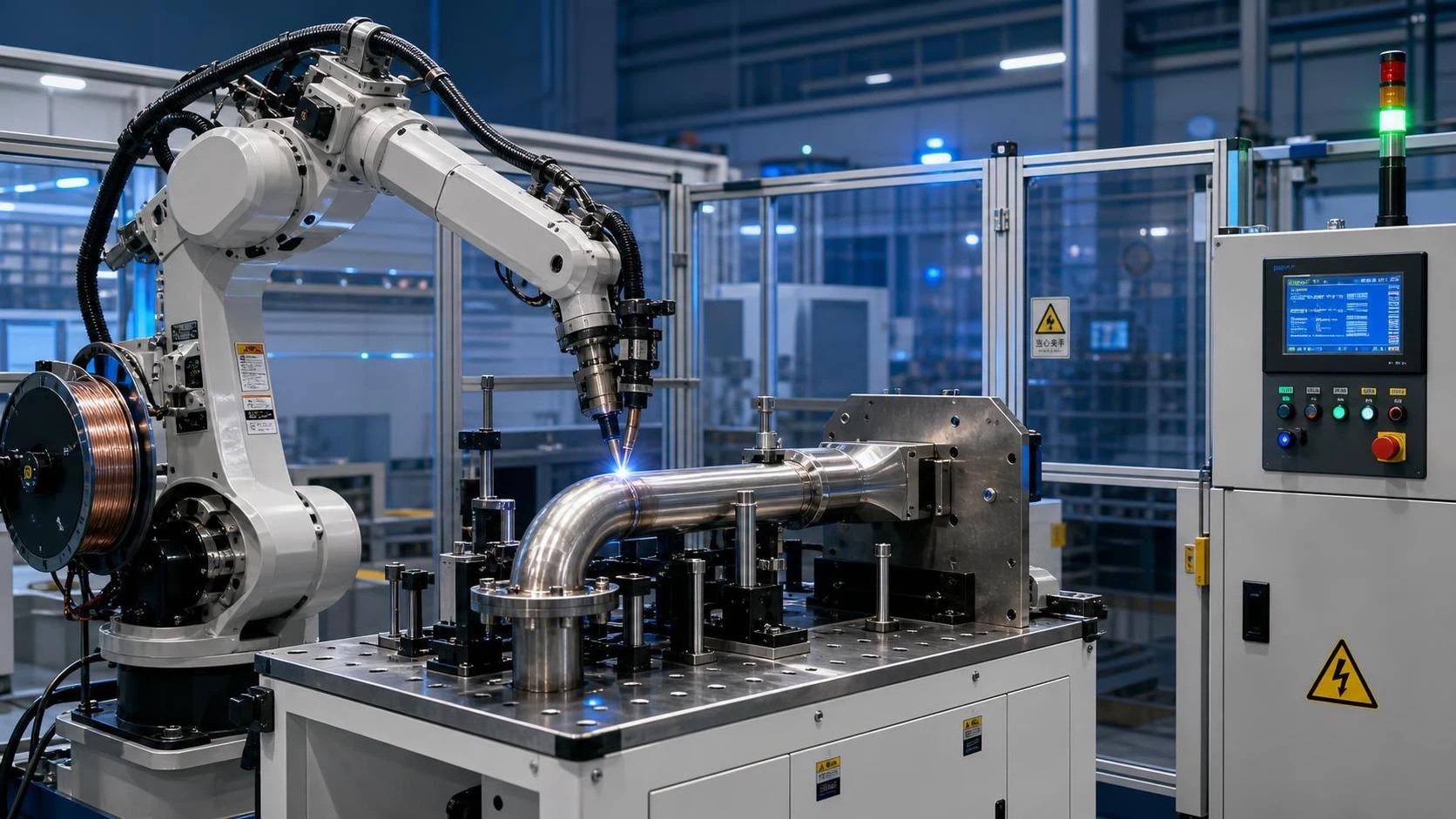
How to Tell if a Welding Robot Is Right for Stainless Steel Welding
If you’re asking, “How do I know if a welding robot is suitable for welding stainless steel in my plant?”, the answer depends on more than speed alone. Stainless steel welding demands stable arc behavior, tight repeatability, controlled heat input, and a finish that does not create unnecessary downstream rework. In many factories, the real question is not whether a robot can weld stainless steel at all, but whether it can do it consistently on your parts, with your joint design, your fit-up variation, and your production rhythm.
That distinction matters. Stainless steel is less forgiving than mild steel in several practical ways. Heat tint, distortion, spatter, inconsistent penetration, and contamination can quickly turn a promising automation project into a quality problem. A robot that performs well on carbon steel frames may still struggle on stainless assemblies if the torch package, control system, welding process, or fixture strategy is not right.
For manufacturers evaluating automated welding equipment, a useful starting point is this: a suitable robot for stainless steel should improve consistency without creating new bottlenecks in preparation, programming, cleaning, or inspection.
The material itself changes the automation equation
Stainless steel is widely used because of its corrosion resistance, clean appearance, and performance in food processing, medical, chemical, architectural, and fabrication applications. But those same expectations raise the bar for welding quality. Surface discoloration may be acceptable on some industrial parts and completely unacceptable on visible or sanitary components. A small amount of distortion may be manageable on heavy sections and a serious issue on thin sheet or tube.
So when judging robot suitability, start with the weld quality standard your plant actually has to meet. Are you producing structural supports, decorative components, pressure-related fabrications, process piping, or sheet metal enclosures? The answer influences process choice, torch access, seam tracking requirements, and even whether robotic welding is the right first automation step.
In practice, stainless steel automation tends to succeed where part geometry is repeatable, joint access is predictable, and fit-up is controlled upstream. If incoming parts vary too much, even a high-quality robot cell will spend its life compensating for inconsistent fabrication.
What a suitable welding robot should be able to do
A robot for stainless steel does not need to be marketed as “special stainless equipment” to be effective. What matters is the total system capability. The robot arm, welding power source, wire feed stability, torch package, motion control, fixture design, and programming method all affect results.
Look closely at repeatability. Stainless steel welding often benefits from steady travel speed and consistent torch angle, especially where appearance matters. If bead shape changes from one shift to another, the issue is rarely just the operator; it is often a combination of arc instability, poor part positioning, or insufficient control of the weld path. A capable robot helps eliminate that variation.
Arc stability is another indicator. Stainless steel is commonly welded with MIG, TIG, or pulsed processes depending on thickness, finish requirements, and productivity targets. Not every robotic setup handles these equally well. If your application needs low spatter and controlled heat input, you may need a power source and software package designed for pulse welding or more refined parameter control. That is not a luxury feature; it can determine whether post-weld cleaning becomes manageable or expensive.
Torch access sounds basic, but it rules out more projects than many buyers expect. Stainless tanks, frames, cabinets, manifolds, and tube assemblies often include corners, internal seams, or multi-pass joints that are awkward for a robot wrist. A robot may be technically accurate and still be the wrong fit if it cannot approach the joint at the proper angle without collision or excessive repositioning.
Questions to ask inside your own plant before comparing machines
Before focusing on robot brand or model, review your own production conditions. A welding robot is only as good as the process environment around it.
- Are your stainless parts consistent in dimension and fit-up?
- Do you weld mostly thin material, medium sections, or mixed thicknesses?
- Is bead appearance as important as penetration and throughput?
- Will the robot handle short-run product changes or long production batches?
- Can fixtures hold parts securely without introducing distortion or contamination?
- Do you have enough upstream process discipline to keep the cell running?
If these answers are unclear, the safest path is usually a weldability and automation review rather than a direct equipment purchase decision. Many unsuccessful automation projects come from trying to solve fixture, design, or process variation with a more advanced robot.
Signs that a robot is probably a good fit
There are a few patterns that usually point toward robotic suitability for stainless steel welding.
One is repetitive production. If the same or similar assemblies move through the line regularly, the value of repeatable weld paths becomes obvious. Another is labor pressure. Stainless welding often requires experienced welders, and shops may want to reserve those skills for complex joints, prototypes, or final quality work rather than repetitive seam welding.
You should also look at rework patterns. If defects are caused less by design and more by inconsistency in torch angle, travel speed, start-stop quality, or operator fatigue, a robot may address the root problem. In that case, the machine is not replacing judgment; it is stabilizing execution.
A suitable system also integrates with your plant layout and workflow. That means realistic loading and unloading, clear maintenance access, compatible electrical and gas supply, and programming support your team can actually use. A technically impressive cell that sits idle because changeovers take too long is not suitable in any meaningful sense.
Red flags that should slow the decision down
Some stainless projects are poor candidates for automation, at least at the current stage of process maturity. Very low volumes with frequent design changes can make programming and fixturing costs hard to justify. Parts with highly variable gaps or inconsistent tack-up may require seam finding or adaptive control beyond what a standard cell can handle efficiently.
Another warning sign is when the required weld appearance approaches hand-finished cosmetic standards, but the upstream cutting, forming, and assembly quality is still rough. The robot will repeat the path faithfully; it will not hide poor fit-up. In stainless work, that often means the cell exposes variation more clearly rather than solving it.
Material handling can also be underestimated. A robot may weld well, but if stainless parts must be protected from scratching, iron contamination, or mixed-material contact, the surrounding cell design becomes part of the decision. Tooling material, cleaning discipline, and separation from carbon steel work areas may matter as much as the robot itself.
The process package matters more than the robot brochure
When buyers compare options, they often start with payload, reach, and motion accuracy. Those are important, but stainless steel results usually depend more on the full welding package. The power source should support the process mode your application needs. The torch and cable routing should remain stable through the robot’s motion envelope. Consumable selection, shielding gas control, and parameter windows all deserve attention during evaluation.
This is where an experienced equipment supplier can add real value, especially one already working across welding equipment, CNC machinery, cutting systems, and fabrication lines. Wuxi Samgins International Trade Co., Ltd., based in Wuxi City in Jiangsu Province and established in 2012, operates in exactly that broader machinery environment. A company with exposure to welding robots, automatic welding equipment, CNC cutting machines, laser cutting systems, and sheet metal processing equipment is often better positioned to discuss whether the robot fits the whole production chain rather than only the welding station in isolation.
That wider view matters because stainless welding quality often begins before the arc starts. Cutting accuracy, edge condition, forming consistency, and deburring can all affect robotic success. If a supplier understands those linked processes and works under structured quality requirements such as ISO9001-based organization and CE-oriented design practices where applicable, the conversation tends to become more practical and less promotional.
A simple way to evaluate suitability
If you need a working decision framework, evaluate the project across five points:
If most of these areas are under control, a welding robot is far more likely to be a sound investment for stainless steel work. If several remain uncertain, those gaps should be addressed before final equipment selection.
What to confirm before moving ahead
Ask for a discussion grounded in your actual parts, not only machine specifications. Joint drawings, material grades, thickness range, target cycle time, expected weld appearance, and fixture concept should all be reviewed together. If export markets are involved, confirm any required electrical, safety, or conformity expectations early, especially where CE-related compliance or local installation standards may apply.
It is also worth checking how the robotic cell fits into the rest of your fabrication process. A company like Wuxi Samgins, which works across welding, cutting, forming, and machine tool categories and serves multiple overseas markets, is generally in a better position to discuss those interdependencies than a seller focused on a single machine alone. That does not remove the need for project-specific verification, but it often leads to better questions and fewer assumptions.
In the end, the right welding robot for stainless steel is the one that matches your part stability, weld quality target, process discipline, and production mix. If a proposed system can hold arc consistency, control heat input, reach the joint properly, and fit your workflow without adding constant manual correction, it is probably worth serious consideration. If it relies on perfect parts in a plant that does not produce perfect parts yet, the smarter move may be to fix the process first and automate second.
search
Products Navigation
Send Us A Message