




Robotic Arms and Robotics: ROI Calculation Framework for Integrating Articulated Arms into Medium-Volume Structural Steel Welding Lines
ROI Isn’t Just About Payback — It’s About Line Behavior
When manufacturing leaders in structural steel fabrication begin evaluating robotic arms and robotics for medium-volume welding lines, they often start with a spreadsheet. Labor cost per hour. Welding time reduction. Machine uptime. But those numbers rarely capture what actually happens on the shop floor when an articulated arm joins a line that handles H-beams, trusses, or custom frames at 30–120 units/week.
Medium volume sits in a tricky middle ground: too high for full manual flexibility, too low for the rigid throughput of high-mix, high-volume automotive-style cells. That means ROI isn’t just about cutting labor costs — it’s about whether the system stabilizes weld quality across shifts, adapts to part variation without reprogramming downtime, and avoids becoming a bottleneck during peak demand.
Three Real-World Cost Drivers Most Models Ignore
Standard ROI calculators treat robotic arms and robotics as plug-and-play hardware. They assume consistent part geometry, stable fixturing, and uninterrupted power/data infrastructure. In practice, three hidden cost drivers dominate real-world integration:
1. Re-work due to seam misalignment
Structural steel parts rarely arrive with perfect edge prep or identical fit-up. A robot without real-time arc tracking will follow nominal paths — and deposit weld metal where the joint isn’t. That leads to grinding, re-welding, and QA hold-ups. The cost isn’t in the robot’s hourly rate — it’s in the 15–25 minutes per joint spent verifying, correcting, and re-running.
2. Programming latency between jobs
Medium-volume shops switch between job families weekly — say, from column bases to crane rails. If each new part requires hours of offline programming, path verification, and teach-point adjustments, automation becomes a scheduling constraint, not an enabler. The true cost is lost capacity, not software license fees.
3. Floor-space-induced workflow friction
A robot that needs 14 meters of linear footprint doesn’t just occupy space — it reshapes material flow. If the cell forces cranes to detour, or blocks access to adjacent saws or drills, throughput gains vanish behind logistical drag. That’s not captured in a CapEx vs. OpEx model.
A Practical Framework: Four Layers of ROI Assessment
Based on over a decade of supporting structural steel fabricators across Southeast Asia, Europe, and the Americas, Wuxi Samgins has refined a four-layer framework used internally to scope integrations. It’s built around constraints, not assumptions.
Layer 1: Throughput Consistency (Not Just Speed)
Ask: “What’s the longest cycle time we’ve seen on this part family — including loading, alignment, weld, inspection, and unloading?” Then compare it to the robot’s theoretical cycle. If the gap exceeds 18%, investigate why — usually fixturing repeatability or thermal distortion management, not robot speed. This layer reveals whether automation will smooth output or just shift bottlenecks.
Layer 2: Parameter Stability Across Shifts
Weld quality variance between shifts is rarely about operator skill — it’s about inconsistent gas flow, wire feed tension, or torch angle drift. A robot with closed-loop arc tracking and automatic seam recognition reduces that variance. But only if its control system integrates with your existing MIG power sources and shielding gas regulators. Don’t assume compatibility — verify signal interfaces early.
Layer 3: Part Handling Realism
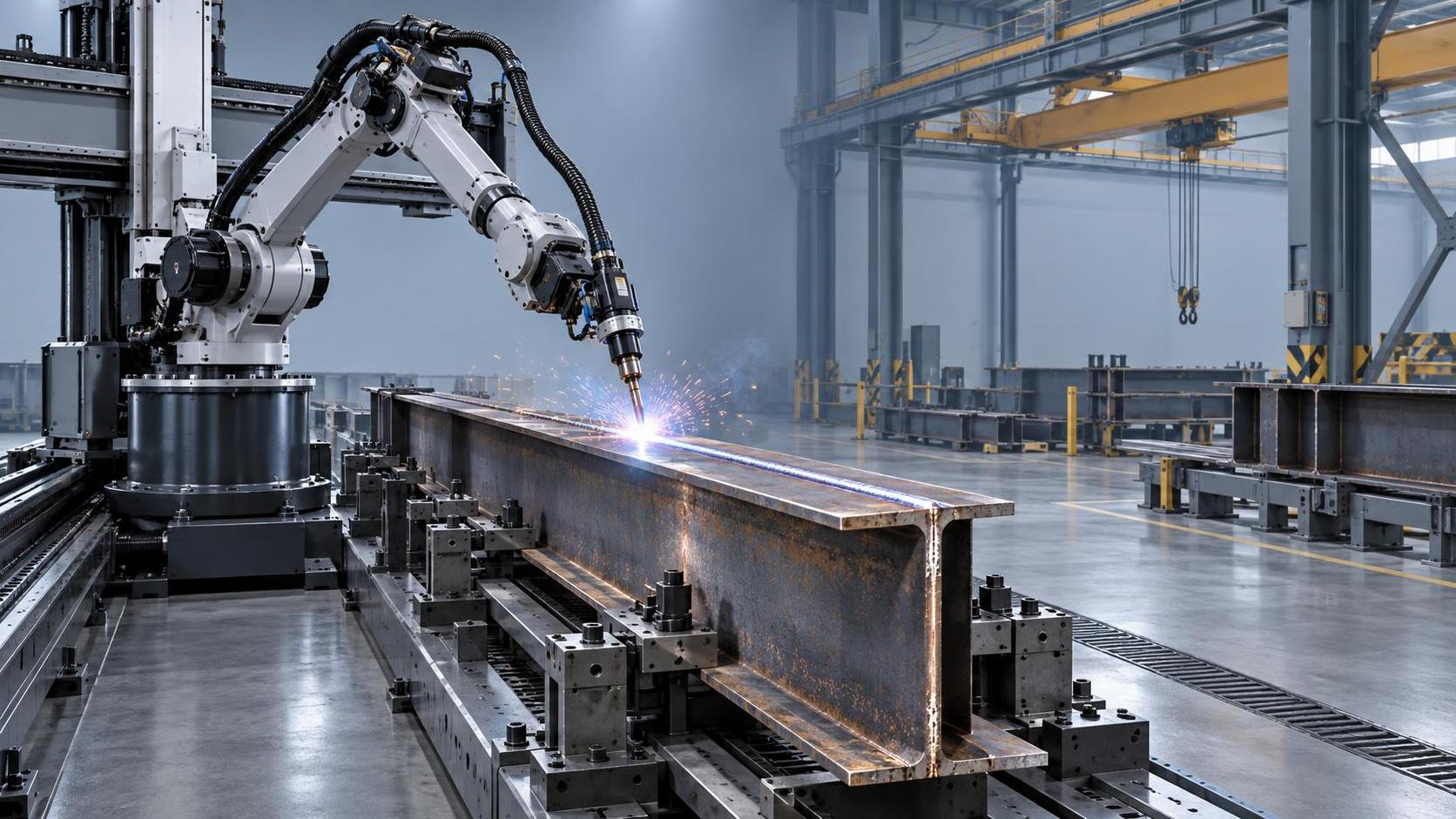
For large steel workpieces — especially those exceeding 8 meters — handling isn’t an afterthought. It’s the first gate. Can your overhead hoist position a 3-ton beam within ±1.5 mm of the programmed origin? Does the robot’s base structure accommodate the required cantilever reach without vibration? These aren’t “nice-to-haves.” They’re prerequisites for repeatable weld placement. That’s why systems like the 9 axis cantilever type welding robot are designed with extended travel and integrated hoist coordination — not just for reach, but for stability under load.
Layer 4: Integration Friction Points
Map every handoff: raw material delivery → pre-fit → fixturing → welding → post-weld handling → QA. Where does the robot insert itself? Does it require new jigs? Does it change crane lift patterns? Does it force operators to walk further? Every added step adds seconds — and seconds compound across hundreds of joints per week. This layer often uncovers more savings in layout optimization than in robot selection itself.
Why Certification Matters More Than You Think
CE and ISO9001 compliance aren’t checkboxes — they’re proxies for design discipline. CE certification requires documented risk assessments for moving parts, emergency stops, and electrical safety. ISO9001 demands traceability from drawing to final weld, including parameter logs and calibration records. For fabricators supplying EU infrastructure projects or North American ASME-certified work, skipping certified hardware means rework before first weld — not after.
Wuxi Samgins designs and tests all automated welding systems — including CNC welding automation platforms — against these standards. Not because it’s required for export paperwork alone, but because the same rigor that satisfies CE also delivers predictable behavior under thermal stress, consistent motion control across ambient temperature swings, and service documentation that matches field conditions.
Next Steps Aren’t About Quotes — They’re About Constraints
Before comparing robot brands or calculating payback periods, clarify three things specific to your line:
- What’s the largest part you’ll weld in the next 18 months — length, width, height, and weight?
- How much variation do you see in joint gap and bevel angle across a typical batch?
- Where does your current biggest throughput delay occur — loading, welding, cooling, or inspection?
Those answers determine whether a 9-axis cantilever system makes sense — or whether a simpler gantry-based solution with stronger seam-following logic fits better. They also define what “customized” really means: not just longer rails, but calibrated torque profiles for heavy-section welding, or interface protocols for your existing MES.
Wuxi Samgins has supported structural steel fabricators since 2012 — not with one-size-fits-all automation, but with equipment selected and adapted for how steel behaves, how people move, and how schedules compress. If your evaluation hinges on procurement and cost, start there — not with robot specs, but with your next five production orders.
search
Products Navigation
Send Us A Message