




Steel Plate Handling Robot Design Considerations: Vacuum Cup Suction vs. Electromagnetic Grippers for 10–50 mm Thick Hot-Rolled Plates
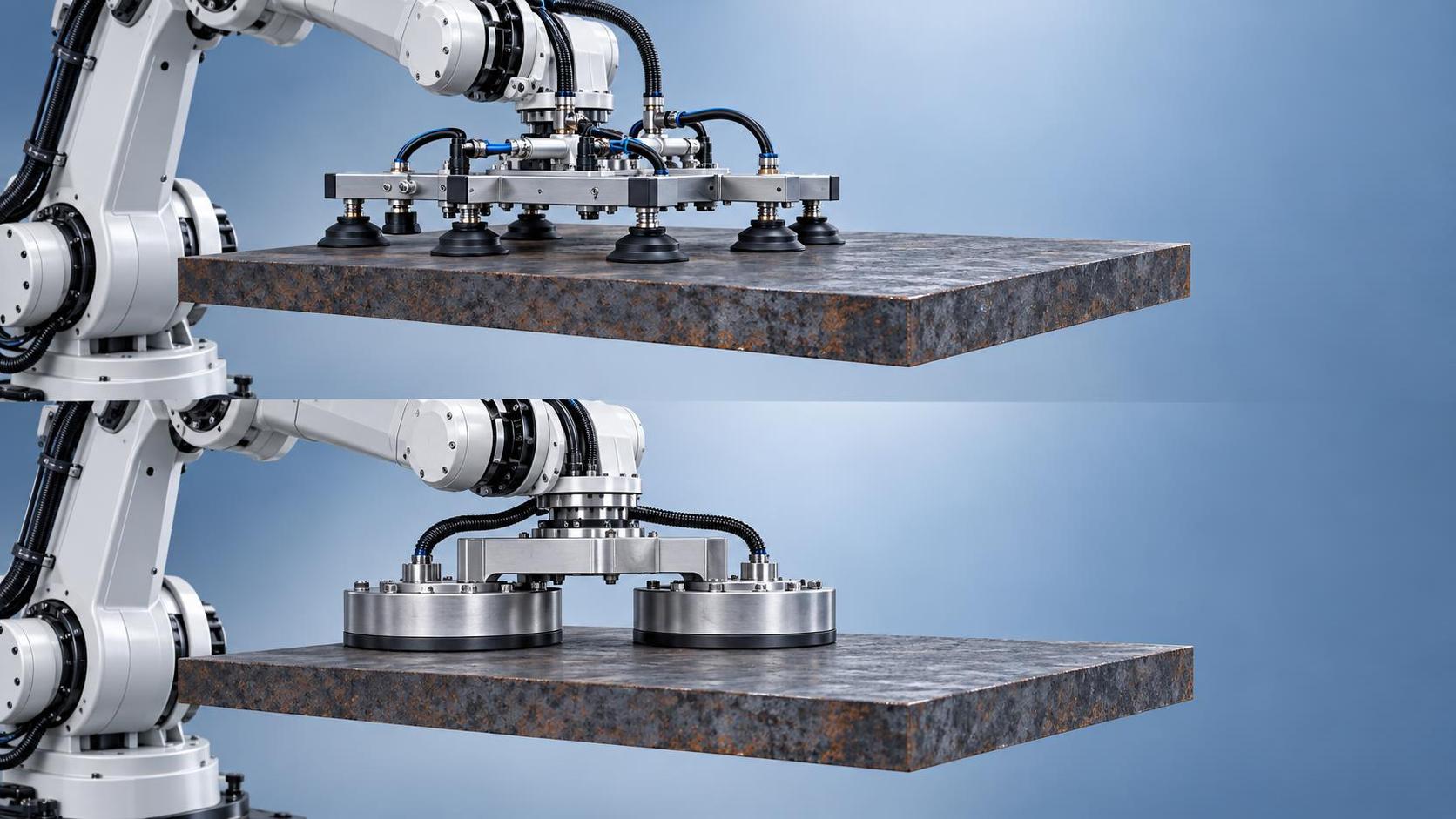
Selecting the optimal end-effector for a steel plate handling robot is not a matter of preference—it’s a functional necessity when automating transfer of 10–50 mm hot-rolled carbon steel plates. These thicknesses present unique mechanical and thermal behaviors that directly challenge vacuum cup suction and electromagnetic grippers in distinct ways. Surface oxide scale, mill-induced curvature, residual thermal gradients from rolling, and minor dimensional variation across batch lots all interact with gripping physics—not abstractly, but in real-time motion cycles where failure means dropped loads, misaligned positioning, or compromised weld preparation upstream.
Vacuum Cup Suction: Strengths and Critical Limitations
Vacuum-based systems rely on surface seal integrity and atmospheric pressure differential to generate holding force. For plates under 20 mm thick with consistent flatness and minimal scale, high-capacity multi-cup arrays can deliver adequate retention—especially if plates are cooled below 150°C before handling. However, hot-rolled plates in the 30–50 mm range often retain subsurface heat longer than surface temperature suggests; localized thermal expansion at cup contact points disrupts seal continuity, causing gradual pressure decay. More critically, mill-scale morphology varies significantly across plate surfaces: heavy, flaky oxide layers prevent uniform cup adhesion, while tightly bonded scale may fracture under shear during acceleration, creating micro-leaks that go undetected until mid-cycle slippage occurs.
Another constraint emerges in high-precision workflows. Vacuum systems require stable, predictable plate orientation prior to lift-off. If the plate exhibits even 1–2 mm of crown or edge wave—common in hot-rolled stock—the cups engage unevenly, inducing torsional load on the robot arm. This compromises repeatability in downstream operations such as edge milling or robotic welding alignment, where positional accuracy must remain within ±0.15 mm over repeated cycles.
Electromagnetic Grippers: Magnetic Circuit Integrity Dictates Performance
Electromagnetic end-effectors generate holding force through induced eddy currents and magnetic flux closure in ferromagnetic material. Their advantage lies in insensitivity to surface condition—scale, rust, or light oil film do not impede grip—as long as the plate’s permeability and saturation threshold support full flux linkage. For plates between 25–45 mm, properly sized electromagnets (typically 180–250 mm diameter units) achieve secure engagement without pre-conditioning.
Yet performance degrades predictably outside narrow boundaries. Below 15 mm thickness, insufficient cross-sectional area limits magnetic circuit closure, reducing effective holding force by up to 40% compared to rated capacity. Above 45 mm, thermal lag becomes problematic: plates exiting the hot-rolling line may exceed 400°C at core while surface reads <200°C. At these temperatures, the Curie point of common structural steels (≈760°C for A36, ≈730°C for S355) remains distant—but localized heating near weld seams or flame-cut edges can locally reduce permeability, weakening grip without triggering system alarms. Electromagnets also introduce inertial challenges: de-energization must be sequenced precisely with deceleration to avoid residual magnetic drag during release, particularly when handling plates with tight tolerances for downstream CNC machining.
Integration Implications for Robotic Systems
Neither technology operates in isolation. The choice cascades into robot kinematics, control architecture, and safety validation. Vacuum systems demand dedicated compressed air lines, filtration, and real-time vacuum monitoring—adding complexity to cell layout and increasing failure modes related to hose routing, condensation, or filter clogging. Electromagnetic grippers require robust power conditioning to maintain stable DC supply during rapid on/off cycling, especially when integrated with high-speed robots like the 6 Axis 1800mm ArmSpan MlG Industrial Welding Robot , whose J6 axis rotates at 426.7°/s. Unfiltered ripple or voltage sag during magnet discharge can induce momentary torque spikes, affecting path accuracy in applications requiring ±0.08 mm repeatability.
Thermal compatibility extends beyond the gripper itself. Hot-rolled plates placed directly onto conveyor-fed workstations may radiate heat upward, raising ambient temperature around robot joints. Standard servo motor enclosures tolerate 0–45°C—but sustained exposure above 38°C accelerates grease degradation in harmonic drives, increasing backlash over time. This is especially relevant when handling 50 mm plates continuously; thermal management must include both gripper selection and surrounding infrastructure design—not just component specs.
Application-Specific Decision Logic
No universal threshold exists, but three operational conditions reliably tip the balance:
- Plate temperature stability: If plates enter the handling zone at ≤100°C with controlled cooling history, vacuum cups become viable—even at 40 mm—provided surface profile is verified via laser scan pre-lift.
- Downstream process tolerance: When feeding plates into automated arc welding cells requiring precise seam registration, electromagnetic grippers minimize repositioning risk caused by micro-slip during acceleration, making them preferable despite higher power demands.
- Maintenance access constraints: In compact H-beam production lines where robot reach overlaps with hydraulic leveling equipment, electromagnetic systems eliminate pneumatic tubing runs, simplifying retrofit and reducing collision hazards.
Crucially, hybrid approaches are rarely practical. Combining vacuum and electromagnetic elements adds weight, increases control complexity, and introduces conflicting failure modes—e.g., vacuum loss during magnet energization creates unpredictable release behavior. Instead, success hinges on matching gripper physics to the dominant variable: thermal state for vacuum, magnetic path continuity for electromagnets—and validating that match against actual plate lot data, not nominal specifications.
Final selection must account for dynamic loading—not static hold ratings. A 45 mm plate accelerating at 0.8 m/s² exerts ~1.2× its static weight on the gripper interface. Both technologies degrade nonlinearly under combined thermal, inertial, and surface-condition stress. Testing must replicate worst-case combinations—not isolated parameters—to avoid field failures rooted in oversimplified lab validation.
search
Products Navigation
Send Us A Message