




Sheet Metal Handling Robot Trends in 2024: AI-Based Vision Guidance Adoption Rates, Modular End-Effector Demand Growth, and OEM Integration Shifts
Sheet Metal Handling Robot Trends in 2024: AI-Based Vision Guidance Adoption Rates, Modular End-Effector Demand Growth, and OEM Integration Shifts
Sep 24, 2026
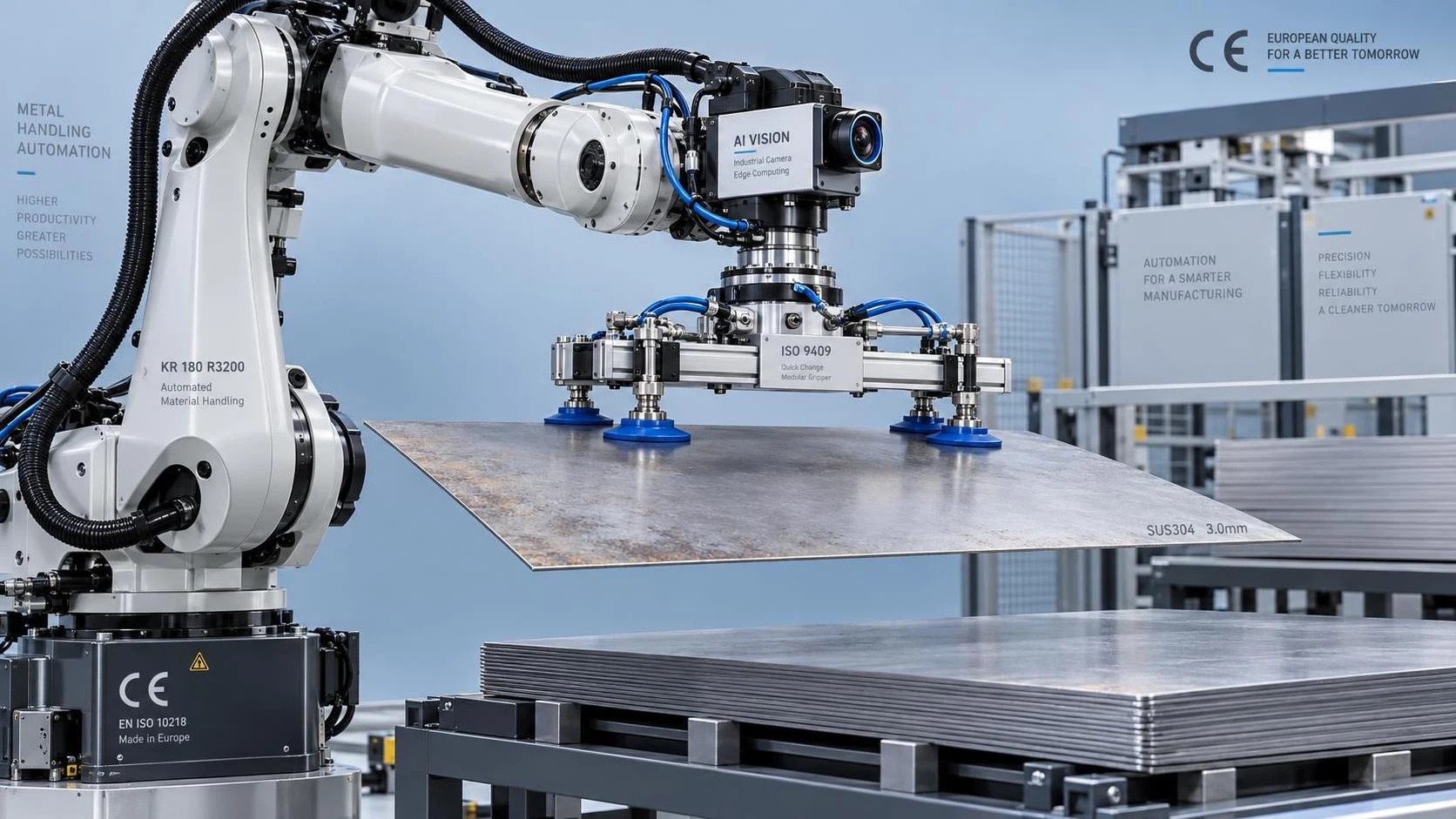
The sheet metal handling robot market in 2024 is not evolving along incremental lines—it is bifurcating. Three interlocking developments are reshaping how evaluators assess automation: AI-based vision guidance adoption is no longer optional for precision-fed workflows; modular end-effectors are shifting from niche customization to baseline procurement criteria; and OEM integration is moving beyond mechanical coupling into real-time data synchronization with upstream fabrication systems. These are not parallel trends—they compound each other. A robot with AI vision but rigid tooling cannot scale across part families. One with modular grippers but legacy control architecture cannot feed process data back to ERP or MES layers. And a system tightly integrated at the OEM level but lacking certified compliance undermines qualification in regulated sectors like pressure vessel manufacturing or structural steel fabrication.
AI-based vision guidance is now embedded—not bolted on—in high-utility deployments. Early adopters used external cameras for coarse part localization, often requiring manual re-teaching after minor fixture shifts. In 2024, vision is fused with motion planning at the controller level: real-time edge detection, thickness-aware pose correction, and thermal distortion compensation during handling are standard in CE-certified platforms deployed across European and North American job shops. What separates functional implementation from marginal utility is not camera resolution, but how vision output feeds directly into path recalibration—within 120ms—and whether that loop remains stable under ambient lighting variance, oil film interference, or surface oxidation common in uncoated mild steel blanks. Systems relying on post-capture offline alignment or requiring dedicated lighting zones fail this threshold. For evaluators, the critical question is not “Does it have AI?” but “Does the vision pipeline operate inside the safety-rated motion controller—and does it retain sub-millimeter repeatability when handling 3-mm-thick stainless sheets at 1.2 m/s?”
Modular end-effector demand reflects a deeper shift: part variability has outpaced traditional fixturing economics. Where once a single vacuum cup array sufficed for flat panels, today’s bending cells must handle nested cut parts, hemmed flanges, and pre-painted surfaces—all within the same cycle. Modular systems now prioritize mechanical interchangeability over electrical complexity: standardized ISO 9409-1-2006 mounting interfaces, pneumatic quick-disconnects with integrated pressure sensing, and torque-limited actuation that prevents damage to delicate edges. Crucially, modularity is no longer about swapping tools between jobs—it’s about dynamic reconfiguration *within* a single handling sequence. A single robot arm may deploy a low-suction gripper for lacquered aluminum, then switch mid-cycle to a high-vacuum array for galvanized steel without stopping the line. This requires not just hardware compatibility, but firmware-level coordination between end-effector I/O and motion trajectory buffers. Evaluators should audit whether tool-change commands execute as deterministic PLC signals—or as asynchronous API calls vulnerable to network latency.
OEM integration has moved past mechanical docking and basic I/O handshaking. The 2024 benchmark is bidirectional, time-stamped data exchange tied to specific machine states: when a CNC press brake completes its last bend, the handling robot receives not just a “ready” signal—but the exact tooling configuration used, material springback coefficient applied, and positional tolerance band for the next operation. This level of convergence demands native support for OPC UA PubSub over TSN—not just gateway translation—and adherence to ISO 9001 traceability requirements for all exchanged parameters. It also means the robot’s motion planner must accept dynamic constraints from the bending machine’s servo tuning profile, adjusting acceleration ramps to avoid resonance in shared structural frames. Systems that require custom middleware layers or proprietary fieldbus extensions introduce validation overhead, delay certification cycles, and increase long-term maintenance cost—especially when upgrading either component independently.
These three trends converge where compliance meets scalability. CE marking alone no longer guarantees interoperability: EN ISO 10218-1 now explicitly references cybersecurity requirements for collaborative functions, and EN 62061 mandates SIL2-rated safety logic for vision-guided motion paths. Similarly, ISO 9001:2015 clause 8.5.2 requires documented evidence that process parameters—including vision calibration frequency, end-effector wear thresholds, and OEM data handshake timeouts—are monitored and controlled. A robot that passes initial CE testing but lacks built-in logging for these variables creates audit exposure downstream. Wuxi Samgins’ approach—embedding ISO 9001-aligned diagnostics into core firmware, validating vision modules against EN ISO 13849-1 PLd requirements, and designing end-effector interfaces to withstand 500,000+ mechanical cycles—reflects this tightening linkage between technical capability and procedural accountability.
The welding manipulator—a core component in integrated sheet metal cells—illustrates how these trends translate into operational resilience. Its Welding manipulator series, for instance, integrates seam tracking feedback directly into the VFD-controlled boom retraction logic, enabling adaptive torch positioning during longitudinal welds on curved H-beam flanges. More critically, its remote control interface exposes real-time data on column rotation torque, cross-slide position deviation, and power supply voltage fluctuation—parameters required for ISO 9001 nonconformance reporting when welding procedure specifications (WPS) mandate ±5% voltage stability. This isn’t feature stacking; it’s architectural alignment with the verification pathways evaluators must document for quality audits.
What matters most for business evaluation is not whether a system checks all three trend boxes—but whether the integration points between them are exposed, testable, and auditable. A robot with AI vision that cannot export calibration logs in CSV format compliant with EN 61508 Part 3 Annex D fails traceability. A modular end-effector system whose firmware update process voids CE certification invalidates operational continuity. An OEM-integrated solution that requires separate vendor approvals for every software patch breaks change management discipline. The 2024 inflection point lies here: technical capability is now inseparable from procedural verifiability. Evaluators who treat these trends as discrete purchasing criteria—vision as a sensor spec, modularity as a hardware option, OEM integration as a connectivity checkbox—will underestimate total cost of ownership. The real differentiator is how cleanly each trend supports documented, repeatable, and inspectable process control across the entire fabrication workflow.
search
Products Navigation
Send Us A Message