




Welding and Welders: How Certification Standards (AWS D1.1, ISO 3834) Impact Hiring, Training, and Project Bid Compliance
Welding and Welders: How Certification Standards (AWS D1.1, ISO 3834) Impact Hiring, Training, and Project Bid Compliance
For project managers overseeing structural steel, heavy fabrication, or infrastructure projects, welding isn’t just a trade—it’s a contractual and technical linchpin. When AWS D1.1 or ISO 3834 appears in bid specifications, it’s not a suggestion. It’s a gatekeeper. And misreading its implications—especially how it reshapes hiring, training investment, and bid viability—can delay schedules, trigger rework, or even disqualify your tender before review begins.
It’s Not About “Certified Welders.” It’s About Traceable, Validated Welding Systems
Many project managers assume compliance starts and ends with pulling a welder’s AWS or ISO certificate from a file. That’s dangerously incomplete. AWS D1.1 (Structural Welding Code – Steel) and ISO 3834 (Quality Requirements for Fusion Welding of Metallic Materials) don’t certify individuals in isolation. They certify *systems*: the documented procedures, qualified personnel, calibrated equipment, controlled environment, and auditable records that collectively produce repeatable, code-compliant welds. That means your “welding and welders” strategy must shift from checking names on certificates to verifying three interdependent layers:- Welder Performance Qualification (WPQ): Proof a specific welder can execute a defined procedure (e.g., SMAW on 25mm carbon steel, 3G position) under your shop’s conditions—and that their qualification is current, unexpired, and covers the exact joint geometry and material thickness in your scope.
- Procedure Qualification Record (PQR) & Welding Procedure Specification (WPS): Evidence that your shop has tested and documented *how* each weld will be made—including preheat, interpass temperature, filler metal, voltage/amperage ranges, travel speed—and that those parameters are actively enforced, not just filed.
- Organizational Capability (ISO 3834 Level 2 or 3): For ISO-governed work, your entire welding operation—not just one crew—must demonstrate systematic control: traceability of consumables, calibration logs for ammeters/voltmeters, NDE personnel certifications, and internal audit records. It’s about institutional discipline, not individual skill.
Hiring Isn’t Just Filling Roles. It’s Matching Credentials to Contractual Scope
A common oversight: hiring a welder certified to AWS D1.1 for plate welding—and then assigning them to pipe girth welds on API 1104 work without additional qualification. AWS D1.1 doesn’t cover pipeline welding; it covers structural steel. Confusing the two isn’t a paperwork gap—it’s a technical mismatch that invalidates the entire weld record. Before posting a job description, ask:- What specific clauses of AWS D1.1 or ISO 3834 are cited in the contract? (e.g., Section 4.2.2 for welder requalification frequency, Annex B for ISO 3834-2 documentation requirements)
- What base materials, thickness ranges, and joint configurations will dominate the work? (A welder qualified on 10mm stainless steel may not be valid for 300mm carbon steel H-beams—even under the same code.)
- Does the scope include automated or robotic welding? If so, AWS D1.1 Article VI requires separate operator qualification—not just welder qualification—and validation of robot path accuracy, torch angle consistency, and seam tracking reliability.
Training ROI Changes When Certification Drives Workflow Design
Traditional “certification training” often treats qualification as a one-time event: send welders to a test lab, pass, return. Under AWS D1.1 and ISO 3834, that model fails. Both standards mandate periodic requalification—AWS D1.1 requires it every 6 months if a welder hasn’t used a process, ISO 3834-2 requires documented evidence of continued competence. More critically, they demand that training be *integrated into production*, not separated from it. High-ROI training for certified compliance looks like this:- Process-Specific Drills: Not generic “welding practice,” but timed, documented runs replicating actual WPS parameters—preheat monitoring, interpass temp checks, arc length control—under supervision, with real-time feedback.
- Non-Destructive Testing (NDT) Literacy: Welders who understand *why* a particular radiograph rejection (e.g., lack of fusion at root) links back to travel speed or electrode angle are far more likely to self-correct than those trained only to “pass the test.”
- Equipment Calibration Awareness: Training that includes how to verify ammeter accuracy, recognize worn contact tips affecting voltage stability, or interpret shielding gas flow meter drift—because AWS D1.1 Section 4.7.2 explicitly requires verification of “measuring and test equipment.”
Bid Compliance Starts Long Before Submission—It Starts With Your Equipment Stack
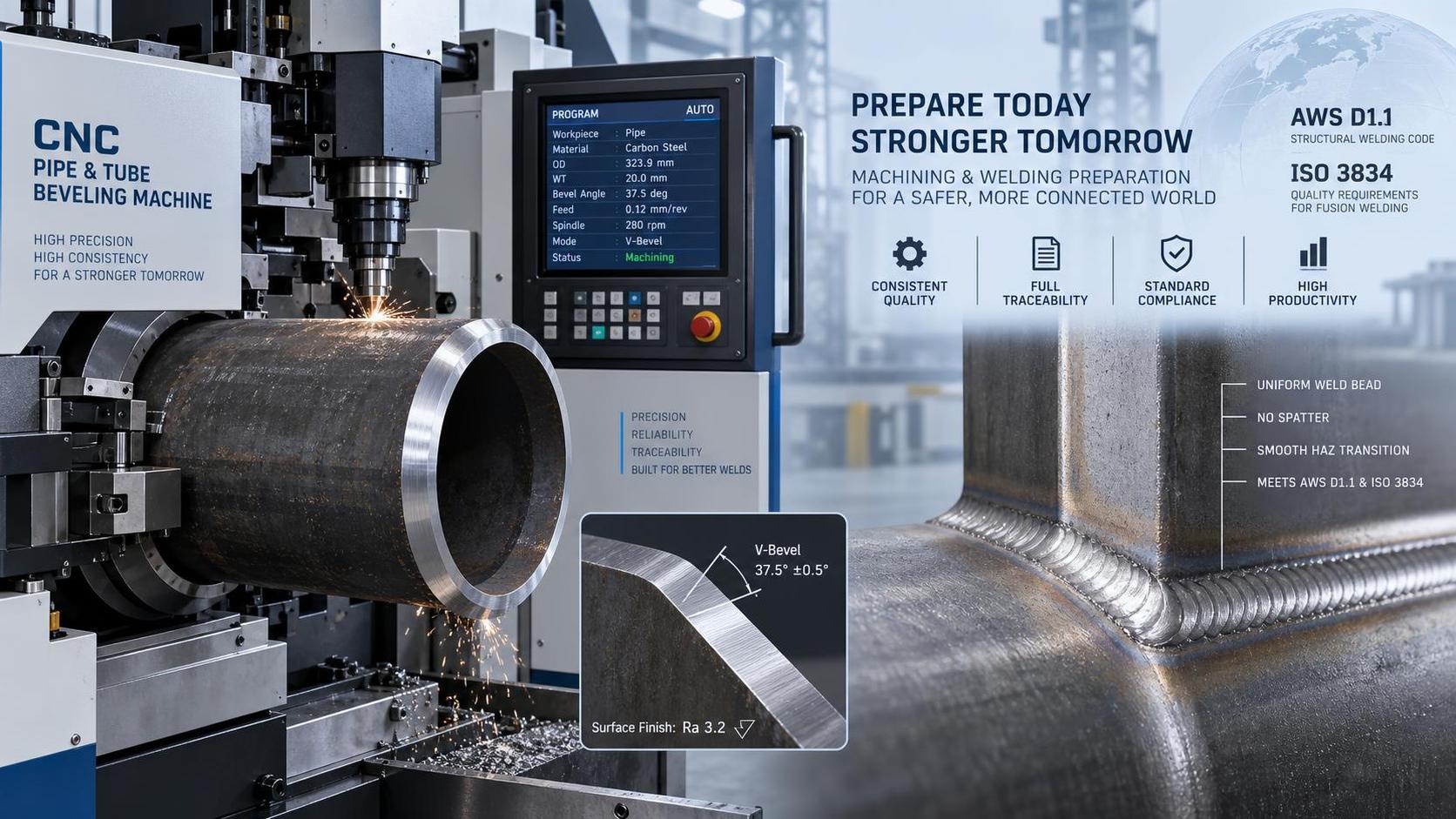
Your bid isn’t evaluated solely on price and schedule. It’s assessed on *demonstrable capability*. Clients—especially in EU infrastructure or U.S. DOT-funded projects—increasingly request evidence *upfront*: copies of your latest ISO 3834 certificate, sample PQRs, welder qualification matrices, and calibration logs for key equipment. That means your CNC cutting machines, welding robots, and beveling systems aren’t just production tools—they’re compliance assets. If your CNC Square & Pipe Beveling Machine automatically logs bevel angle, feed rate, and material thickness for each part processed—and integrates with your MES—those records become auditable proof of controlled, repeatable edge preparation. That’s not convenience; it’s verifiable alignment with ISO 3834-2 Clause 8.3 (Control of Production Process). Conversely, relying on manual beveling or outdated edge planers introduces undocumented variables: operator fatigue, inconsistent pressure, uncalibrated angle gauges. Those gaps don’t appear in your bid documents—but they’ll surface during the first third-party audit or when the client’s NDE team flags inconsistent root penetration.The Real Risk Isn’t Failing the Test. It’s Passing the Wrong One.
The most costly mistake isn’t having uncertified welders. It’s having welders certified to the *wrong standard*, for the *wrong material*, at the *wrong thickness*, using the *wrong procedure*—while assuming the certificate alone satisfies the contract. AWS D1.1 Table 4.1 defines exactly which positions and thicknesses require requalification. ISO 3834-2 Annex A lists mandatory documentation categories. Ignoring those specifics doesn’t create a “minor deviation.” It creates contractual non-conformance—with real consequences: withheld progress payments, mandated third-party re-inspection, or termination for cause. So before your next bid deadline, don’t just check “welding and welders” off the list. Ask: Does our hiring screen match the *exact* scope-defined variables? Does our training reinforce *our* WPS—not just the code book? Do our machines generate the *traceable data* the standard requires—not just parts? That’s how certification stops being a hurdle—and becomes your competitive advantage.search
Products Navigation
Send Us A Message