




What Is the Annual Maintenance Cost of a Metal Laser Cutter?
For most buyers, the real question is not whether a metal laser cutter needs maintenance. It does. The more useful question is how much that maintenance will cost over a year, and whether that cost stays predictable enough to protect margins. That matters because a laser cutter is rarely judged only by purchase price. In fabrication shops, contract manufacturing, sheet metal processing, and equipment production, the machine earns its place through uptime, cut quality, throughput, and the stability of operating costs over several years.
Annual maintenance cost sits in the middle of that calculation. It is not just a service budget line. It affects scheduling, spare-parts planning, operator confidence, and the risk of unplanned stoppages during busy production periods. A cheap machine with unstable maintenance needs can become more expensive than a better-built machine within a short time. On the other hand, some maintenance fears are overstated, especially when the machine is properly matched to the workload and supported with disciplined daily care.
In practical terms, the metal laser cutter maintenance cost per year usually comes from five areas: routine preventive service, consumables, replacement parts, labor, and downtime. The exact number depends heavily on machine type, power level, shift pattern, material mix, operator discipline, and local service access. That is why two shops running apparently similar fiber laser systems can report very different annual ownership experiences.
What annual maintenance cost usually includes
Many first-time buyers treat maintenance as “service visits plus a few nozzles.” That is too narrow. The yearly cost profile is broader and often more operational than mechanical.
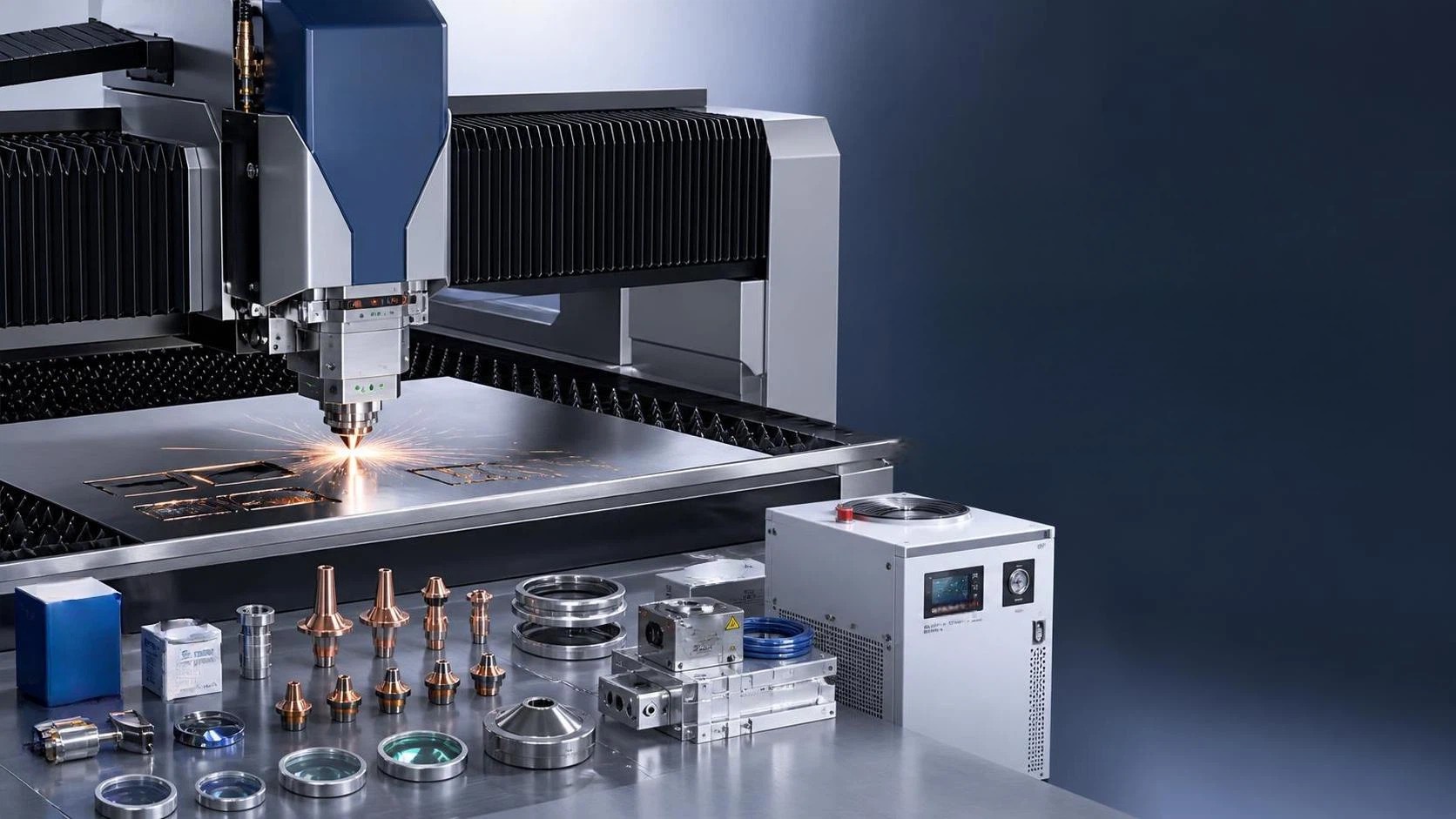
At the most basic level, maintenance includes scheduled inspections, cleaning, lubrication where applicable, calibration checks, optical path checks on relevant systems, assist gas system checks, chiller maintenance, and electrical cabinet cleaning. On fiber laser equipment, users also need to budget for wear items around the cutting head, protection windows, ceramic rings, nozzles, filters, and sometimes sensors or cables. Machines with heavier production loads also put more stress on motion components, dust extraction, gas lines, and cooling systems.
A useful way to think about cost is to separate it into predictable and unpredictable items. Predictable costs are the ones you should plan for before purchase. Unpredictable costs are the ones that hurt cash flow because they arrive after a failure, often together with lost production time.
The second column is where maintenance budgeting often becomes unrealistic. Shops may account for parts but ignore the cost of interrupted delivery schedules, overtime recovery, subcontracted overflow work, or scrap generated while a machine drifts out of optimal condition.
The biggest factors that change the yearly number
1. Laser source type and machine configuration
In most current metal fabrication applications, fiber laser cutters are favored because they generally require less maintenance than older CO2 systems. That does not mean maintenance is negligible. It means the maintenance burden is different. Fiber systems usually reduce optical alignment complexity and eliminate some of the upkeep associated with mirrors and beam-path maintenance found in traditional CO2 designs. For many buyers, that shifts annual cost downward, but only if the cutting head, chiller, controls, and motion platform are also reliable.
Buyers should be careful with a common shortcut: assuming “fiber laser” automatically means “low maintenance.” A poorly integrated fiber laser machine with inconsistent electrical design, weak dust protection, or unstable consumable quality can still become maintenance-heavy.
2. Power level and processing range
Higher-power machines often deliver faster throughput and broader thickness capacity, but they can also raise the financial consequences of maintenance. Consumables may wear faster under aggressive production settings. Cutting head components are under greater thermal and process stress. Tolerance for contamination in optics and cooling systems becomes tighter. When these machines stop, the lost output per hour is also higher.
That does not mean high power is the wrong decision. It means maintenance cost should be evaluated alongside output value, not in isolation. A shop processing thick carbon steel in volume may accept a higher annual maintenance budget because the machine produces far more billable output than a lower-power alternative.
3. Shift pattern and utilization rate
A single-shift machine cutting light-gauge stainless intermittently lives a very different life from a two- or three-shift system feeding production every day. Annual maintenance costs often rise less because the machine “ages” by calendar year and more because key components age by operating hours, thermal cycles, contamination exposure, and collision risk.
When comparing supplier claims, ask whether maintenance estimates are based on single-shift, moderate-duty operation. Many quoted ownership figures look attractive because they quietly assume light usage.
4. Material mix and shop environment
Processing reflective materials, dirty plate, oily sheets, or inconsistent stock can increase spatter, contamination, and cutting instability. That affects nozzle life, protective windows, sensor performance, and cut consistency. The surrounding workshop also matters. Dust, poor ventilation, unstable power supply, and weak compressed air quality can all increase maintenance frequency.
This is one reason maintenance cost should never be discussed separately from plant conditions. In some shops, the machine is blamed for problems that actually start with gas purity, air dryness, grounding, voltage fluctuations, or poor material storage.
What a realistic annual budget looks like
It is difficult to state a universal figure without overpromising. Costs vary by region, brand, service coverage, machine size, and production intensity. If a supplier gives a very precise annual maintenance number before asking about your material thickness range, operating hours, and staffing model, that estimate is probably too generic to be useful.
A more reliable approach is to build a range-based budget. For many buyers, the yearly total can be thought of in three layers:
- Base maintenance budget: scheduled service, routine inspections, standard consumables, and minor wear parts.
- Operational buffer: replacement of items that wear unevenly depending on workload, such as protection windows, nozzles, ceramic parts, filters, and occasional sensor-related items.
- Risk reserve: unplanned failures, collision-related damage, urgent technician visits, and downtime recovery costs.
For an established shop, this layered method is more practical than chasing a single clean number. It helps management compare machines by risk profile rather than by optimistic headline cost. In purchasing discussions, it also forces suppliers to clarify what is and is not included in their estimate.
Where buyers tend to underestimate cost
The first blind spot is downtime. A machine that needs only a few parts each year may still be expensive to maintain if service support is slow or spare parts are hard to source. In export markets especially, lead times for original components can materially affect annual cost. One failed part can create a far larger loss than the value of the part itself.
The second blind spot is operator handling. Cutting head crashes, poor piercing setup, neglected cleaning, and improper nozzle replacement can all increase maintenance spend. Shops sometimes attribute this to machine quality alone, but the maintenance outcome is often a mix of equipment robustness and process discipline.
The third blind spot is installation quality. Machines that are badly commissioned tend to create recurring “small problems”: unstable cutting, unexpected alarms, accelerated consumable wear, cooling faults, or positioning errors. Over a year, those small problems accumulate into a serious maintenance burden.
Questions worth asking before you buy
Annual maintenance cost becomes easier to control when the right questions are asked early. Buyers evaluating metal laser cutters should push beyond the brochure and ask for operating detail.
- What maintenance items are expected daily, weekly, monthly, and annually?
- Which consumables are proprietary, and which are standard market items?
- What are the usual replacement intervals under the intended material and shift conditions?
- What spare parts should be stocked locally to avoid production delays?
- How long does remote support usually take, and when is onsite service required?
- What are the typical causes of unplanned stoppage on this machine model?
- How sensitive is the machine to gas quality, compressed air quality, and voltage fluctuation?
- What training is included for operators and maintenance staff?
If the supplier cannot answer these questions clearly, the buyer is not really being given a maintenance forecast. They are being given a sales estimate.
Why build quality matters more than low advertised service cost
In the machinery trade, low annual maintenance claims are easy to make because they are hard to verify before installation. A stronger indicator is the machine’s underlying build logic: component brand consistency, electrical cabinet layout, dust protection strategy, bed rigidity, software stability, cooling system design, and how well the machine handles long production runs without drifting out of process.
For buyers sourcing internationally, it is reasonable to pay attention to manufacturers that work to established quality systems and export standards such as ISO9001 and CE-related compliance where applicable. These do not guarantee low maintenance on their own, but they can indicate a more disciplined manufacturing and documentation process. That usually matters when a machine enters real production and requires repeatable support over time.
Companies active in broader sheet metal and fabrication equipment supply, including CNC cutting, welding, milling, and forming systems, sometimes have a practical advantage here: they tend to understand how the laser cutter fits into the larger production line rather than treating it as an isolated product. That can help in matching the machine to actual workload and avoiding overspecification, which is one of the quieter drivers of maintenance inefficiency.
How to reduce annual maintenance cost without under-maintaining the machine
Cost control does not come from delaying service. In most cases, delayed maintenance simply converts a planned expense into a more expensive interruption. The better path is to make maintenance structured, visible, and tied to production reality.
- Standardize daily checks. Nozzle condition, lens cleanliness, gas pressure stability, coolant status, and slag buildup should be reviewed routinely.
- Track consumable life by material and shift. This exposes whether wear is normal or caused by setup and handling issues.
- Keep critical spares on site. Waiting for common failure items is rarely economical.
- Train operators beyond basic startup. Many avoidable maintenance events begin as operating errors.
- Audit utility conditions. Gas quality, compressed air dryness, dust extraction, and power stability directly affect upkeep.
- Review downtime as a maintenance metric. A low parts bill does not mean maintenance performance is good if stoppages remain frequent.
One practical habit is to compare monthly maintenance spend against output value, not only against the maintenance budget. A machine that costs more to maintain but consistently delivers higher throughput, cleaner edges, and fewer downstream finishing steps may still be the better economic asset.
The decision point is total ownership stability
When manufacturers search for the annual maintenance cost of a metal laser cutter, they are usually trying to protect themselves from a bad ownership surprise. That is the right instinct. But the answer is rarely a single number that applies across all shops. The more useful conclusion is whether the machine’s upkeep will be stable, supportable, and proportionate to the production value it creates.
For serious buyers, annual maintenance cost should be evaluated together with service response, spare-parts access, operator training, utility requirements, and the machine’s fit with actual materials and production tempo. A laser cutter that looks inexpensive to maintain on paper can become costly when these conditions are weak. A better-built system with clearer service logic may cost more upfront but remain easier to live with over the years.
That is usually the difference between buying a machine and building a dependable cutting capability.
search
Products Navigation
Send Us A Message