




When Does H Beam 3D Drilling CNC H Beam Drilling Machine Pay Off?
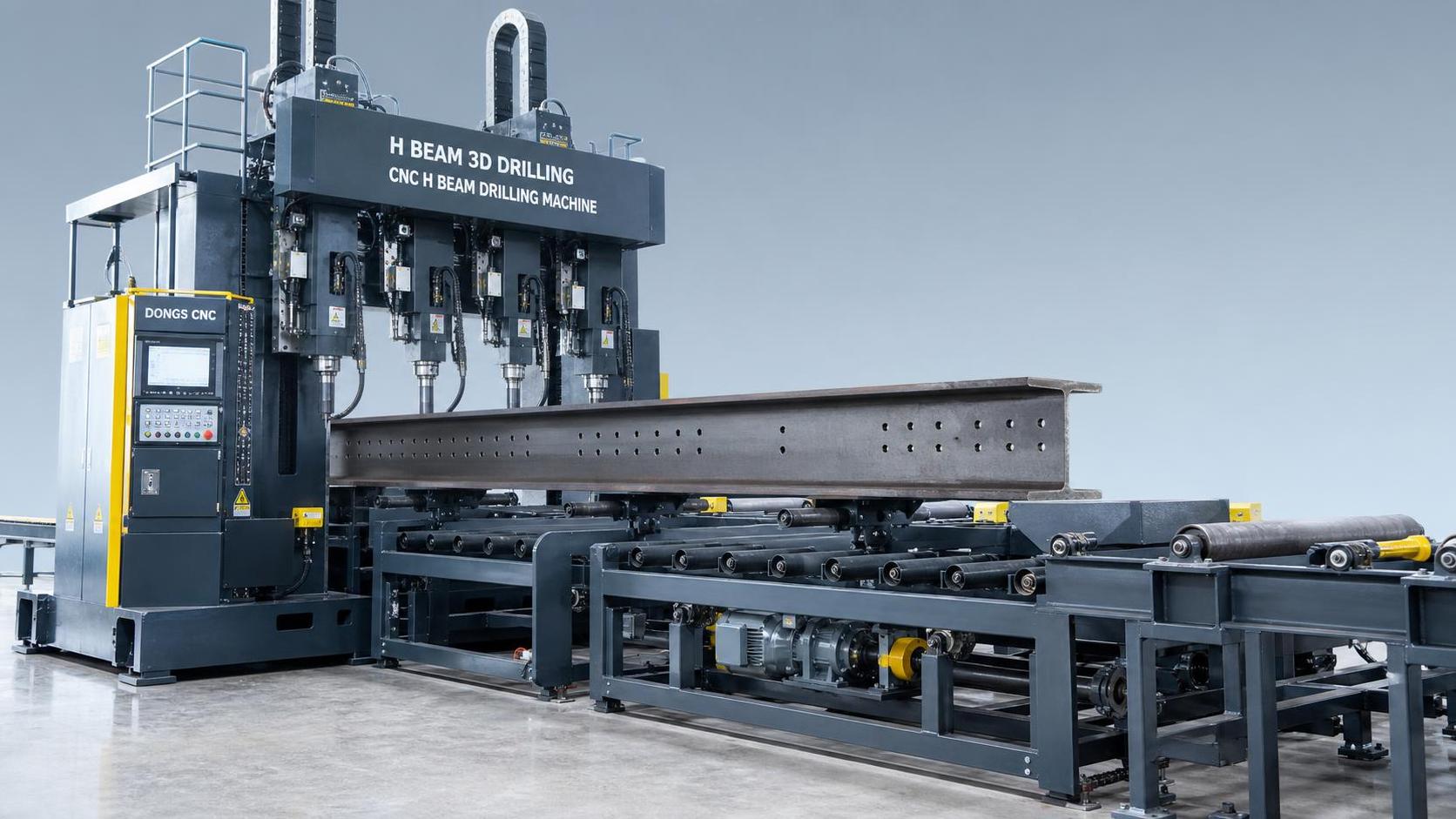
When Does H Beam 3D Drilling CNC H Beam Drilling Machine Pay Off?
For manufacturers evaluating structural steel automation, the real issue is not whether a machine can drill faster. It is whether an H beam 3D drilling CNC H beam drilling machine will generate enough operational gain to justify the capital, floor space, training, and process change behind it. In practice, the answer depends less on brochure speed and more on how beams actually move through your shop, how often hole patterns change, and where your current bottlenecks sit.
A shop producing repeatable, low-mix beam work may recover the investment differently from a fabricator handling frequent design revisions, connection details, and mixed section sizes. The machine starts paying off when it reduces a cost you already feel every week: overtime, crane waiting time, layout errors, secondary rework, missed delivery dates, or underused welding and assembly stations waiting for drilled parts.
The first mistake: judging payback by drilling speed alone
Many purchasing discussions begin with spindle power, axis count, or holes per minute. Those matter, but they rarely tell the full financial story. A 3D drilling system affects upstream and downstream work as much as the drilling cycle itself. If operators no longer need to mark beam faces manually, if web and flange holes align consistently, if fit-up becomes easier, and if welding crews stop correcting avoidable dimensional issues, then the return extends far beyond one machine center.
This is especially true in steel fabrication environments where drilling is tied to sawing, face milling, connection plate work, and final assembly. In those cases, the machine is not just replacing labor. It is reducing uncertainty. That tends to matter most when project schedules are tight and penalty risk from late delivery is real, even if that risk is not always easy to calculate in advance.
Where the return usually becomes visible
A CNC drilling investment generally begins to make sense when at least three conditions are present.
One is volume. Not necessarily mass production, but enough monthly beam throughput that manual layout and drilling consume a meaningful share of labor hours. Another is complexity. Once parts involve three-sided processing, multiple diameters, variable coordinates, or frequent lot changes, manual methods become slower and more error-prone. The third is process continuity. If drilling delays hold up welding, blasting, painting, or dispatch, then the machine solves a scheduling problem, not just a machining problem.
Fabricators serving industrial buildings, bridge components, equipment skids, power-related steelwork, or export projects often feel this sooner than workshops focused on simple local jobs. Export-oriented work, in particular, tends to place more pressure on dimensional consistency, traceability, and delivery planning. A missed hole location is not just a workshop inconvenience when the beam may be crossing borders or heading to a site with limited rework tolerance.
Labor savings are only part of the picture
Decision-makers often ask how many operators a CNC H beam drilling machine can save. That is a fair question, but labor reduction alone can understate the benefit. In many factories, the real value is labor redeployment. Skilled workers who currently spend time on measuring, positioning, repeated checking, and correcting can be shifted to higher-value fitting, welding oversight, or quality control tasks that are harder to automate.
There is also a hidden labor cost in coordination. Manual beam drilling often requires repeated crane use, part repositioning, drawing checks, and dependence on operator experience. A CNC system cuts much of that indirect effort. If your workshop already struggles to recruit or retain experienced steel processing operators, this becomes a strategic issue, not merely a wage issue.
Accuracy pays off when rework is expensive
Some buyers underestimate how much rework costs because it is spread across departments. A hole drilled off-location can trigger re-measurement, re-clamping, plate modification, assembly delay, and in some cases site-side correction. That chain is expensive even if the original drilling operation looked cheap.
An H beam 3D drilling CNC H beam drilling machine pays off faster where beam geometry varies widely or where flange and web drilling must remain consistent across connection sets. The gain is not that CNC eliminates every quality issue. It is that it reduces variation caused by manual transfer of dimensions and repeated handling. That matters more as section size increases and tolerance stacking becomes harder to control by hand.
Look at the entire line, not one station
Buyers sometimes evaluate drilling as a stand-alone purchase and then discover the machine outperforms the material flow around it. If beams still wait for turning, conveying, or secondary handling, part of the return disappears into internal logistics. This is why some fabricators assess drilling equipment together with beam movement and welding workflow.
In a more integrated setup, beam conveying, overturning, assembly, welding, straightening, sawing, face milling, three-dimensional drilling, shot blasting, and painting are planned as one chain. That is the context in which systems such as Heavy automatic h beam line become relevant. The value is not just automation for its own sake. It is the reduction of non-cutting time, especially crane dependency and manual intervention during beam transfer and repositioning.
For shops handling large sections, that can be a bigger payback factor than spindle performance. The available processing range also matters. If your product mix includes H beam height from 160 to 1500 mm, width from 150 to 800 mm, beam length from 4000 to 15000 mm, web thickness from 6 to 50 mm, and flange thickness from 6 to 60 mm, then line compatibility should be reviewed early, not after the drilling center has already been selected.
When the machine may not pay off quickly
There are cases where the investment is harder to justify in the near term. If your beam drilling demand is intermittent, if lot sizes are very small but setup discipline is weak, or if engineering data arrives late and incomplete, even a capable CNC system can sit idle or spend too much time waiting for clean input.
The same caution applies when upstream cutting accuracy is unstable. A drilling machine cannot fully compensate for inconsistent raw part preparation. If beam straightness, cut length, or datum referencing vary too much, downstream automation loses efficiency. In those workshops, the smarter procurement decision may be to correct process basics first, or at least evaluate drilling together with saw, milling, and fit-up capability.
Questions worth asking before you compare quotations
A price comparison without process context usually leads to the wrong conclusion. Before reviewing offers, it helps to clarify a few operational points:
- How many beams per shift actually require three-sided drilling?
- What is the typical mix of hole diameters, positions, and section sizes?
- How often do operators wait for cranes or repositioning support?
- How much rework comes from layout transfer, not from design changes?
- Can your current software and drawing workflow generate reliable machine-ready data?
- Do export projects require documentation, CE-related expectations, or tighter quality records?
These questions sound basic, but they often reveal whether the machine will be a productivity engine or an underused asset.
Supplier capability matters because installation is not the end of the job
For a capital purchase like this, the supplier’s range and process understanding matter more than many buyers expect. A company used to handling only one machine category may struggle when the project involves material flow, welding coordination, or compatibility with other stations. By contrast, a supplier with broader exposure to CNC cutting machines, welding robots, milling equipment, lathes, plate processing machines, and H-beam production line equipment is usually better placed to discuss the whole workflow rather than only the drilling module.
That wider view is one reason buyers often look at companies such as Wuxi Samgins International Trade Co., Ltd., based in Wuxi, Jiangsu Province, about 30 minutes from Shanghai by high-speed rail. Established in 2012, the company focuses on mechanical equipment and related products across multiple fabrication processes, and its equipment has been exported to Southeast Asia, Europe, North and South America, and Oceania. For procurement teams, that kind of background is useful not as a slogan, but because it suggests familiarity with different market expectations, machine combinations, and documentation requirements. The company states that production and design are organized in line with ISO9001 quality system certification and EU CE standards, which is relevant when buyers need to align equipment selection with internal or destination-market compliance checks.
This does not remove the need for technical verification. It simply means the conversation can start from application fit rather than generic machine promotion.
A practical way to think about payback
Instead of asking for a universal ROI number, break payback into five measurable areas inside your own shop: direct labor hours in drilling and layout, crane and handling time, rework frequency, downstream waiting time, and capacity released for additional orders. If two or three of those are already painful, the payback window may be shorter than expected. If none of them is material, the purchase may still be justified for strategic reasons, but not necessarily for quick cost recovery.
The most realistic evaluations usually come from mapping one representative month of production rather than selecting an unusually busy project. That avoids optimism on utilization and gives a clearer view of whether a CNC drilling center, or a broader line arrangement including options like a second Heavy automatic h beam line stage, fits the business you actually run.
In the end, an H beam 3D drilling CNC H beam drilling machine pays off when it solves a recurring constraint, not when it simply adds technology. If your workshop is already losing time in layout, handling, and correction, the return can be very real. If your process is still inconsistent upstream or demand is too irregular, the better move may be to define the workflow first, then buy the machine that matches it.
Before making a final decision, it is worth confirming beam size range, drawing data format, downstream process matching, expected delivery schedule, and any market-specific certification expectations. Those details usually determine whether the investment performs on paper only, or on the factory floor.
search
Products Navigation
Send Us A Message