




How a gantry welding machine Works: Components and Processes Explained
What A Gantry Welding Machine Is And Where It Fits
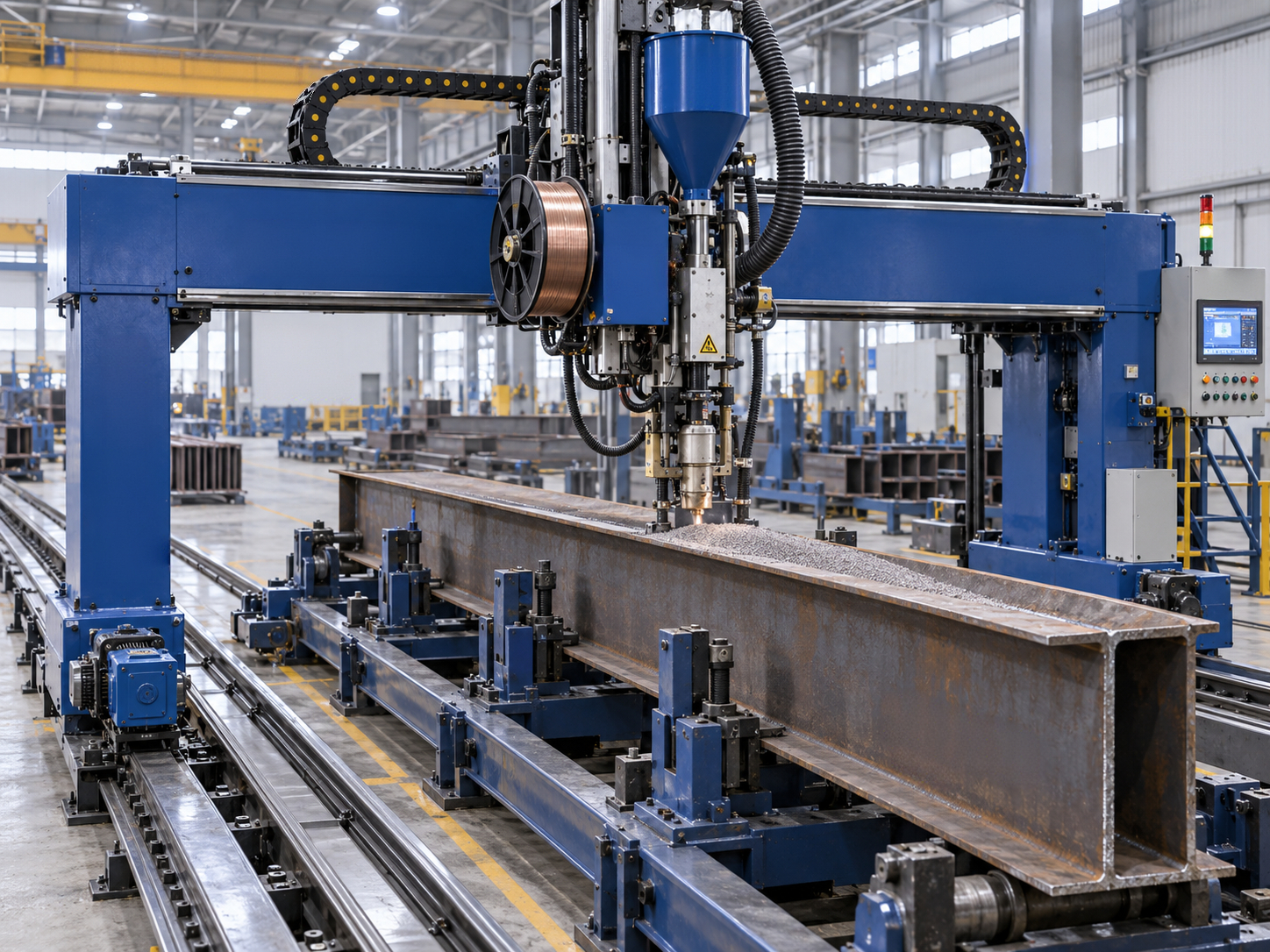
A gantry welding machine is a mechanized welding system built around a bridge that spans a workpiece or production bed. Welding heads mount on the bridge, while controlled axes move them along the required joints. In a common arrangement, the bridge travels on parallel floor rails, a carriage moves across the bridge, and a vertical slide adjusts torch height. Other designs keep the gantry stationary and move the workpiece. The defining feature is the bridge structure supporting controlled welding motion across a substantial working area.
These machines commonly weld long, accessible joints on structural beams, plate assemblies, box sections, and other large fabrications. A gantry welding machine can improve travel consistency and reduce repeated manual torch handling, particularly when similar joints recur throughout production. Its suitability depends on seam accessibility, workpiece geometry, production volume, and preparation accuracy. Irregular assemblies with frequent changes in torch angle may require additional axes, repositioning equipment, or a welding robot, while straightforward longitudinal seams often suit a simpler mechanized arrangement.
Buyers should distinguish the gantry structure from the welding process it carries. Submerged arc welding, commonly abbreviated SAW, is frequently used for long seams and higher deposition requirements. Gas metal arc welding, or GMAW, and flux cored arc welding, or FCAW, may suit different materials, positions, and access conditions. The machine provides motion and integration; the selected process determines shielding requirements, consumables, operating characteristics, and much of the achievable weld profile. No single configuration serves every fabrication task equally well.
Core Components And How They Work Together
The mechanical foundation includes the bridge, supporting columns, rails or guides, drive mechanisms, and welding head slides. Structural stiffness helps limit unwanted torch movement, while aligned rails support smooth travel over the working length. Depending on the design, geared drives, rack and pinion systems, or other mechanisms provide motion. Encoders supply position or speed feedback where fitted. Rail alignment, bridge squareness, backlash, and vibration all affect actual torch movement, so a servo drive alone does not establish the accuracy of the complete machine.
The welding package normally comprises a power source, wire feeder, torch or welding head, cables, and process-specific accessories. A submerged arc installation also needs flux delivery and may include flux recovery equipment. A gas shielded installation requires suitable gas delivery and protection against disruptive air movement. Cooling arrangements depend on torch duty and configuration. Cable and hose management must accommodate full machine travel without pulling on the head, creating trip hazards, or interfering with fixtures and moving workpieces.
The control system coordinates travel, arc initiation, wire feeding, and the welding sequence. A programmable logic controller may handle machine sequencing, while CNC functions support programmed paths where required. Optional contact probes, arc sensing, or optical sensors can help follow joint variation within defined limits. Fixtures hold the workpiece in a repeatable position, and guarding, emergency stops, interlocks, extraction, and appropriate electrical protection support safe operation. The effectiveness of a gantry welding machine depends on these systems working together under actual production conditions.
The Welding Process From Preparation To Inspection
Production begins with material identification, joint preparation, and fit-up. Operators remove contaminants, check edge preparation and root gaps, and confirm that tack welds and fixtures can maintain alignment. The welding procedure specification, or WPS, establishes the applicable process, consumables, parameter ranges, and temperature controls. Before welding, personnel verify rail travel, torch clearance, seam location, and the workpiece support arrangement. A dry run helps expose collisions and access problems before an arc starts, especially with multiple heads or unusually shaped assemblies.
During welding, the controller establishes the required sequence for shielding or flux delivery, arc initiation, and travel. Current, voltage, wire feed, and travel speed must remain compatible with the qualified procedure. Travel speed affects energy delivered per unit length, while torch position and angle influence bead placement and fusion. Where seam tracking is installed, its correction range must accommodate expected joint movement. Tracking cannot compensate indefinitely for excessive gaps, poor edge preparation, or fixtures that allow the assembly to move unpredictably.
After each pass, operators perform the cleaning and checks required by the procedure, including slag removal for processes that produce slag and interpass temperature checks where specified. Completed welds receive visual examination and any additional testing required by the drawing, contract, or governing code. Ultrasonic, radiographic, magnetic particle, or penetrant testing may apply to particular materials and joint types. Inspection results should feed back into setup control: repeated defects can indicate preparation, consumable, parameter, or positioning problems rather than a single machine fault.
Main Machine Types And Suitable Applications
Traveling gantries move along a fixed fabrication bed and suit long assemblies that are difficult to transport during welding. Fixed gantries paired with moving tables can suit shorter components or repetitive production cells. Single-head systems offer a relatively straightforward setup, while multiple-head arrangements may weld more than one seam during a cycle. Their productivity depends on joint accessibility, available electrical capacity, welding sequence, and thermal behavior. Multiple arcs require process planning because their interaction and heat distribution can affect weld quality and distortion.
Structural steel workshops often consider gantry systems for H-beam fillet welds and plate or box assemblies. A beam welding installation may work alongside assembly, straightening, drilling, and handling equipment. Wuxi Samgins offers H-beam assembly machines, H-beam welding machines, straightening machines, and horizontal H-beam welding lines, allowing buyers to discuss the complete production sequence. The relevant commercial question is whether upstream preparation and downstream handling can support the proposed welding rate; a faster welding station can otherwise leave the overall line constrained elsewhere.
For tanks and pipe fabrication, equipment selection depends strongly on seam orientation and component movement. Longitudinal seam machines, welding manipulators, and rotators from the Wuxi Samgins product range may suit particular tasks better than a gantry. The company also offers customized welding robots and heavy-duty rotators for application-specific requirements. Its supplied customer references include Zein Steel Industries Co.LLC and Lincoln Electric-MENA. Buyers should request relevant project evidence and reference permission, because the supplied names alone do not establish a particular installation, machine configuration, or measured production result.
Selection Criteria And Industry Standards
Start a gantry welding machine specification with representative drawings, material grades, thickness ranges, joint details, and required output. Define the working envelope, head travel, torch access, floor loading, and loading method. Then identify the required process, duty cycle, number of heads, and procedure limits. Ask suppliers to distinguish positioning accuracy from actual weld acceptance capability. A useful acceptance trial uses representative joints and records setup time, arc time, handling time, dimensional results, and inspection findings under clearly agreed conditions.
Separate machinery conformity, quality management, and welded-product compliance when evaluating documentation. ISO 9001 concerns an organization's quality management system; it does not certify every weld. CE marking concerns conformity with applicable European requirements and does not establish compliance with an ASME or API fabrication code. Depending on the application, contracts may reference AWS D1.1, relevant ASME provisions, API requirements, or ISO welding standards. Confirm the applicable editions, qualification requirements, inspection responsibilities, and destination-market obligations before finalizing the equipment specification.
Wuxi Samgins reports ISO 9001 quality-system compliance, CE-related machinery and electrical conformity, utility model patents, and more than ten years of export experience. It also states that key hydraulic, servo, and CNC components use established international brands. During procurement, verify current certificates, their scope, the declaration and technical documentation for the ordered machine, and the actual component schedule. Familiarity with ASME or API requirements can support technical discussions, while responsibility for procedure qualification and fabrication-code compliance must remain explicitly assigned in the project contract.
Installation Maintenance And Production Quality Control
Installation planning should cover foundations, rail alignment, electrical supply, grounding, extraction, lighting, lifting access, and safe movement around the work area. Confirm these requirements with the supplier before equipment delivery. Commissioning should verify travel limits, emergency stops, interlocks, cable movement, and operational clearances, followed by welding trials on representative material. Establish baseline measurements for motion and weld performance. Operator and maintenance training should cover setup, permitted adjustments, fault recovery, isolation procedures, and the records needed to maintain consistent production.
Maintenance intervals should follow the manufacturer's instructions and reflect actual duty, dust, flux exposure, and environmental conditions. Routine checks commonly include rails, guides, wire feeding, contact tips, cables, hoses, and extraction performance. Scheduled work may cover lubrication, drive condition, electrical connections, cooling circuits, and verification of travel speed or positioning. Isolate relevant energy sources before servicing. Changes in bead location, unstable wire feeding, unusual drive noise, or repeated tracking corrections should trigger investigation instead of being masked through repeated parameter adjustments.
Production quality control links the machine recipe to the approved procedure and the correct job. Useful records include material identification, consumable batches where required, parameter settings, inspection outcomes, and repair history. Recipe access controls can reduce unintended changes, but operators still need clear authority to stop production when conditions fall outside the procedure. Wuxi Samgins describes support covering design, manufacturing, sales, and after-sales service. Buyers should convert that service scope into documented training, spare-parts availability, response arrangements, and warranty terms for the selected configuration.
Ownership Costs And Investment Return
The purchase price is only one part of owning a gantry welding machine. Initial expenditure can include welding power sources, heads, tracking equipment, fixtures, foundations, extraction, freight, commissioning, and training. Production costs include wire, flux or shielding gas, electricity, wear parts, labor, maintenance, and inspection. Allow for loading and unloading equipment, service access, and the floor area occupied by rails and fabrication beds. Compare quotations against the same scope, since excluded infrastructure or accessories can materially change the final installed cost.
Estimate throughput using the full production cycle rather than welding travel speed alone. Loading, alignment, tack welding, preheating, cleaning, repositioning, inspection, and unloading can occupy a substantial share of available time. Higher deposition capacity creates value only when the joint, procedure, and supporting operations can use it. Likewise, labor savings depend on actual staffing and supervision requirements. Use measured baseline data from existing production, then test realistic machine utilization and product mix assumptions before assigning financial benefits to automation.
A practical simple-payback estimate divides total installed investment by expected annual net cash benefit. That benefit may include labor capacity released, lower rework costs, and additional contribution from saleable output, less added maintenance, consumables, energy, and financing costs where applicable. Avoid double counting labor savings and capacity gains from the same released hours. Evaluate conservative and expected utilization scenarios, and consider the consequences of a service interruption. A supplier trial using representative parts provides a stronger investment basis than an unsupported productivity percentage.
Future Trends And Planning The Next Step
Development is moving toward better seam sensing, more coordinated motion, and improved production data collection. Optical sensors can help locate joints, while suitable adaptive controls can adjust selected variables within validated limits. These capabilities are most useful when they address a known source of variation, such as repeatable changes in seam position. Sensor performance still depends on joint geometry, visibility, contamination, heat, and process conditions. Buyers should evaluate the complete sensing application through trials instead of treating a technology label as evidence of reliable performance.
Connected controls can support recipe management, parameter recording, maintenance planning, and links to factory production systems. Integration with cutting, beam assembly, positioners, or material handling may improve production flow when interfaces and responsibilities are defined. Retrofitting an existing gantry welding machine may be practical if the structure and drives remain suitable and support is available. The decision should compare remaining mechanical life, controls compatibility, safety requirements, downtime, and upgrade cost against the benefits and lifecycle support offered by a replacement.
To develop a project with Wuxi Samgins, provide sample drawings, materials, thickness ranges, seam types, workpiece dimensions, production targets, and destination requirements. Request a proposal that identifies the welding process, motion arrangement, fixtures, optional tracking, utility requirements, and acceptance method. Include installation responsibilities, training, consumables, spare parts, and support terms in the discussion. This information allows the supplier to assess whether a gantry, dedicated seam welder, beam welding line, or another configuration best matches the actual work and the investment case.
search
Recommended Products
Recommended blogs
Send Us A Message
Send us a Message
A dedicated person will follow up on your needs one-on-one and provide personalized customized solutions according
to your needs.
Get In Touch
We look forward to hearing from you for in-depth communication on how to fulfill your mixing requirements.