




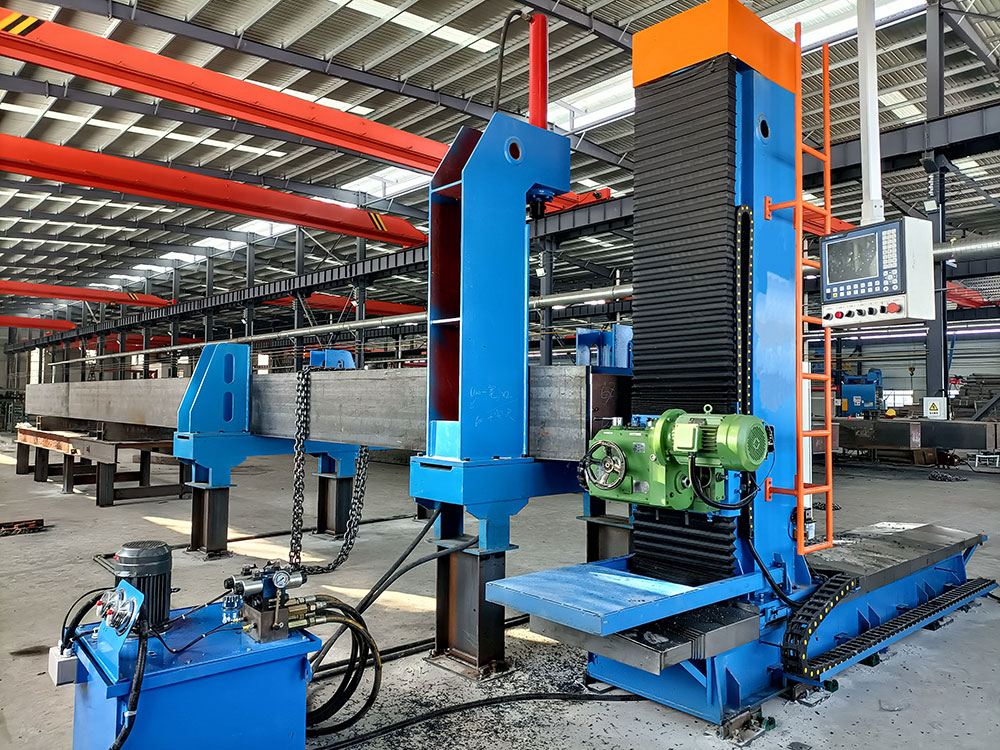
CNC Face milling machine
Face milling machine is used for h beam ,box beam ,cross beam etc metal structure face milling process.H beam face milling machine can mill max face beam 2500*2000.H beam end face milling machine is very easy to operate ,simple structure and fast to adjust.Box beam end face milling machine is necessary equipment for Beam or column structure manufacturer.
Full-range Machinery & Customized Non-standard Solutions
Authorized Certificates & Independent R&D Patents
Over 10 Years Global Export & Worldwide Project Cases
CNC Face milling machine Description
1.Introduction for CNC Face milling machine:
The Face Milling Machine is specifically designed for face milling of metal structural components, including H-beams, box beams, cross beams, and columns. It provides precise, flat surfaces on workpiece ends to ensure accurate fit-up and alignment for subsequent welding or assembly operations.
Key Features:
Wide processing range – capable of milling beam ends up to 2500mm × 2000mm (max.)
User-friendly operation – simple structure, quick adjustment, minimal operator training required
Essential equipment – widely used by beam and column manufacturers for structural fabrication
System Composition:
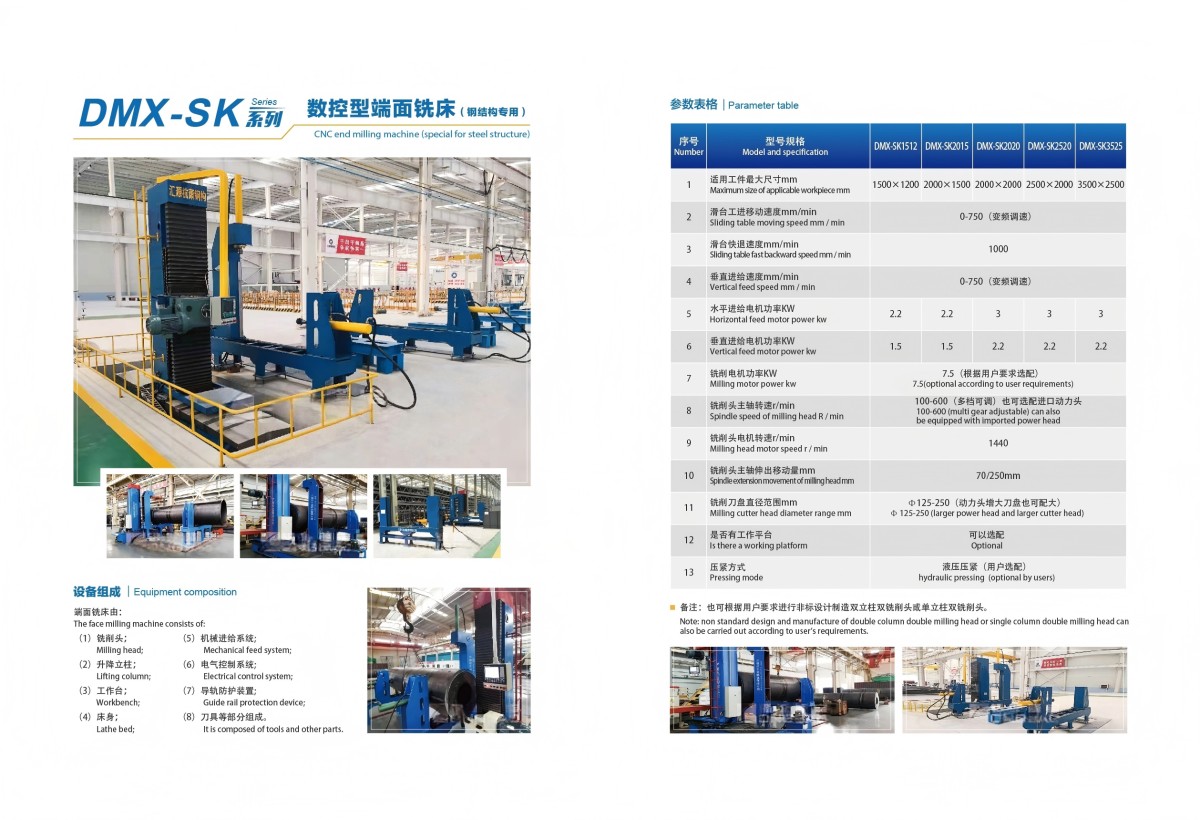
The beam end face milling machine consists of the following main components:
Milling head – with cutting tools for material removal
Elevating column – supports vertical movement of the milling head
Working table – secures the workpiece during machining
Bed – provides stable foundation for the entire machine
Feeding system – controls movement along X, Y, and Z axes
Electrical control system – manages operation and parameters
Railway protection unit – ensures operator safety
Tooling – includes milling cutters and inserts
2.Technical parameter for CNC Face milling machine
3.Characters for CNC Face milling machine:
3.1 High-Precision Processing
The CNC system precisely controls tool path and feed rate, ensuring accurate flatness and perpendicularity of the workpiece end face. The system effectively compensates for mechanical errors, maintaining consistent geometric accuracy.
3.2 High Efficiency & Metal Removal Rate
End milling cutters with both primary and secondary cutting edges perform cutting and smoothing simultaneously, delivering excellent surface finish. Combined with stepless VFD speed control and servo drive, the machine achieves high-speed cutting for maximum productivity.
3.3 High Degree of Automation
Based on advanced CNC systems (e.g., GSK, Huachuan), the machine supports programmed operation with multiple parameter sets stored for quick job changeover. Ideal for mass production with minimal setup time.
3.4 Rigid Structure & Strong Adaptability
Key components such as the bed and columns are made of high-strength cast iron (e.g., C250 Hanas iron), with quenched guide rails for long-term accuracy. The machine processes various workpieces including H-beams, box columns, molds, and flanges.
3.5 Multi-Functional Integration
Beyond end face milling, the machine can expand functions with accessories for drilling, boring, tapping, chamfering, and T-slot processing. Some models support multi-axis linkage (e.g., seven-axis) for complex operations.
3.6 Convenient Operation & High Safety
Equipped with electronic handwheels, safety interlocks, automatic lubrication, and guide rail covers—reducing labor intensity and enhancing operational safety.
products faq
A Face Milling Machine is designed to machine flat, smooth surfaces on the ends of workpieces such as H-beams, columns, pipes, and flanges. It ensures accurate dimensional tolerances and proper surface preparation for subsequent welding, assembly, or further machining operations.
The machine can process a wide range of materials including carbon steel, stainless steel, aluminum alloys, cast iron, and other common structural metals. The specific cutting parameters (speed, feed rate, depth of cut) should be adjusted according to material hardness and tooling selection.
Our face milling machines typically achieve dimensional tolerances of ±0.05mm and surface finishes down to Ra 1.6μm or better, depending on the workpiece material, tool selection, and cutting parameters. This level of precision ensures excellent fit-up for welding and assembly applications.
Yes. Manual and hydraulic models feature user-friendly controls with minimal training required. CNC models are equipped with intuitive interfaces and pre-programmable parameters, allowing operators to quickly set up for different workpiece sizes and milling requirements. We provide comprehensive training and documentation as part of our commissioning package.
Routine maintenance includes:
Regular lubrication of slide guides, ball screws, and spindle bearings
Inspecting and replacing worn cutting tools (inserts / milling cutters)
Checking hydraulic oil levels and seals (on hydraulic models)
Cleaning coolant filtration systems (if equipped)
Verifying spindle run-out and alignment periodically
Backing up CNC programs and software (on CNC models)
Following a scheduled maintenance plan ensures long-term accuracy, reliability, and service life.