




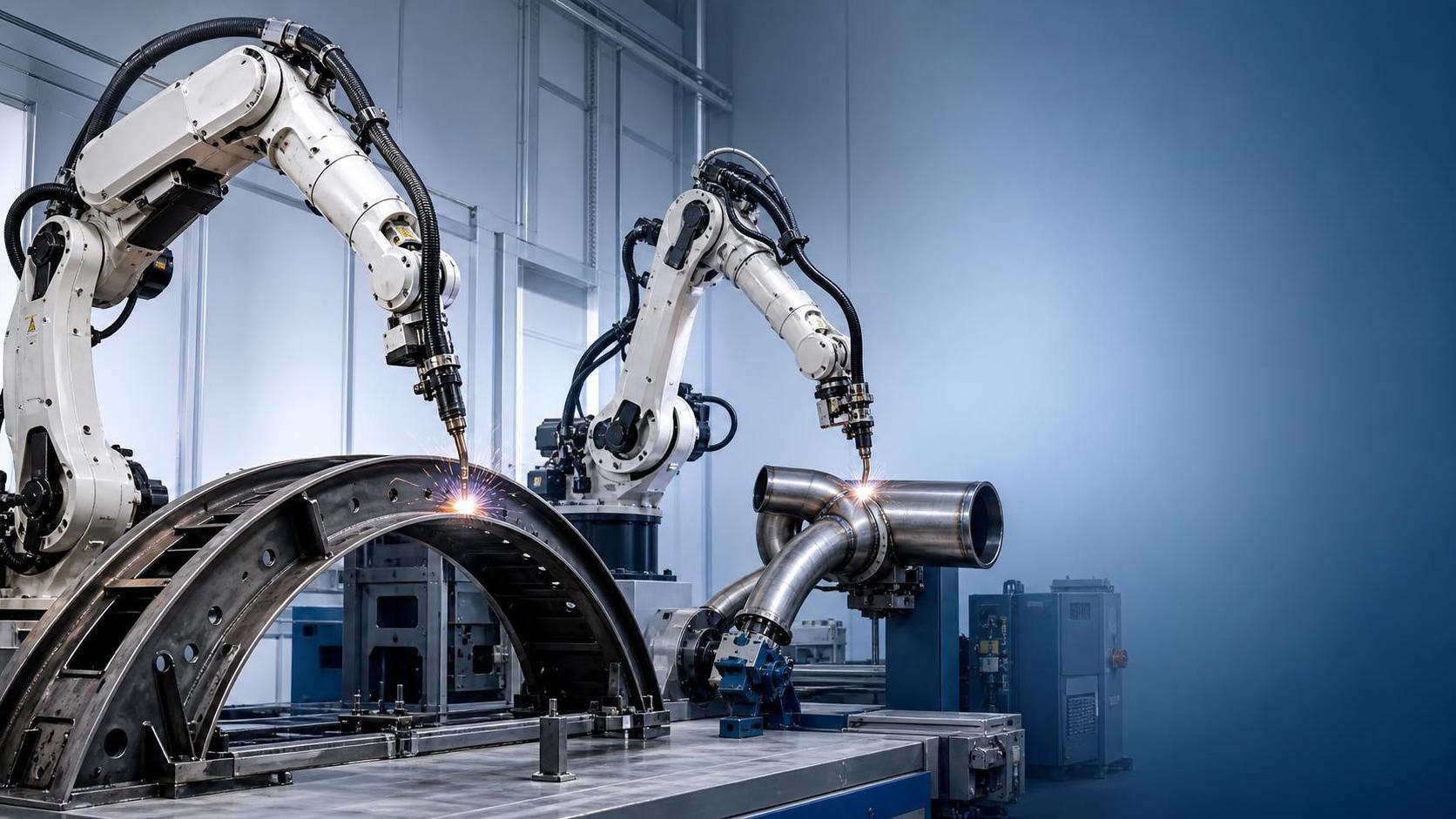
When curved steel structures are involved, choosing a welding robot is rarely a simple equipment comparison. The trouble usually starts when a weld path looks manageable on paper, but in production the torch angle becomes unstable, the robot needs repeated repositioning, or some joints are difficult to reach without compromising bead consistency.
If you are asking, “Should I choose a 6-axis or 7-axis welding robot for curved steel structure welding?”, the better answer comes from the workpiece and process, not from a general preference for more axes. For curved steel assemblies, the key is to match robot motion capability to seam geometry, fixture layout, access limits, and production rhythm so that weld quality stays stable without adding unnecessary complexity.
Why This Decision Becomes Difficult on Curved Steel Structures
Flat parts and simple linear welds are usually easier to automate because the torch can maintain a predictable path and angle with fewer motion conflicts. Curved steel structures are different. Common situations include cylindrical sections, bent profiles, intersecting pipes, arched supports, formed plates, and assemblies where the weld seam wraps around changing contours. In these cases, the robot is not only following a path. It is also constantly adjusting orientation, reach, and approach direction.
That is where many selection mistakes happen. Some buyers assume a 6-axis robot is always enough because it is the standard option for welding cells. Others assume a 7-axis robot is automatically better because it offers one more degree of freedom. In practice, both assumptions can lead to avoidable problems. A robot with too little flexibility may struggle in tight or changing positions. A robot with more motion capability than the process requires may raise programming difficulty, integration cost, and maintenance demands without delivering a practical gain.
The question matters because poor robot selection affects more than cycle time. It can influence weld consistency, fixture design, cell footprint, operator workload, and how easily the line can adapt to part variation later.
What Usually Goes Wrong When the Robot Type Does Not Match the Job
A mismatch between robot capability and welded structure often shows up as secondary symptoms rather than a single obvious failure. For example, the welding result may appear acceptable on accessible sections, but quality starts changing on inner curves, transition zones, or points where the seam direction shifts quickly.
In a 6-axis setup, a common issue is that the robot can technically reach the seam, but only by using awkward arm postures. That can reduce motion smoothness, create sudden orientation changes, or make torch angle control harder near critical points. The result may be inconsistent penetration, unstable arc behavior, or extra teaching adjustments at several positions.
In a 7-axis setup, the problem is usually different. The system may be very capable, but if the production team does not actually need the extra axis, programming becomes more involved than necessary. More kinematic freedom can improve access, but it also requires clearer path planning, collision logic, and process coordination. For a relatively straightforward curved part, that added flexibility may not create enough value to justify the extra complexity.
This is why the choice should be based on how the robot moves through the real weld path, not only on a brochure comparison.
How to Compare a 6-Axis and 7-Axis Welding Robot for Curved Steel Structures
To answer “Should I choose a 6-axis or 7-axis welding robot for curved steel structure welding?” in a practical way, it helps to compare them against the actual constraints of curved steel fabrication.
1. Weld path flexibility
A 6-axis robot is often sufficient when the curved seam is continuous, the workpiece can be positioned well, and the torch can maintain the required angle through most of the weld without difficult reorientation. This is common in cells where fixtures or positioners are already doing part of the work.
A 7-axis robot becomes more useful when the seam geometry changes frequently, when multiple approach angles are needed in a compact area, or when the robot must navigate around structural obstructions. The added axis can improve redundancy in motion, which means the robot may keep a better torch posture while following a difficult curve.
2. Reach versus usable reach
Nominal reach figures do not tell the full story. For curved steel structures, usable reach matters more than raw reach. A 6-axis robot may have enough arm length, but if it loses favorable wrist orientation at certain points, that theoretical reach is less valuable. A 7-axis design can sometimes access the same seam with a more stable arm posture, especially in enclosed or offset welding areas.
3. Fixture and positioner dependence
Many successful curved-structure welding cells rely on a good positioner rather than a more complex robot body. If the workpiece can be rotated or tilted so the seam stays accessible, a 6-axis robot is often a sound and efficient choice. If repositioning the workpiece is difficult, limited, or likely to slow production, the extra robot axis may reduce that dependence.
4. Programming and commissioning difficulty
In general, a 6-axis robot is easier to commission, teach, and maintain because the motion behavior is more familiar to most welding integrators and operators. A 7-axis robot offers more flexibility, but the process team must be ready to manage that flexibility properly. If programming resources are limited, this is not a minor point.
5. Future part variation
If the current product is only one of many curved steel assemblies you plan to automate, a 7-axis system may give more room for future changes. If the product family is stable and fixtures are dedicated, a 6-axis robot may deliver better cost control and easier long-term operation.
When a 6-Axis Welding Robot Is Usually the Better Choice
A 6-axis welding robot is often the better fit when the welding cell is built around controlled part positioning and repeatable geometry. This is especially true in fabrication environments where the curved structure is not simple, but also not so obstructed that the torch repeatedly loses access.
You will usually lean toward 6-axis if the following conditions apply:
- The seam is curved, but the robot can maintain a proper torch angle with normal wrist movement.
- The workpiece can be presented effectively by a rotary positioner, head-tail stock, or a fixture arrangement that reduces access conflicts.
- The production team values easier programming, faster operator learning, and simpler maintenance.
- The product range is moderate, with predictable dimensions and limited variation.
- The main goal is stable automated welding without expanding the kinematic complexity of the cell.
In these situations, a well-matched 6-axis robot can be the more practical solution. It keeps the system straightforward while still delivering repeatable weld motion for many curved steel applications.
When a 7-Axis Welding Robot Makes More Sense
A 7-axis welding robot tends to make sense when access is the main difficulty, not just welding automation itself. The extra axis is valuable when the robot has to maintain torch orientation across changing curves, avoid nearby structural interference, or reach weld zones that would otherwise require frequent part repositioning.
It is often the stronger option in these conditions:
- The structure has complex curvature combined with deep, narrow, or partially blocked weld locations.
- The seam wraps around intersections, transitions, or compound curves where a standard arm posture becomes unstable.
- Reducing fixture complexity is important because the workpiece is large, heavy, or inconvenient to reposition.
- The production plan includes multiple curved part variants that would benefit from broader robot motion flexibility.
- The integrator and operators are prepared to handle more advanced path planning and commissioning.
In short, the seventh axis is most valuable when it solves a real access or posture problem. If that problem does not exist, the benefit may stay theoretical.
A Practical Decision Method Instead of Guessing
If you are still weighing whether to choose a 6-axis or 7-axis welding robot for curved steel structure welding, use a process-based evaluation rather than starting from the machine type. This usually leads to a better result.
- Map the actual seam path. Identify where curvature changes, where the torch angle is most sensitive, and where access is limited. Do not judge the job by the outer shape alone.
- Check whether a positioner can solve most orientation problems. If part handling can present the seam cleanly, a 6-axis robot may be enough.
- List the no-go zones. Include clamps, stiffeners, enclosed corners, adjacent members, and any areas where the robot wrist could lose freedom.
- Assess programming resources. A more capable robot only helps if your team can commission and optimize it effectively.
- Consider future variation. If upcoming parts will introduce more irregular curves or tighter access, choosing a more flexible system may prevent a second equipment change later.
- Review the whole cell, not just the robot arm. Welding power source, torch package, cable routing, fixture design, and part transfer all influence whether the extra axis will create real value.
This approach keeps the decision grounded in production reality. Many curved steel welding challenges are solved by a combination of robot selection, positioner design, and fixture planning rather than by the robot alone.
Common Misunderstandings That Lead to the Wrong Choice
One common misunderstanding is that more axes automatically mean better weld quality. Extra kinematic freedom can help the robot hold a better posture, but weld quality still depends on process setup, seam tracking needs, workpiece repeatability, and torch stability. A poorly planned 7-axis cell will not outperform a well-integrated 6-axis cell just because it has an extra joint.
Another misunderstanding is that a 6-axis robot is only suitable for simple flat welding. In reality, many curved steel components are welded successfully with 6-axis robots when the cell uses proper part presentation and path planning.
A third mistake is evaluating the robot separately from the rest of the fabrication line. For companies dealing with mechanical equipment and metal processing systems, the robot should be treated as part of a broader manufacturing arrangement. A supplier with experience in automatic welding equipment, CNC cutting machines, beam processing equipment, and related fabrication machinery can often help assess how upstream cutting accuracy, fit-up quality, and fixture logic affect robotic welding results.
How to Reduce Decision Risk Before Final Selection
Before finalizing the system, it helps to prepare a short technical checklist. This is especially useful for buyers comparing several robot models or talking to more than one supplier.
- Confirm the thickest and thinnest material combinations you plan to weld on curved sections.
- Mark the joints where access is most restricted and ask how torch approach will be maintained there.
- Verify whether a positioner is assumed in the proposed solution and how much of the access problem it solves.
- Ask how many part families the cell is expected to support and whether frequent model change is likely.
- Review offline or online programming requirements based on your team’s actual capabilities.
- Check cable package routing and collision exposure on long or wrapping weld paths.
- Look at serviceability and spare part planning, especially if the cell will run in continuous production.
For manufacturers sourcing from companies that supply broader fabrication equipment, such as welding automation, CNC cutting systems, machine tools, beam line equipment, plate processing machines, and related workshop solutions, it is often helpful to discuss the robot selection together with the full production flow. That keeps the welding decision tied to fit-up, material handling, and downstream finishing requirements instead of treating it as an isolated purchase.
Frequently Asked Questions
Is a 7-axis welding robot always better for curved welds?
No. It is better only when the extra axis solves real motion or access problems. If a 6-axis robot can maintain the required torch posture with proper part positioning, it may be the more efficient choice.
Can a 6-axis robot handle pipe, arch, or cylindrical steel structures?
Yes, in many cases it can. The key question is whether the seam remains accessible and whether the torch angle can stay stable through the curved path, often with support from a positioner or well-designed fixture.
What matters more for curved steel welding: more robot axes or a better positioner?
It depends on the part. For many applications, a strong positioner solves access and orientation issues more effectively than adding robot complexity. For obstructed or highly variable structures, the extra robot axis can become more valuable.
Will a 7-axis robot be harder to program?
Usually yes, at least to some extent. More motion freedom can improve weld access, but it also requires more careful path planning, posture control, and collision checking.
How should I evaluate suppliers for this type of welding automation?
Ask them to discuss the weld path, fixture strategy, positioner role, part variation, and integration with the rest of your fabrication process. A useful supplier conversation should focus on your production conditions, not only on robot specifications.
Conclusion
If you are deciding whether to choose a 6-axis or 7-axis welding robot for curved steel structure welding, start with the seam geometry, access restrictions, and cell layout rather than with a fixed preference for one robot type. A 6-axis robot is often the right answer when fixtures and positioners can present the workpiece effectively. A 7-axis robot becomes the better choice when posture flexibility and difficult access are the real bottlenecks.
The most reliable path is to evaluate the robot as part of the whole fabrication process, including part preparation, fixturing, motion planning, and future product variation. That gives you a decision based on manufacturing logic instead of assumption, which is exactly what curved steel welding demands.