




Automatic Shear Safety Risks That Lead to Downtime and Rework
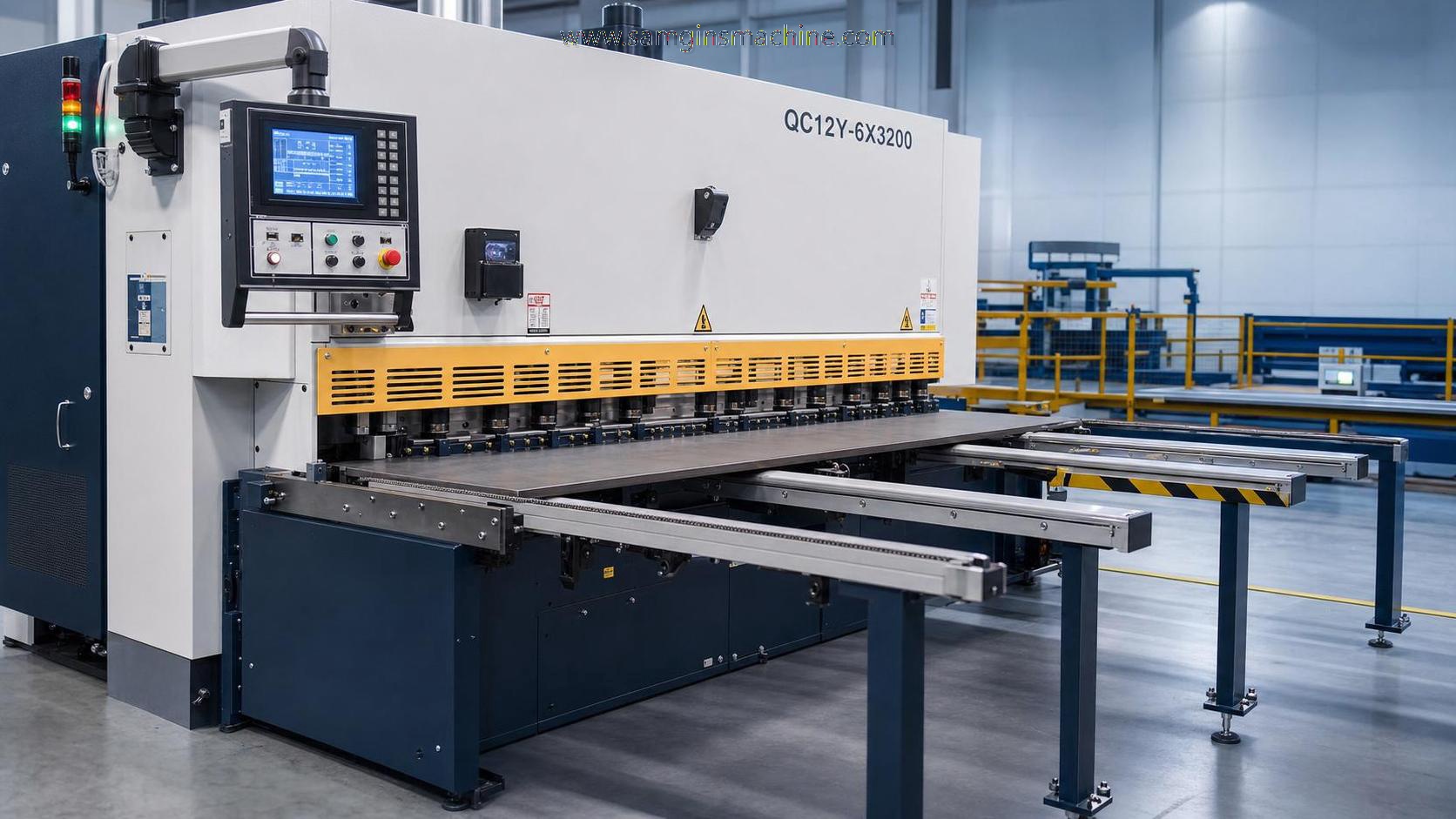
Automatic Shear Risks Usually Start Before the Blade Moves
An Automatic Shear often enters a production line to reduce manual handling and keep output stable.
Yet in real workshops, downtime rarely begins with one dramatic failure.
It usually starts with small safety gaps, unstable sheet positioning, and maintenance habits that drift over time.
Those issues do more than raise injury exposure.
They also create burrs, edge deviation, scrap, and repeated setup corrections.
In manufacturing and processing machinery, the same Automatic Shear can behave very differently across metal service work, structural fabrication, and high-accuracy parts production.
The risk profile changes with plate thickness, batch size, surface requirements, and how material reaches the cutting zone.
That is why safety review and process review should be treated as one discussion.
Companies supplying global fabrication equipment, including Wuxi Samgins International Trade Co.,Ltd, usually see this pattern clearly across export projects.
Standards may be similar, but on-site conditions are rarely identical.
Actual Use Conditions Explain Why Safety Risks Differ
An Automatic Shear in automotive panels faces a different problem than one cutting medium-thick plates for construction frames.
Thin sheets are easier to mark, slip, and rebound.
Heavy plates bring higher clamping load, larger off-center stress, and more severe consequences when handling is inconsistent.
In decoration and appliance work, surface damage can trigger rework even when the cut dimension stays within tolerance.
In shipbuilding or metallurgy, the bigger concern may be wide plates, repeated cycles, and alignment drift during long runs.
A useful review starts with four questions.
- How often does material size change during the shift?
- Does the line depend on manual feeding, roller support, or automated transfer?
- Is edge quality more sensitive than pure output speed?
- What happens to the process when one guard, sensor, or backgauge loses consistency?
These questions reveal whether the main risk sits in guarding, handling, control logic, or maintenance discipline.
High-Volume Plate Cutting Exposes Guarding and Handling Weakness First
In construction, power generation, and heavy fabrication, throughput often receives most of the attention.
That is reasonable, but it can hide two common Automatic Shear risks.
The first is incomplete guarding around the feed path.
The second is unstable sheet support during side loading or discharge.
When large plates sag, twist, or drag, the operator often compensates manually.
That increases hand exposure and also shifts the sheet away from the intended cut line.
Downtime then appears as jam clearing, edge correction, and unexpected blade wear.
For this kind of work, support balls on the table, firm hold-down action, and stable backgauge positioning matter as much as nominal cutting force.
A machine such as Hydraulic Swing Beam Shear is usually better judged by how safely it controls plate movement during full-cycle operation, not only by tonnage.
Precision-Focused Production Loses Money Through Small Deviations
Aviation, electrical appliances, and light industry often place tighter pressure on repeatability.
Here, the dangerous assumption is that safety and precision are separate topics.
They are closely linked.
If the backgauge drifts, the line does not only produce wrong sizes.
Operators may bypass normal checks to recover output.
If hold-down pressure varies, thin sheets can shift or mark, causing both scrap and unsafe intervention near the blade area.
For these settings, repeat positioning around ±0.01 to 0.05 mm and cutting accuracy at or below ±0.02 mm are not abstract figures.
They indicate whether the process can stay predictable without repeated adjustment.
More advanced control systems with stored programs and automatic parameter adjustment help reduce setup variability between batches.
That becomes especially useful when one shift handles many part numbers.
Different Environments Change What Safe Operation Really Means
Chemical engineering and metallurgy usually introduce harsher operating conditions.
Dust, scale, heat, and fluid contamination can interfere with sensors, hydraulic stability, and routine inspection quality.
In those cases, an Automatic Shear may appear mechanically sound while control reliability is already degrading.
Shipbuilding and wide-plate work add another complication.
Large sheets create uneven loading and longer travel paths.
That makes alignment, side support, and interlock consistency more important than on smaller cells.
A mature swing beam structure can be effective for straight cutting of medium-thick material, but the surrounding handling system still decides whether the line remains safe and productive.
In practice, integrated hydraulic design, lower-noise return movement, and stable return action reduce fatigue on both the machine and the people around it.
Where the judgment points usually change
The Most Common Misjudgments Are Usually Preventable
One repeated mistake is evaluating an Automatic Shear only by cutting thickness and speed.
That ignores how the material enters, settles, and exits the machine.
Another mistake is treating similar industries as if they share the same requirements.
Automotive brackets, appliance housings, and decorative panels may use similar sheet sizes.
Their tolerance for surface damage and edge shape is rarely the same.
A third problem is underestimating maintenance as a safety control.
Loose sensors, delayed blade inspection, contaminated hydraulic circuits, and inconsistent nitrogen return behavior all increase hidden process risk.
It is also risky to compare equipment without checking compliance and control integration.
Alignment with ISO9001-based production discipline, CE-oriented safety thinking, and standards such as GB/T 14404-2024 provides a more reliable baseline than headline specifications alone.
Useful Adaptation Steps Before Downtime Becomes Routine
A practical review does not need to be complicated.
It needs to be specific to the actual cutting mix.
- Map all sheet types by thickness, width, surface sensitivity, and batch frequency.
- Check where manual intervention happens during loading, alignment, and offloading.
- Review whether guards and interlocks still support normal productivity without being bypassed.
- Validate backgauge repeatability under real production loads, not only during empty tests.
- Set inspection points for blade condition, hold-down behavior, and hydraulic cleanliness.
- Compare energy, noise, and return impact when the machine runs continuously.
Where production includes medium-thick plate batches, stored programs, automatic backgauge adjustment, laser alignment, and safety interlocks can remove many avoidable errors.
That is one reason lines built around equipment such as the Hydraulic Swing Beam Shear are often assessed by long-run stability, not by one clean sample cut.
What to Clarify Next for a Safer Automatic Shear Process
The real value of an Automatic Shear appears when safety protection, positioning accuracy, and material flow support each other.
When they do not, downtime and rework usually arrive together.
A better next step is to sort cutting tasks by scenario, then compare each one against handling method, tolerance target, guard layout, and maintenance demand.
That makes it easier to identify whether the current Automatic Shear setup fits the process, or whether the process is forcing unsafe compensation.
Clear scenario standards, realistic inspection intervals, and verified control consistency usually prevent more losses than another round of output pressure.
search
Products Navigation
Send Us A Message