




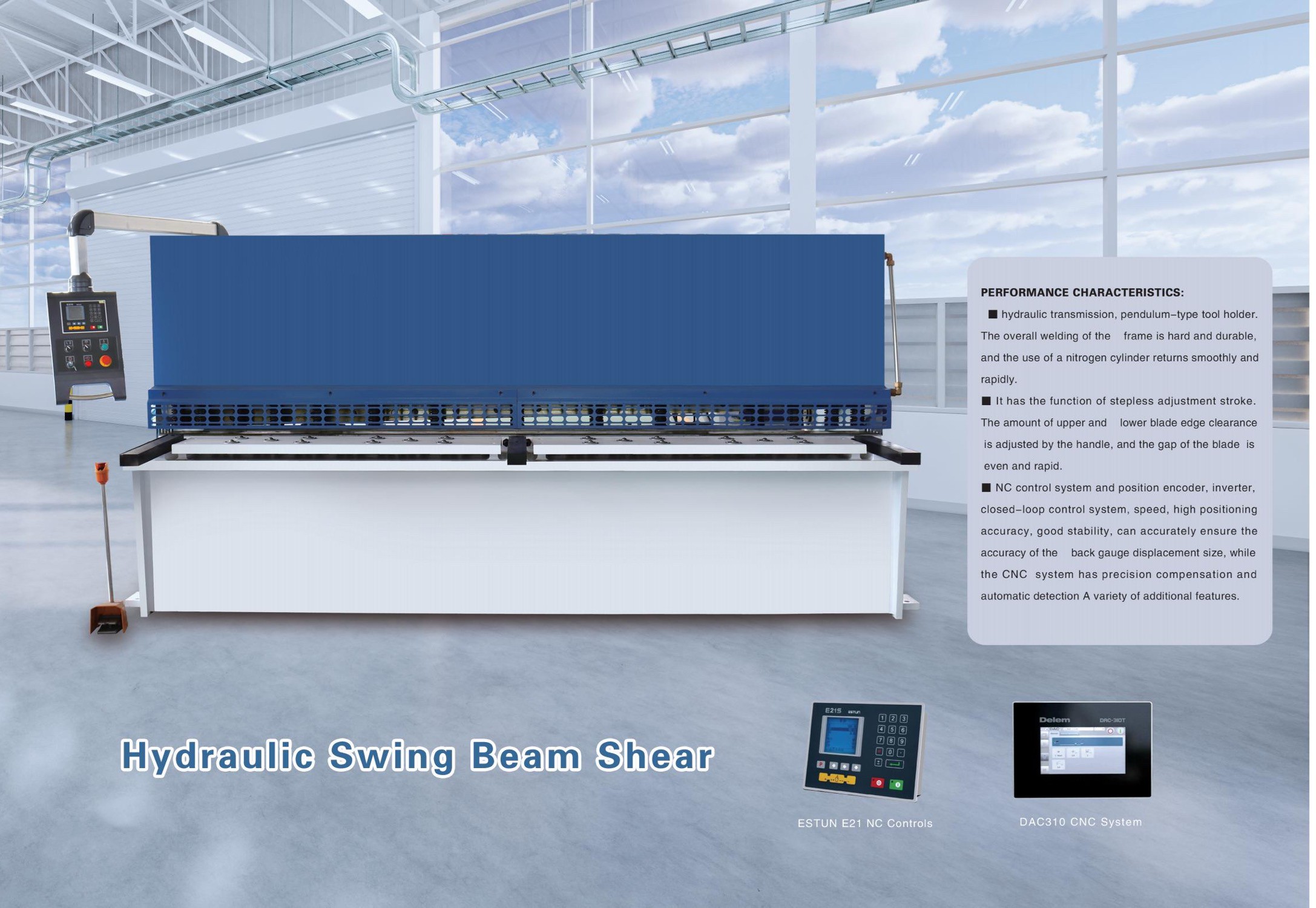
Hydraulic Swing Beam Shear
Shearing machines belong to the category of forging machinery and are primarily used in the metal processing industry. Their products are widely applied across numerous sectors, including aviation, light industry, metallurgy, chemical engineering, construction, shipbuilding, automotive, power generation, electrical appliances, and decoration, providing essential specialized machinery and complete equipment for these fields.
Full-range Machinery & Customized Non-standard Solutions
Authorized Certificates & Independent R&D Patents
Over 10 Years Global Export & Worldwide Project Cases
Navigation
Related products
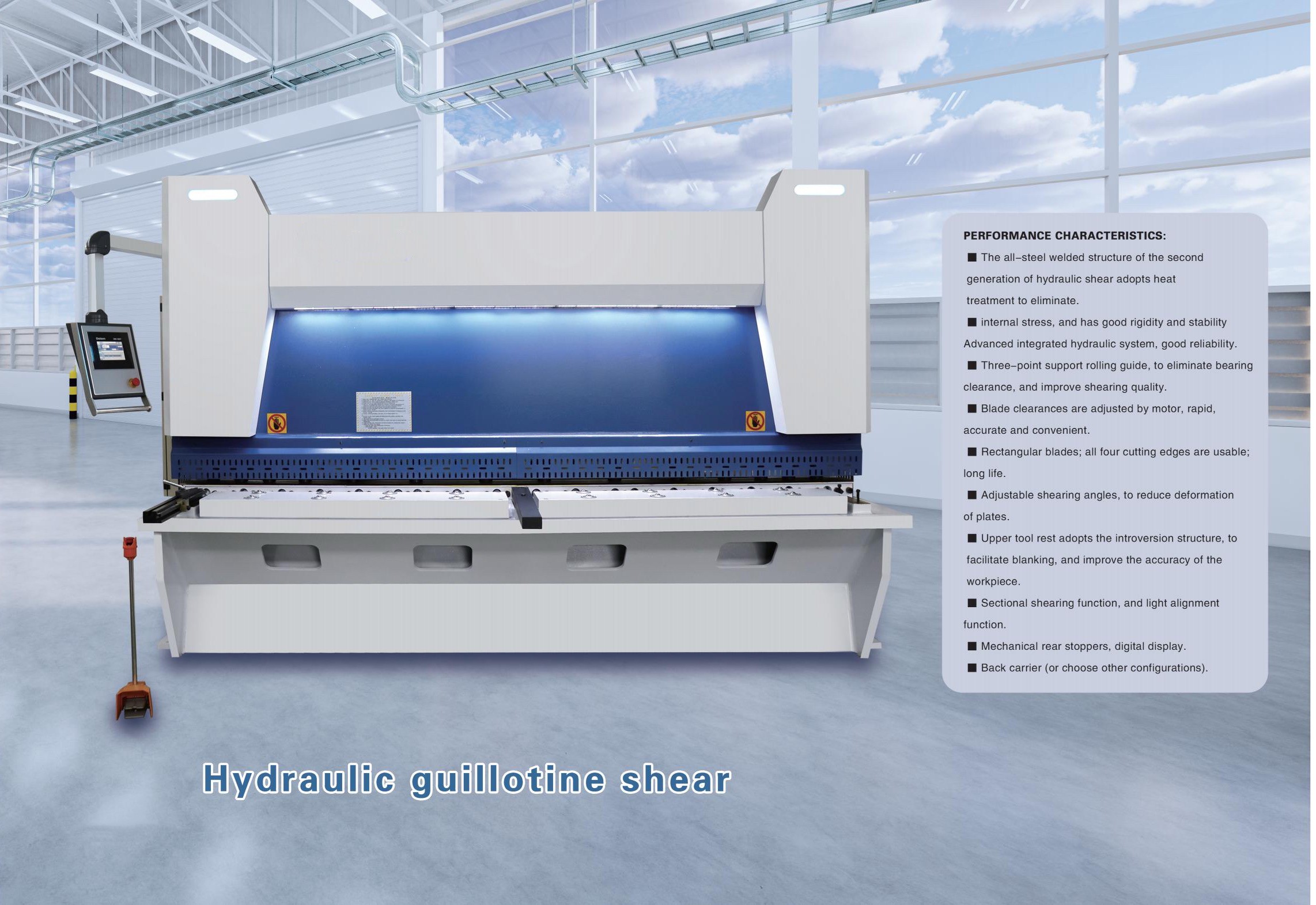

Hydraulic Swing Beam Shear Description
1.Introduction for Hydraulic Swing Beam Shear:
A shearing machine is a piece of equipment that uses a blade performing reciprocating linear motion to cut sheet metal. It operates with a moving upper blade and a fixed lower blade, set at an appropriate clearance, to apply shearing force to metal sheets of varying thicknesses. This force causes the material to fracture and separate along the required dimensions.
Shearing machines belong to the category of forging machinery and are primarily used in the metal processing industry. Their products are widely applied across numerous sectors, including aviation, light industry, metallurgy, chemical engineering, construction, shipbuilding, automotive, power generation, electrical appliances, and decoration, providing essential specialized machinery and complete equipment for these fields.
After the shearing process, the cut surface of the sheet must meet requirements for straightness and parallelism, while distortion of the sheet should be minimized to produce high-quality workpieces.
In terms of construction, the upper blade is fixed to the knife holder, while the lower blade is mounted on the worktable. The worktable is equipped with support balls to prevent the sheet from being scratched during sliding. A rear stopper, positioned by an electric motor, is used for accurate sheet positioning. A press cylinder holds the sheet firmly in place to prevent movement during cutting. A guard is provided as a safety device to protect operators from injury. The return stroke is typically driven by nitrogen, which offers fast action with low impact.
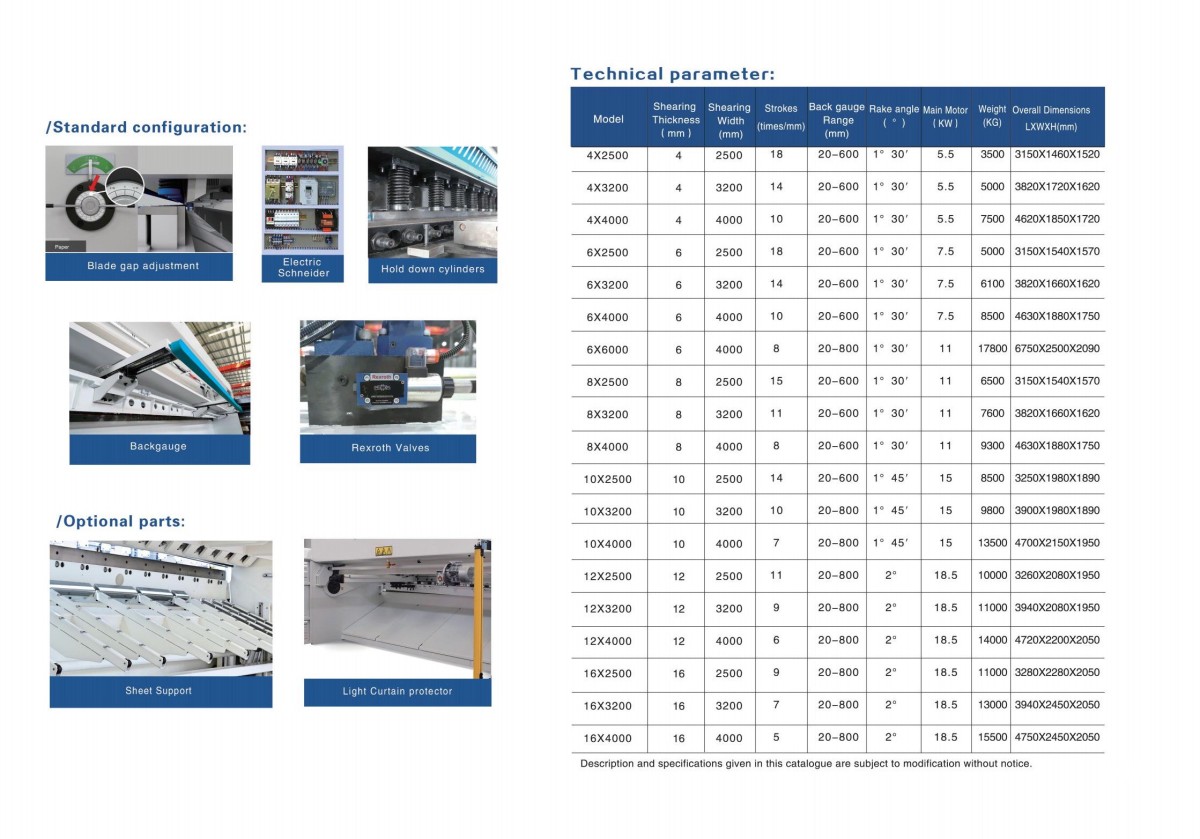
2.Technical parameter for Hydraulic Swing Beam Shear
 3.Characters for Hydraulic Swing Beam Shear:
 3.Characters for Hydraulic Swing Beam Shear:
3.1 Advantages: High shear force, smooth operation, suitable for batch production of medium-thick plates (6–40mm);
3.2 Swing-type: Mature structure, fast cutting speed, suitable for straight-line cutting of medium-thick plates;
3.3 Gate Type: Capable of withstanding significant off-center loads, suitable for scenarios with wide plates or high verticality requirements.
3.4 Modern Improvements: Utilizing an integrated welded fuselage, an integrated hydraulic system, and nitrogen return circuit, resulting in significantly reduced noise levels and a 20%–30% decrease in energy consumption.
3.5 High Precision: The repeatability positioning accuracy is ±0.01 - 0.05mm, meeting the new national standard GB/T 14404-2024 (the cutting accuracy is ≤ ±0.02mm)
3.6 Intelligence: Equipped with CNC systems (such as Delem, ESTUN), it supports automatic parameter adjustment, multiple program storage, and AI visual correction.
3.7 Automation: Automatic adjustment of the rear stopper, laser alignment, safety interlock protection
products faq
A swing beam shear has an upper blade that pivots on a fixed axis, offering a simpler, more cost-effective design suitable for general fabrication and routine cutting. A guillotine shear features an upper blade that moves vertically, providing better blade gap control, higher precision, and stronger performance on thicker materials—making it ideal for demanding applications with tighter tolerances.
The machine processes a wide range of materials including carbon steel, stainless steel, aluminum, and galvanized sheet. Standard models typically cut from 0.5mm to 40mm thickness, while heavy-duty configurations can handle up to 60mm or more. The maximum cutting length ranges from 1,000mm to 16,000mm, depending on the model and configuration.
Manual (conventional hydraulic) – relies on manual settings; economical and suitable for smaller workshops or repetitive work. NC – features a motorized backgauge with digital readout for faster, more accurate positioning. CNC – fully programmable with multi-step programs, setup storage, and automatic parameter adjustment—ideal for mixed orders, tight tolerances, and short lead times. CNC models offer the highest productivity and repeatability.
Routine maintenance includes:
Inspecting and sharpening blades; replacing when worn
Lubricating moving parts, guide rails, and bearings
Checking hydraulic oil levels, filters, and seals
Verifying backgauge accuracy and calibration
Inspecting electrical connections and control system components
Cleaning the machine to remove metal chips and debris
Following a scheduled maintenance plan ensures long-term reliability, cutting accuracy, and extended machine service life. We provide detailed maintenance schedules, spare parts support, and technical assistance.