




Automatic Welding Robot ROI: Labor Savings, Throughput, and Payback Period
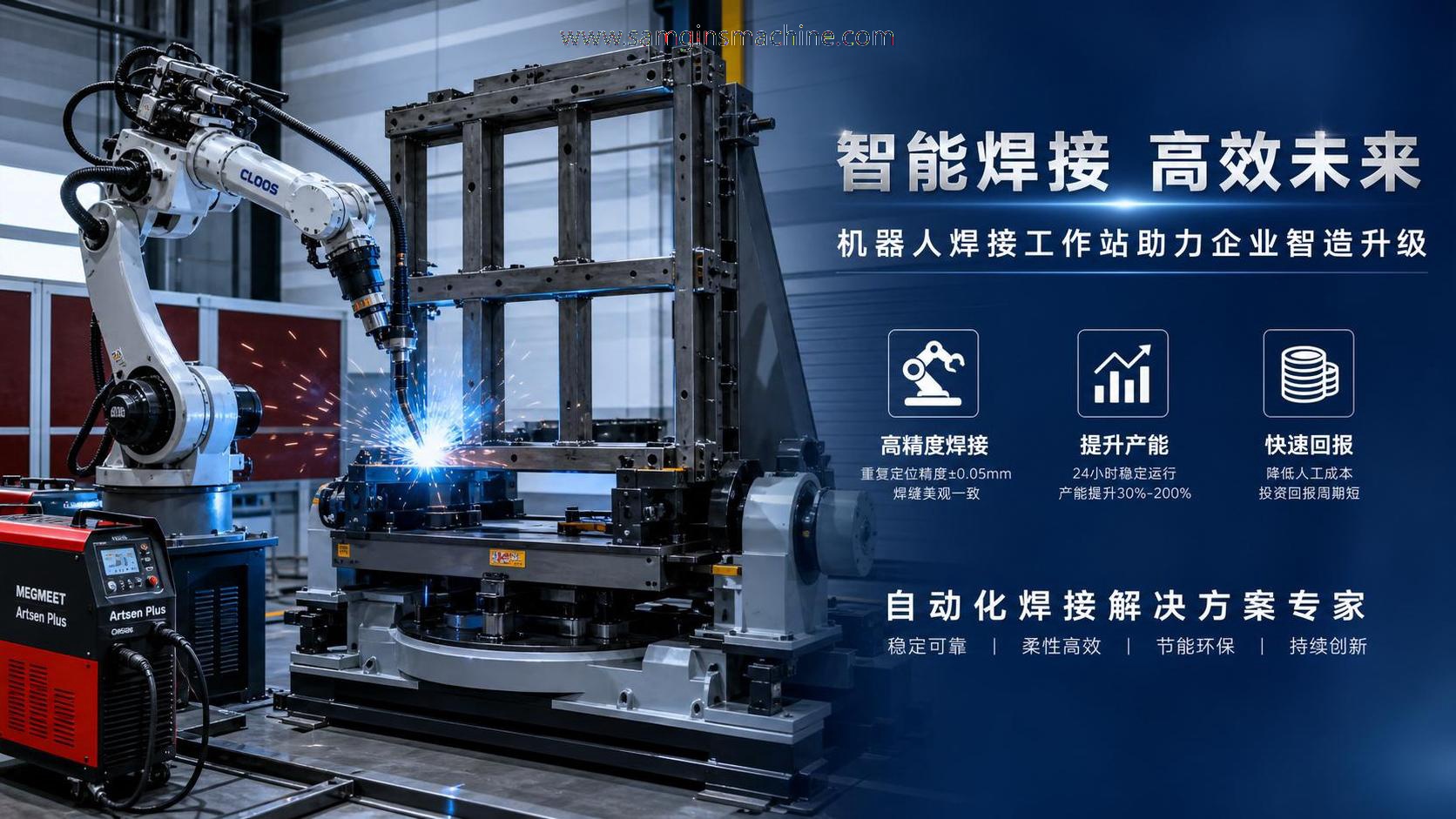
Automatic Welding Robot ROI: Labor Savings, Throughput, and Payback Period
For manufacturing leaders evaluating automation, the ROI of an Automatic Welding robot comes down to three key metrics: labor savings, throughput gains, and payback period.
In today’s fabrication market, cost pressure is constant. Skilled welders are harder to recruit, quality expectations are rising, and delivery windows keep shrinking.
That is why the Automatic Welding robot is no longer seen as a future upgrade. It is becoming a practical investment decision tied to margin, capacity, and operational stability.
A good ROI review should move beyond headline pricing. The real question is how fast the system improves output, lowers labor dependency, and pays back in normal production conditions.
Why Automatic Welding Robot ROI Is Under Closer Review
Several market shifts are driving more careful evaluation. Fabricators now need predictable costs, repeatable quality, and the ability to scale without depending on a few critical operators.
Manual welding still has an important place. However, repetitive welds, long batch runs, and high-volume parts often create the strongest case for an Automatic Welding robot.
This is especially true in structural steel, pressure vessels, machinery frames, agricultural equipment, automotive components, and general metal fabrication.
Wuxi Samgins International Trade Co.,Ltd has served global buyers with mechanical equipment since 2012, supplying welding automation, CNC machinery, cutting systems, and related production equipment.
With ISO9001-based production management and EU CE-oriented design standards, the company focuses on practical equipment performance, stable quality, and export-ready solutions.
Start With Labor Savings, But Calculate Them Correctly
Labor savings are usually the first ROI driver. Still, many buying teams underestimate or oversimplify the math.
The cost of manual welding is not just hourly wages. It also includes overtime, training, rework, supervision, turnover, and the production loss caused by labor shortages.
A typical Automatic Welding robot often allows one operator to manage multiple tasks. Depending on fixture design, programming complexity, and part consistency, one person may support several automated cycles.
That changes labor economics quickly. Instead of paying only for arc time, you begin paying for managed production time.
What to Include in Labor Cost Analysis
- Direct welder wages and benefits
- Overtime and shift premium costs
- Recruitment and onboarding expenses
- Rework caused by inconsistency
- Scrap from poor weld quality
- Production delays linked to staffing gaps
- Operator utilization after automation
In many plants, the biggest labor benefit is not headcount reduction. It is labor redeployment.
Experienced welders can move to fit-up, inspection, complex joints, prototype work, or bottleneck operations where manual skill has higher value.
Throughput Gains Often Matter More Than Labor Savings
Labor savings get attention first, but throughput is often the stronger reason to invest in an Automatic Welding robot.
Robotic welding improves cycle stability. Once the program, tooling, and part presentation are under control, output becomes more predictable across shifts and batches.
That consistency supports better scheduling. It also reduces hidden downtime caused by variation between operators.
Higher throughput can come from several sources:
- Faster welding speed on repeat parts
- Reduced setup variation
- Shorter non-arc handling time
- More stable production across shifts
- Lower rework and inspection delays
- Potential for longer running hours
In practical terms, throughput gains can unlock new orders without expanding floor space or adding another full manual welding team.
That matters when demand rises suddenly. It also matters when current output is limited by one welding cell holding back the rest of the line.
A Related Upstream and Downstream Point
Welding automation performs best when cutting and part preparation are consistent. Uneven blanks and dimensional variation reduce robotic efficiency.
That is why some manufacturers review supporting equipment during automation planning, including cutting, edge preparation, and material handling systems.
For example, a Hydraulic guillotine shear can support cleaner, repeatable sheet preparation for downstream fabrication processes.
In batch production of medium-thick plates, features like automatic parameter adjustment, rear stopper control, laser alignment, and safety interlock protection help stabilize input quality.
Where precision matters, repeatability of ±0.01 - 0.05mm and cutting accuracy of ≤ ±0.02mm can reduce downstream fit-up issues before welding starts.
How to Estimate Payback Period for an Automatic Welding Robot
The payback period is where ROI becomes concrete. Most buyers want to know when the investment starts generating net financial benefit.
A realistic payback model should include both cost and revenue factors. Focusing only on purchase price creates a distorted picture.
Key Cost Inputs
- Robot system price
- Welding power source and torch package
- Fixtures and positioners
- Safety enclosure and extraction
- Installation and commissioning
- Programming and training
- Maintenance and consumables
Key Return Inputs
- Annual labor savings
- Added gross profit from higher output
- Lower scrap and rework cost
- Reduced outsourcing expense
- Improved delivery performance and customer retention
A simple formula is useful: payback period equals total investment divided by annual financial gain.
In many fabrication environments, the payback period for an Automatic Welding robot falls between 12 and 30 months. The actual number depends on utilization and part mix.
High-volume, repetitive products usually reach payback faster. Low-volume, high-mix production may still justify automation, but fixture strategy and programming efficiency become more important.
Common ROI Mistakes During Procurement
Some automation projects underperform because the buying team asks the wrong questions early on. Most issues are avoidable.
- Using labor replacement as the only ROI metric
- Ignoring fixture design and part consistency
- Assuming every weld is suitable for automation
- Underestimating training and process setup time
- Failing to measure current welding bottlenecks accurately
- Overlooking upstream preparation quality
The better approach is to assess a real family of parts, current cycle times, rework levels, and available production hours.
That gives a more credible ROI model than using general market averages.
What a Strong Business Case Looks Like
A convincing business case for an Automatic Welding robot usually combines financial return with operational resilience.
It should clearly show:
- Current manual welding cost per part
- Expected robotic cycle time per part
- Expected quality improvement
- Annual capacity increase
- Estimated payback period
- Operational risks and mitigation steps
More importantly, it should reflect the plant’s actual workflow. A theoretical ROI model is less useful than a grounded, line-specific one.
Final Takeaway for Buyers Comparing Options
An Automatic Welding robot is not automatically the right answer for every product. But for repeatable welding tasks, it can materially improve labor efficiency, output, and delivery reliability.
The strongest purchase decisions start with process data, not assumptions. Review real part families, real labor costs, real rework rates, and real production constraints.
When that analysis is done properly, the ROI of an Automatic Welding robot becomes much easier to defend internally and much easier to capture on the shop floor.
The next practical step is simple: define one high-volume welding application, estimate the current cost per part, and build the payback model around that baseline.
That approach creates a clearer procurement path, reduces investment risk, and turns automation from a concept into a measurable operating advantage.
search
Products Navigation
Send Us A Message