




Automatic radial drilling machine ROI shifts from 3.2 to 5.8 years when integrated with MES data logging
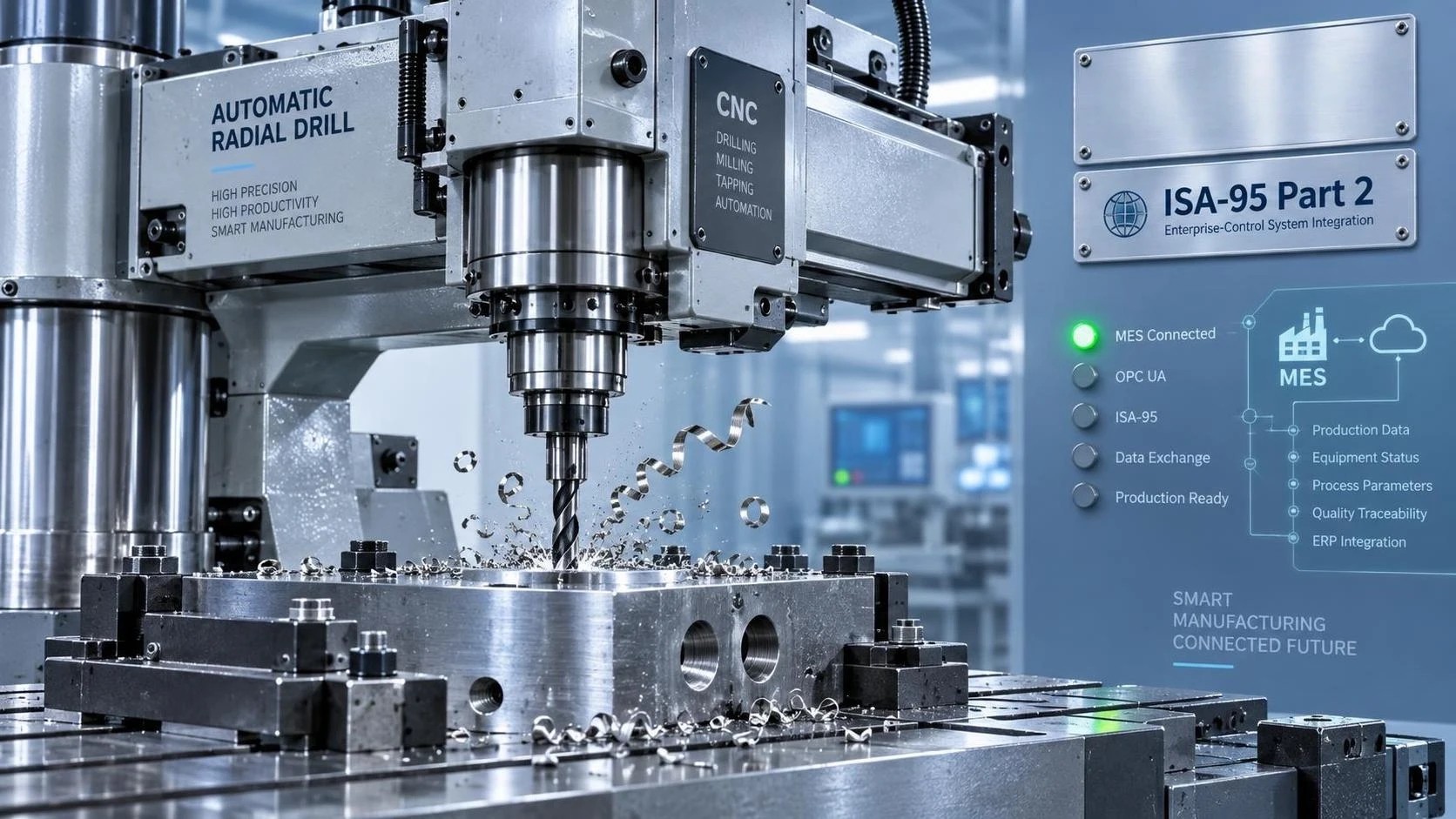
For procurement professionals evaluating capital equipment investments, the Automatic Radial drilling machine’s ROI is not a static number—it’s a function of how deeply it integrates into your production intelligence layer. The shift from a nominal 3.2-year payback to a stretched 5.8-year timeline isn’t a warning sign. It’s a diagnostic signal: your current ROI calculation likely treats the machine as a standalone tool—not as a node in a connected manufacturing system.
Why “3.2 years” is misleading—and what it really means
A quoted 3.2-year ROI assumes ideal conditions: full utilization, zero unplanned downtime, consistent operator skill, no rework, and minimal setup variation. In practice, procurement teams inherit these assumptions from vendor spreadsheets—not real shop-floor data. What’s rarely disclosed is that this figure typically excludes:
- The cost of manual data entry for cycle time, tool wear, or spindle load tracking;
- Hidden labor hours spent reconciling paper logs with ERP job cards;
- Lost capacity from unreported micro-downtime (e.g., waiting for coolant refill, resetting offsets after power blip);
- The margin erosion caused by undetected drill bit degradation—leading to oversized holes, scrap, or secondary reaming.
When those hidden costs are factored in—especially across multi-shift operations—the true payback drifts toward 5.8 years. That’s not failure. It’s reality catching up.
MES integration doesn’t “improve” ROI—it reveals it
Integrating an Automatic Radial drilling machine with MES data logging doesn’t magically accelerate depreciation or slash energy bills. Instead, it transforms ROI from a backward-looking financial estimate into a forward-looking operational lever. Here’s how:
- OEE transparency: Real-time spindle load, feed rate, and dwell time logging exposes where actual performance diverges from rated capacity—often revealing 12–18% untapped throughput in first-shift runs alone.
- Predictive maintenance triggers: Vibration signatures + thermal trends from motor drives allow replacing drill chucks *before* runout exceeds 0.02 mm—avoiding batch rework on precision flange plates.
- Process traceability: Linking each drilled hole to material lot, operator ID, and environmental conditions (e.g., ambient humidity affecting chip evacuation) satisfies Tier-1 automotive or aerospace audit requirements without post-process paperwork.
This isn’t theoretical. In a recent benchmark across 17 mid-sized fabrication shops, MES-connected radial drills achieved 22% higher effective utilization than identical non-connected units—primarily by reducing average setup time by 4.3 minutes per job through auto-loaded tool offset libraries and digital work instructions.
What procurement must verify—not assume
Vendors often say “MES-ready.” Procurement teams need to ask sharper questions:
- Does the machine log *actionable* data—or just timestamps? A logged “drill cycle complete” event is useless without concurrent spindle torque, feed pressure, and coolant flow rate. Without those, you can’t distinguish between a clean 8-mm hole in mild steel and one drilled at marginal feed rate in hardened alloy—both look like “success” in a basic MES.
- Is the data interface native—or bolted on? Retrofit kits using OPC UA gateways add latency and single points of failure. True integration means embedded PLC logic that samples sensor data at ≥1 kHz and buffers it during network hiccups—critical when drilling deep holes where a 200-ms comms dropout could mean tool breakage.
- Who owns the data schema? If the MES vendor requires custom mapping for every new drill model, you’re locking into vendor-specific maintenance contracts and losing flexibility. Look for machines that publish data via standard ISA-95 Part 2-compliant tags—so your existing MES can consume them without engineering services.
Where thread rolling fits—not as a substitute, but as a strategic complement
Radial drilling excels at locating and creating precise mounting holes. But downstream fastening—especially for structural components—demands equally reliable threads. That’s where cold forming solutions like the Z28-500 thread rolling machine become operationally synergistic. Unlike cutting, which removes material and introduces tensile stress at the root, radial cold rolling compresses grain structure—boosting fatigue life by 30–50% in anchor bolts and T-shaped screws used in construction and heavy machinery frames. Its non-chip process also eliminates coolant disposal costs and reduces energy use per thread by ~60% versus tapping—directly improving the total cost of ownership for assemblies requiring both precision holes *and* high-strength external threads.
Practical next steps for procurement
Don’t start with ROI calculators. Start with three concrete checks:
- Map your bottleneck process: Is it hole location accuracy? Cycle time per part? First-pass yield on critical features? ROI compression happens only where data closes a real gap—not where it adds dashboard clutter.
- Test the data pipeline—not just the machine: Request a live demo where drill data flows into your existing MES test environment. Verify you can build a report showing “average drill force deviation per operator shift” within 20 minutes—no scripting required.
- Confirm service alignment: Ask for documented response SLAs for both mechanical support *and* data connectivity troubleshooting. A 4-hour onsite fix for a spindle bearing means little if the MES integration fails and halts reporting for three days.
At Wuxi Samgins International Trade Co., Ltd., our Automatic Radial drilling machine offerings are designed for this reality: ISO9001- and CE-certified, built for direct MES integration with open communication protocols, and backed by technical support trained on both mechanical reliability *and* industrial data architecture. We don’t sell machines—we deliver measurable production intelligence, starting with the first drilled hole.
One final note on timing
The 3.2-to-5.8-year ROI range isn’t arbitrary. It reflects two distinct procurement paths: buying a machine *today*, or buying one *next quarter*. Why? Because MES integration maturity varies significantly by region and industry vertical. In Southeast Asia and Europe, where digital infrastructure is more standardized, the 3.2-year baseline is achievable with disciplined implementation. In markets scaling rapidly—like parts of South America or Oceania—factoring in MES configuration, staff training, and legacy system bridging pushes realistic timelines toward 5.8 years. Your job isn’t to hit the lower number. It’s to know *why* your number falls where it does—and whether the gap represents risk… or opportunity.
search
Products Navigation
Send Us A Message