




What makes universal radial drilling machines still relevant for legacy tooling compatibility?
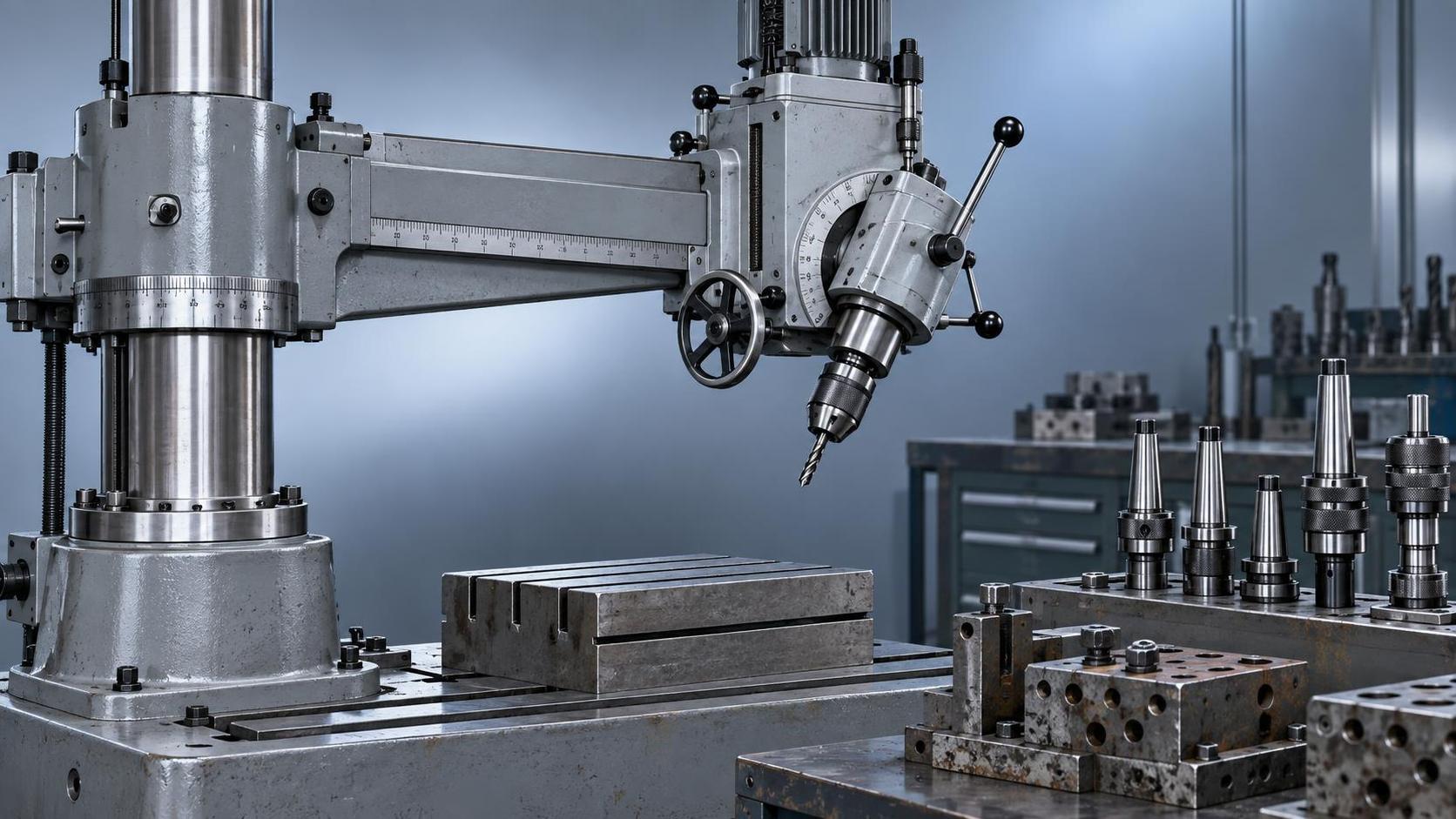
Universal radial drilling machines endure not because they are outdated, but because their mechanical architecture directly addresses a persistent operational constraint: the need to maintain dimensional and functional continuity with tooling, fixtures, jigs, and workholding systems designed decades ago. Unlike CNC or robotic drilling cells—which often require re-engineering of part positioning, datum referencing, and clamping geometry—universal radial drills operate within the same physical and kinematic envelope as legacy manual or semi-automatic units. Their column-and-arm structure, manually adjustable radial arm rotation, telescoping quill feed, and multi-axis spindle tilt allow operators to replicate hole patterns, depth tolerances, and angular orientations using original shop drawings without digital translation layers.
Mechanical Interchangeability Over Digital Integration
The core relevance lies in physical compatibility—not software compatibility. A universal radial drill’s spindle nose interface, taper type (typically Morse or ISO), and chuck mounting standard match those used on 1970s-era machines still active in aerospace overhaul facilities, heavy equipment rebuild shops, and rail maintenance depots. This means existing drill jigs, bushings, pilot pins, and template plates retain full utility. There is no need to re-certify fixture repeatability after retrofitting, nor to recalibrate coordinate systems when switching between machining operations. The machine does not introduce new axes of error—instead, it preserves the accumulated tolerance stack-up already validated across generations of production runs.
Operator Control Without Abstraction
Legacy workflows often rely on tactile feedback and incremental adjustment rather than programmed offsets. On a universal radial drill, an operator can visually align the spindle over a scribed reference point, lock the arm at a precise radius, fine-tune vertical position using micrometer dials, and confirm angular orientation via built-in protractors—all without accessing a control panel or loading a program. This direct mechanical linkage eliminates latency, interpolation drift, or servo tuning variables that affect repeatability when drilling into warped castings, corroded structural members, or thermally aged forgings. Where surface condition varies significantly across a single workpiece—common in repair or refurbishment—the ability to adjust feed rate, spindle speed, and pressure in real time remains decisive.
Structural Stability Under Non-Uniform Loads
Radial drills excel where workpieces defy standard fixturing: large I-beams, curved hull sections, or asymmetrical turbine casings. Their massive column base, ground-and-scraped ways, and rigid arm support deliver minimal deflection during deep-hole drilling in carbon steel or stainless steel—even at extended arm lengths. Unlike gantry-mounted CNC drills, which may induce flexure across long spans, the radial design localizes bending moments within the column-arm junction, preserving perpendicularity and positional accuracy. This stability matters most when matching holes to pre-existing bolt patterns or mating flanges where ±0.1 mm deviation risks assembly interference or seal failure.
Serviceability and Part Longevity
Components such as gearboxes, feed screws, and hydraulic clamps follow standardized dimensions and material specifications established before 1990. Replacement parts remain available from multiple suppliers—not locked behind proprietary firmware or obsolescence-controlled vendor channels. Bearings, belts, and limit switches use off-the-shelf industrial grades, not custom ASICs or sealed modules. Maintenance protocols rely on torque specs, backlash measurements, and visual wear indicators—not diagnostic software requiring OEM licenses. This reduces downtime during emergency repairs and avoids the cascading cost of upgrading ancillary systems just to sustain one machine.
Where Modern Systems Complement—Not Replace
In hybrid shop floors, universal radial drills often coexist with newer equipment for specific process handoffs. For example, a Through CNC Milling machine may prepare plate edges for welding with micron-level bevel accuracy across thicknesses from 6–400 mm, while the radial drill handles subsequent hole-making on the same part—using the same datum surfaces and without relocating the workpiece. This avoids double-setup errors and maintains traceability across operations. The milling machine’s high-speed, dual-side beveling eliminates secondary grinding; the radial drill then drills bolt holes aligned precisely to those beveled edges, leveraging its mechanical rigidity to hold tight positional tolerances even on aluminum plates or stainless steel where thermal expansion shifts during multi-step processing.
Material-Specific Behavior That Reinforces Relevance
Drilling aged cast iron or high-carbon steel demands controlled torque delivery and immediate overload response—features embedded in mechanical gear trains, not algorithmic feed control. When encountering internal porosity or hardness variations, a radial drill’s inertia-damped spindle slows naturally under resistance, allowing the operator to detect anomalies before breakage. CNC systems may override such cues in pursuit of cycle time targets, risking tool fracture or misaligned holes. Similarly, on large-diameter pipe sections or H-beam webs, the radial drill’s ability to pivot the spindle head vertically and horizontally accommodates irregular contours without requiring complex 5-axis programming or costly custom tooling.
Limitations Define Its Niche—Not Its Obsolescence
This relevance is conditional: it applies where legacy tooling must remain in service, where workpiece variability exceeds CNC system compensation limits, and where operator judgment—not automation—is the primary quality gate. It does not scale for high-mix, low-volume job shops relying on rapid program changeovers. Nor does it suit applications demanding sub-micron positional repeatability across hundreds of identical features. But for workshops maintaining decades-old production lines—where replacing every jig, fixture, and inspection gauge would cost more than the machine itself—the universal radial drilling machine isn’t a fallback option. It’s the only path to continuity.
search
Products Navigation
Send Us A Message