




How CE certified welding robot compliance affects pressure vessel fabrication approval timelines
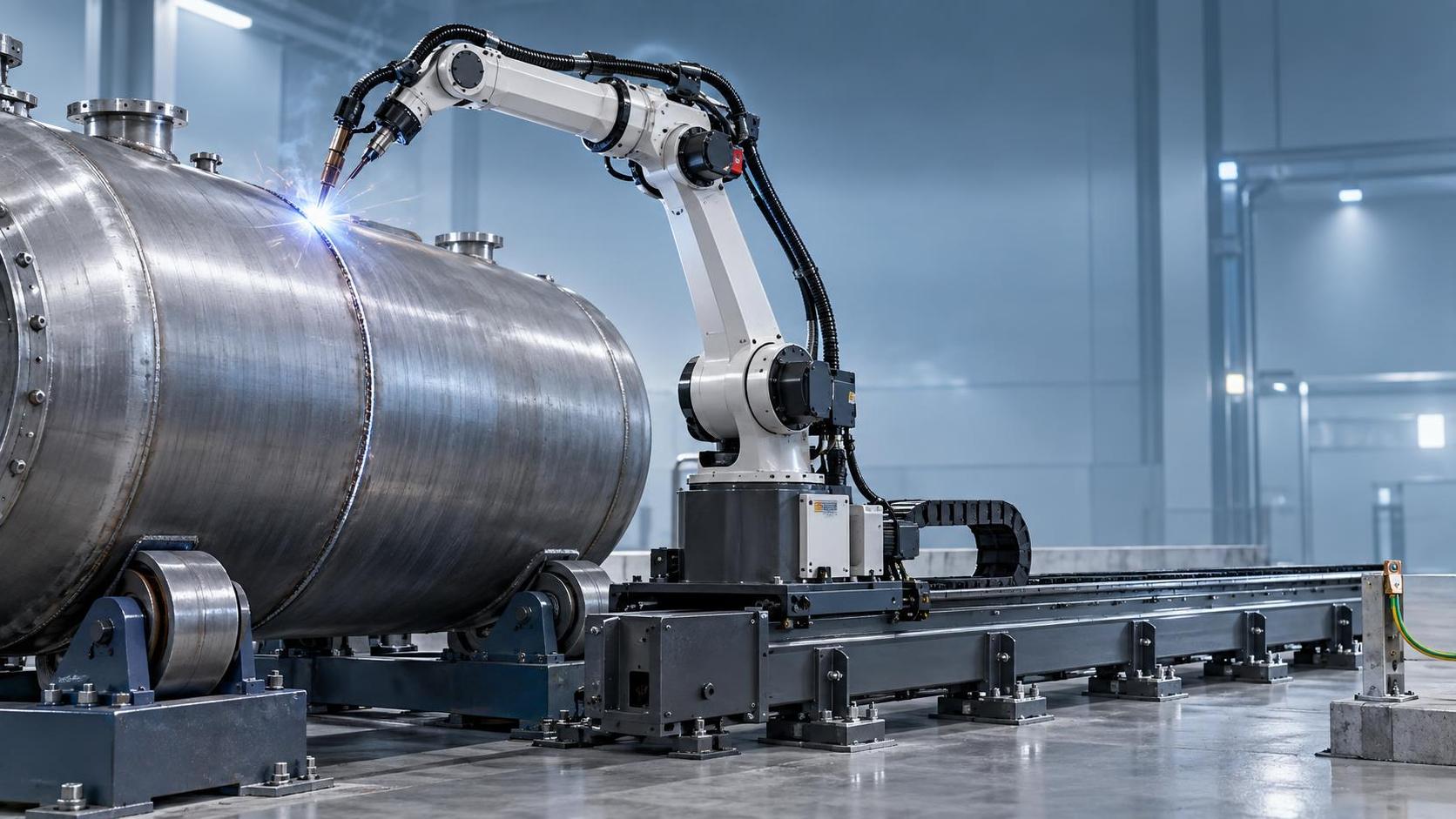
Why CE certified welding robot compliance isn’t just about safety—it’s about timeline predictability
For project managers overseeing pressure vessel fabrication, regulatory approval isn’t a final checkpoint—it’s a thread running through every phase. Delays rarely come from unexpected material flaws or weld defects alone. More often, they emerge during third-party review when documentation gaps surface—especially around automated systems integrated into the fabrication workflow. A CE certified welding robot isn’t merely a machine that meets EU machinery directives. It’s a documented, traceable, and auditable node in your quality chain—one that directly influences how quickly ASME Section VIII or PED conformity can be demonstrated.
CE marking on welding robots signals more than electrical safety or mechanical stability. Under Directive 2006/42/EC (Machinery Directive), it confirms conformity with essential health and safety requirements—including risk assessment, emergency stop functionality, protective guarding, and validated control logic. For pressure vessel fabricators, this matters because notified bodies reviewing your manufacturing system (e.g., TÜV, Lloyd’s Register, or DNV) will examine not only weld procedure qualifications (WPQs) but also how automation is controlled, monitored, and verified. If your robot lacks CE certification—or worse, carries a self-declared CE mark without full technical file backing—the audit may pause while you retrofit documentation, revalidate software logic, or even re-run qualification tests under witnessed conditions.
Where compliance friction actually shows up
Three points consistently trigger hold-ups:
1. Traceability of process parameters. CE-certified robots must log key variables—arc voltage, wire feed speed, travel speed, gas flow—with timestamps and user authentication. Non-compliant units often lack secure, tamper-resistant logging or store data in proprietary formats incompatible with ASME BPVC Section IX record-keeping. That forces manual transcription or custom integration—both vulnerable to error and scrutiny.
2. Emergency response validation. CE requires documented verification that all safety functions (E-stops, light curtains, collision detection) operate within defined response times. In pressure vessel shops, where joint fit-up tolerances are tight and thermal distortion critical, an unverified robot slowdown or abrupt stop can compromise weld geometry—and later, require NDE rework or even joint rejection.
3. Software architecture alignment. CE mandates that control software be developed under a defined lifecycle (IEC 61508 or ISO 13849-1 for safety-related parts). If your robot’s path planning or arc tracking relies on uncertified algorithms—or if updates bypass version-controlled release protocols—you risk non-acceptance of weld records during design review.
Design-to-fabrication continuity reduces approval latency
Compliance isn’t only about passing inspection—it’s about eliminating rework loops between engineering and shop floor. Consider manufacturers processing structural steel parts or fabricated assemblies with frequent model changes. When design files originate in TEKLA Structures, the ability to import drawings directly—not via intermediate CAD conversion—cuts interpretation errors and preserves weld sequence logic. That matters during PED Annex I review, where inspectors assess whether fabrication instructions align with design intent and material specifications.
The Cantilever type welding robot BR-2010A Pro/DG12 exemplifies this integration: no teaching programming required, laser camera positioning for real-time part recognition, and automatic welding program generation from native TEKLA input. Its control architecture includes three fault indicator lights (red/yellow/green), multiple emergency stops, and a safety grounding system—all verified per EN ISO 12100 and EN 60204-1. The result? Less time spent reconciling shop-floor execution with engineering deliverables—and fewer surprises when the notified body cross-checks weld logs against WPS records.
Floor layout and scalability shape audit readiness
Physical integration affects compliance too. A robot installed without dedicated rail support, proper grounding, or documented load-path analysis may pass initial CE testing—but fail during factory inspection if mounting rigidity or vibration damping hasn’t been validated for cyclic loading. The BR-2010A Pro/DG12, for instance, specifies a ground rail support total length of 12 meters and a planned floor space of 12 meters in width and 2 meters in depth. This isn’t arbitrary: it ensures consistent kinematic behavior across its operational envelope, which supports repeatable arc tracking and stable heat input—both prerequisites for ASME-referenced procedure qualification.
For workpieces exceeding 12 meters but less than 25 meters in length, using two robots in zone-based welding avoids single-point failure modes and maintains process consistency across longer seams—a practical advantage when demonstrating uniformity for PED Category III/IV vessels.
What “CE certified” really means on paper—and on site
Wuxi Samgins International Trade Co., Ltd., established in October 2012 and located 30 minutes from Shanghai by high-speed rail, designs and produces equipment under ISO 9001 and EU CE standards. Their CE-certified welding robots undergo full technical file compilation—including risk assessment reports, harmonized standard references (EN ISO 12100, EN 60204-1, EN ISO 13857), and EC-type examination where applicable. This isn’t delegated to a third-party lab for a one-off test. It’s embedded in their development workflow—from component selection to software validation.
That distinction matters. Some suppliers provide CE declarations based solely on component-level certifications (e.g., power supply or servo drive). But full-machine CE requires system-level verification—including how those components interact under fault conditions. For pressure vessel fabricators, that difference surfaces during audit when reviewers ask for evidence of safe state transition during power loss or communication interruption.
Next steps aren’t about choosing a robot—they’re about mapping your approval path
Before specifying any CE certified welding robot, clarify three things with your notified body or internal QA team:
- Which clauses of the Machinery Directive apply to your specific use case (e.g., robotic welding cell vs. integrated production line)?
- Do they require full technical file submission—or will a Declaration of Conformity backed by accredited test reports suffice?
- How do they treat software updates post-installation? Are version-controlled releases mandatory, or is field patching permitted?
If your current approval timelines hinge on manual welder qualification cycles or paper-based logbooks, introducing a CE certified welding robot won’t compress them overnight. But it does shift the bottleneck—from reactive correction to proactive validation. And that’s where real predictability begins.
search
Products Navigation
Send Us A Message