




What total cost of ownership differences emerge between welding robot for tank fabrication and manual GTAW over 5 years?
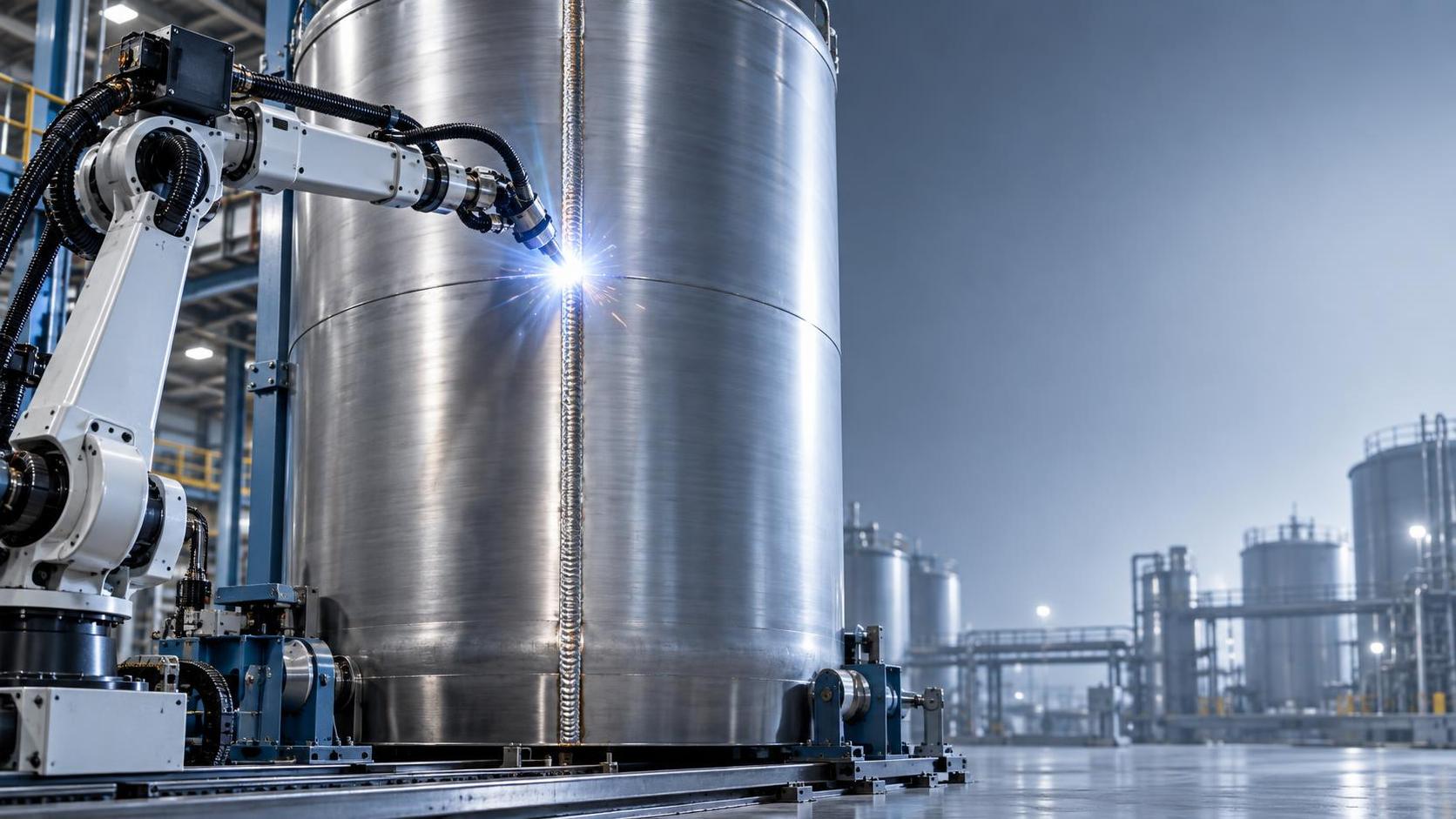
When evaluating the 5-year total cost of ownership (TCO) for tank fabrication, the choice between a welding robot for tank fabrication and manual gas tungsten arc welding (GTAW) is rarely about upfront price alone. For capital-intensive projects—especially those involving large-diameter cylindrical vessels, pressure-rated storage tanks, or ASME-coded components—the real financial impact emerges across labor continuity, weld consistency, rework frequency, consumable consumption, and equipment longevity. Unlike discrete-part manufacturing, tank fabrication demands extended seam integrity over circumferential and longitudinal joints, where human fatigue, positional variability, and process drift directly compound defect probability.
Direct Labor Costs: Scale, Stability, and Hidden Overhead
Manual GTAW relies heavily on certified welders with specialized experience in pipe-to-shell transitions, vertical-up progression, and root pass control on thick-walled carbon or stainless steel. A single qualified welder typically achieves 1.2–1.8 meters of qualified weld per hour under optimal conditions—but this drops to 0.7–1.1 meters when accounting for joint preparation verification, interpass cleaning, preheat monitoring, and post-weld heat treatment coordination. In contrast, a dedicated welding robot for tank fabrication maintains consistent travel speed, arc voltage, and wire feed across shifts. It operates at 92–95% cycle time utilization versus 60–68% for manual crews—factoring in breaks, tool changes, and non-welding administrative tasks. More critically, labor costs include not just wages but also recruitment, certification renewal (AWS D1.1/D1.6 every 6 months), overtime premiums during peak delivery windows, and turnover-related retraining. Over five years, these ancillary burdens add 22–34% to base payroll expense—a factor rarely modeled in initial ROI calculations.
Weld Quality Consistency and Rework Avoidance
Tank fabrication tolerances are unforgiving: undercut exceeding 0.4 mm, incomplete fusion in the first pass, or excessive convexity on fillet welds can trigger full-section NDT rejection or mandatory grinding and re-welding. Manual GTAW introduces variation through torch angle deviation (>±3°), inconsistent filler wire dip frequency, and minor arc length fluctuations—each increasing porosity risk in low-heat-input regimes. Robotic systems eliminate these variables via precise path tracking, closed-loop current regulation, and integrated seam tracking sensors that adjust torch position in real time. Field data from facilities fabricating API 650 and EN 13445 tanks show robotic cells reduce weld-related NDE rework by 68–79% compared to manual lines operating under identical material and joint design specifications. That translates directly into avoided labor hours, scrap material, and delayed project billing cycles—costs that accumulate faster than equipment depreciation.
Maintenance, Consumables, and System Lifespan
GTAW consumables—tungsten electrodes, shielding gas (argon/helium blends), and filler rods—account for 18–23% of total welding cost per meter. Electrode contamination, improper grinding angles, and inconsistent gas flow increase spatter and electrode erosion, raising replacement frequency. Robotic systems use automated tungsten dressing, fixed gas flow calibration, and precision wire feeding—reducing consumable waste by 31–42%. Maintenance is also structurally different: manual setups require frequent recalibration of amperage controls, gas regulators, and water-cooling circuits; robotic cells shift maintenance burden to scheduled servo motor lubrication, encoder verification, and teach-pendant software updates—tasks requiring less specialized technician time and fewer unplanned stoppages. With proper operational discipline, ISO9001-certified robotic welding cells routinely exceed 12,000 operational hours before major component overhaul, while high-utilization manual GTAW stations often require full torch assembly replacement every 4,500–6,000 hours due to thermal stress fatigue.
Integration Context Matters: Supporting Equipment and Workflow Alignment
The TCO advantage of robotic welding does not exist in isolation. It depends on how well auxiliary equipment supports continuous, repeatable part handling. For example, when tanks are fabricated using segmented shells, consistent pipe bending accuracy upstream directly affects fit-up tolerance—and poor bend geometry forces costly manual gap-filling or grinding before welding even begins. A precision NC hydraulic pipe bending machine ensures repeatability within ±0.3° across thousands of bends in power engineering or shipbuilding applications, reducing downstream weld distortion and misalignment correction time. Its PLC-controlled memory system stores up to 100 bending programs, each with 20 preset rotation and bending angles—enabling rapid changeover between tank diameter variants without recalibration downtime. This interoperability reduces bottleneck formation at the welding station, amplifying the TCO benefit of automation beyond the weld cell itself.
Five-Year TCO Breakdown: Where the Margins Shift
Over five years, the robotic solution typically shows breakeven at 18–24 months for medium-volume tank shops (30–50 units/year). The divergence widens after year three—not because robot depreciation slows, but because manual operations face compounding cost pressures: rising wage floors in skilled trades, increased insurance premiums tied to injury rates, and higher scrap allowances as workforce experience levels fluctuate. Meanwhile, robotic cells retain residual value through modular component reuse—such as repurposing manipulators for other heavy-plate applications—or trade-in eligibility against next-generation models. Crucially, the TCO model must include opportunity cost: a robotic cell producing 2.3 meters/minute of qualified weld enables one operator to oversee two cells simultaneously, freeing capacity for value-added activities like dimensional inspection or documentation compliance—activities that manual workflows often delay until final QA gate.
Ultimately, the 5-year TCO comparison hinges less on equipment sticker price and more on how labor, quality, and support systems interact across the fabrication sequence. When weld integrity, schedule adherence, and resource scalability drive contractual penalties or warranty exposure, the robotic approach delivers not just lower cost—but lower risk.
search
Products Navigation
Send Us A Message