




Are 9 axis welding robots compatible with legacy offline programming software used in bridge fabrication?
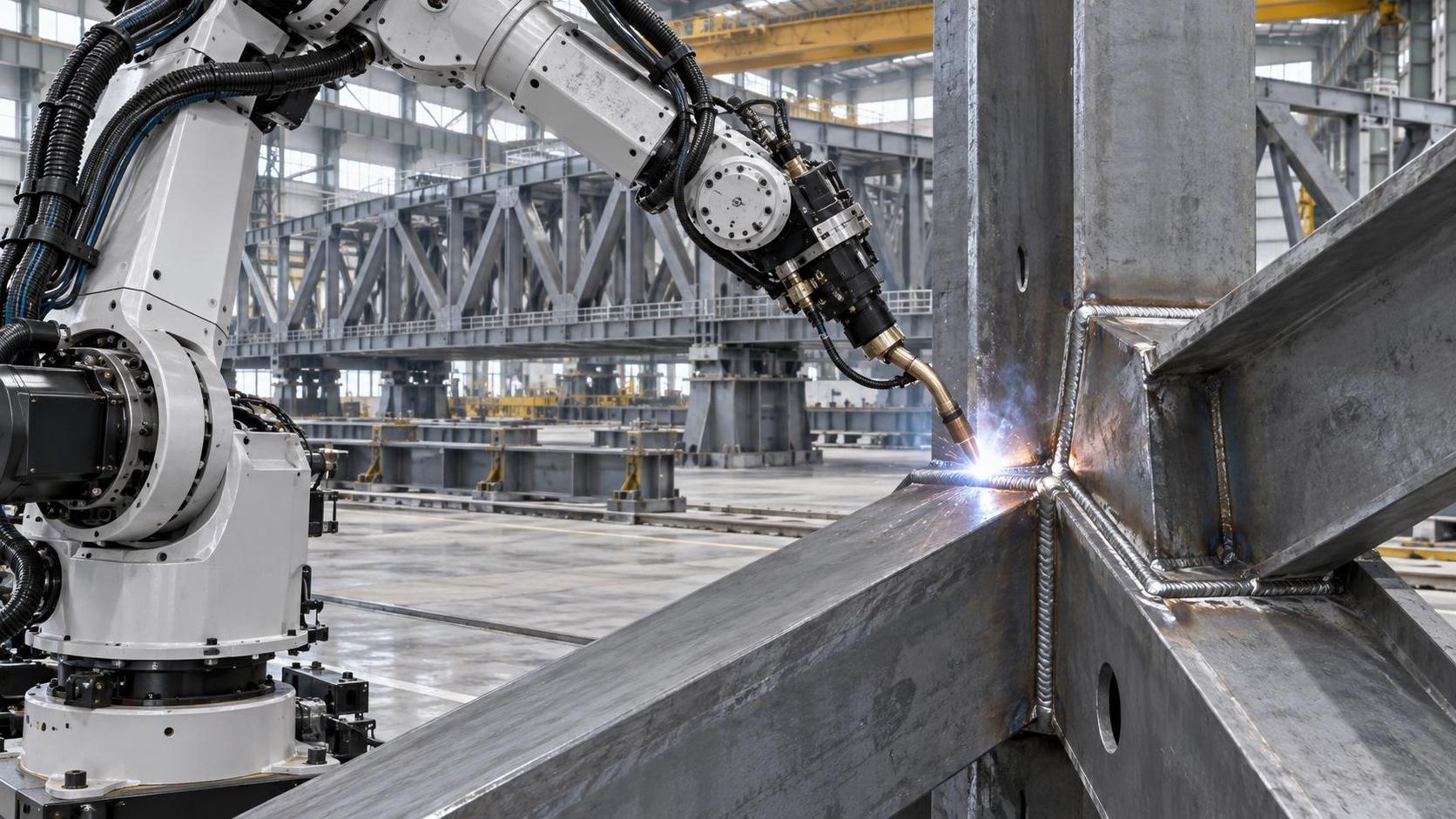
Compatibility Isn’t Just About Ports—It’s About Workflow Continuity
If you’re maintaining bridge fabrication lines in Southeast Asia, Europe, or the Americas—and you’ve just been asked to evaluate a 9-axis welding robot—you’re likely not asking “Does it plug in?” You’re asking: “Will my team still use the same offline programming software they’ve relied on for ten years? Will we retrain everyone? Will weld quality drop during transition?” That’s where real integration begins—not at the Ethernet port, but at the CAD model export step.
Why Legacy OLP Still Matters in Structural Steel
Bridge fabrication rarely runs on cloud-native platforms. Most heavy-steel shops still depend on mature offline programming (OLP) tools—some built in-house, others licensed from vendors like ESAB, ABB RobotStudio (pre-2018 versions), or Siemens NX CAM modules configured for truss and lattice work. These systems often rely on custom post-processors, proprietary path validation logic, and decades of accumulated weld sequence libraries. Introducing a new robot isn’t just about kinematics—it’s about whether your existing toolpath data survives translation without manual rework.
A 9-axis robot adds two rotational axes beyond standard 6-axis arms—typically at the torch or workpiece level—to enable full-envelope access around complex nodes in steel trusses or gusset plates. But that flexibility means nothing if your OLP can’t generate or verify trajectories that respect those extra degrees of freedom. Worse, some legacy systems assume fixed TCP orientation or ignore axis coupling constraints—leading to collisions or unreachable welds when imported into newer controllers.
What “Compatible” Actually Means in Practice
At Wuxi Samgins International Trade Co., Ltd.—a supplier with over a decade of experience supporting structural fabricators across multiple continents—we treat compatibility as a layered requirement:
- Data exchange fidelity: Our 9-axis welding robots accept STEP AP242 and IGES files directly from common CAD platforms used in bridge design (e.g., Tekla Structures, AutoCAD Civil 3D exports). No intermediate translators needed—just validated geometry with preserved layering and reference planes.
- Post-processor transparency: We provide open-source post-processor templates compatible with major OLP environments. If your shop uses a custom post, our engineering team works with your maintenance staff—not to replace it, but to extend it with 9-axis motion logic.
- API extensibility: For shops running internal scheduling or QA traceability systems, our robots expose RESTful endpoints for job status, weld parameter logging, and error codes—no need to retrofit OPC UA gateways or build middleware from scratch.
This isn’t theoretical. It’s how we support customers who run mixed fleets—older Fanuc ARC units alongside newer 9-axis cells—on single production lines for H-beam splicing and space-frame assembly.
A Real-World Anchor Point: Truss Welding Consistency
Take truss node welding—a high-stakes task where misalignment or inconsistent heat input risks fatigue failure under cyclic loading. Here, backward compatibility isn’t convenience—it’s risk mitigation. That’s why our Space frame welding machine was engineered with dual-side simultaneous welding capability and ±25 mm torch oscillation—features that require precise coordination between part geometry, joint gap tolerance (3–5 cm), and torch trajectory timing. When integrated with legacy OLP, this means operators don’t rebuild paths from scratch—they adjust swing parameters and verify reach envelopes using familiar interfaces.
The WJ-5500 model, for instance, handles workpieces up to 5.5 meters long and 180 mm in diameter—common dimensions for bridge lattice members. Its hydraulic clamping system and lead-screw manual lifting accommodate variations in fit-up without forcing recalibration. And because its PLC core is imported and field-tested against China’s flaw detection standards (Class I/II level), weld integrity stays verifiable even when programming originates from older software stacks.
Where Compatibility Breaks Down—And How to Spot It Early
Not all “9-axis” claims are equal. Some vendors market 3-axis positioners + 6-axis arms as “9-axis,” but omit critical details: Is the positioner synchronized in real time? Does the controller handle coupled motion planning? Can the OLP simulate both axes simultaneously—or does it treat them as sequential moves?
Ask these questions before procurement:
- Does your current OLP export toolpaths with explicit axis coupling definitions—or only Cartesian waypoints?
- Can your post-processor generate code that respects joint limits for *all nine* axes, not just the first six?
- Do your weld procedure specifications (WPS) reference angular velocity or dwell time at specific orientations? If yes, your OLP must pass those values through—not approximate them.
We’ve seen shops lose three weeks of commissioning time because their OLP assumed a fixed torch roll angle—only to discover mid-deployment that the 9th axis required dynamic roll adjustment to avoid wire tangling on concave flanges. Prevention starts with file-level testing—not robot commissioning.
No “One Size Fits All”—But There Is a Consistent Standard
Wuxi Samgins doesn’t push a universal adapter. Instead, we map each customer’s existing OLP workflow—its version, custom macros, output format, and validation checkpoints—then deliver integration packages validated against ISO 9001 processes and CE-compliant safety logic. That includes documentation traceable to weld parameter logs, axis position timestamps, and thermal cycle records—so compliance auditors see continuity, not disruption.
For maintenance technicians, this means fewer emergency calls during shift handover, less time reverse-engineering undocumented post-processors, and more confidence that a weld sequence generated in 2015 behaves identically on hardware deployed in 2024. That’s not marketing—it’s what happens when compatibility is designed into the architecture, not bolted on after.
If your next upgrade involves 9-axis welding robots, start by exporting one representative truss joint from your current OLP—then test it against the robot’s native simulator using actual part geometry and weld schedule. The result tells you more than any spec sheet ever could.
search
Products Navigation
Send Us A Message