




How much faster is a dedicated H beam 3D drilling machine versus CNC machining center for batch sizes under 50 pieces?
How much faster is a dedicated H beam 3D drilling machine versus CNC machining center for batch sizes under 50 pieces?
Sep 20, 2026
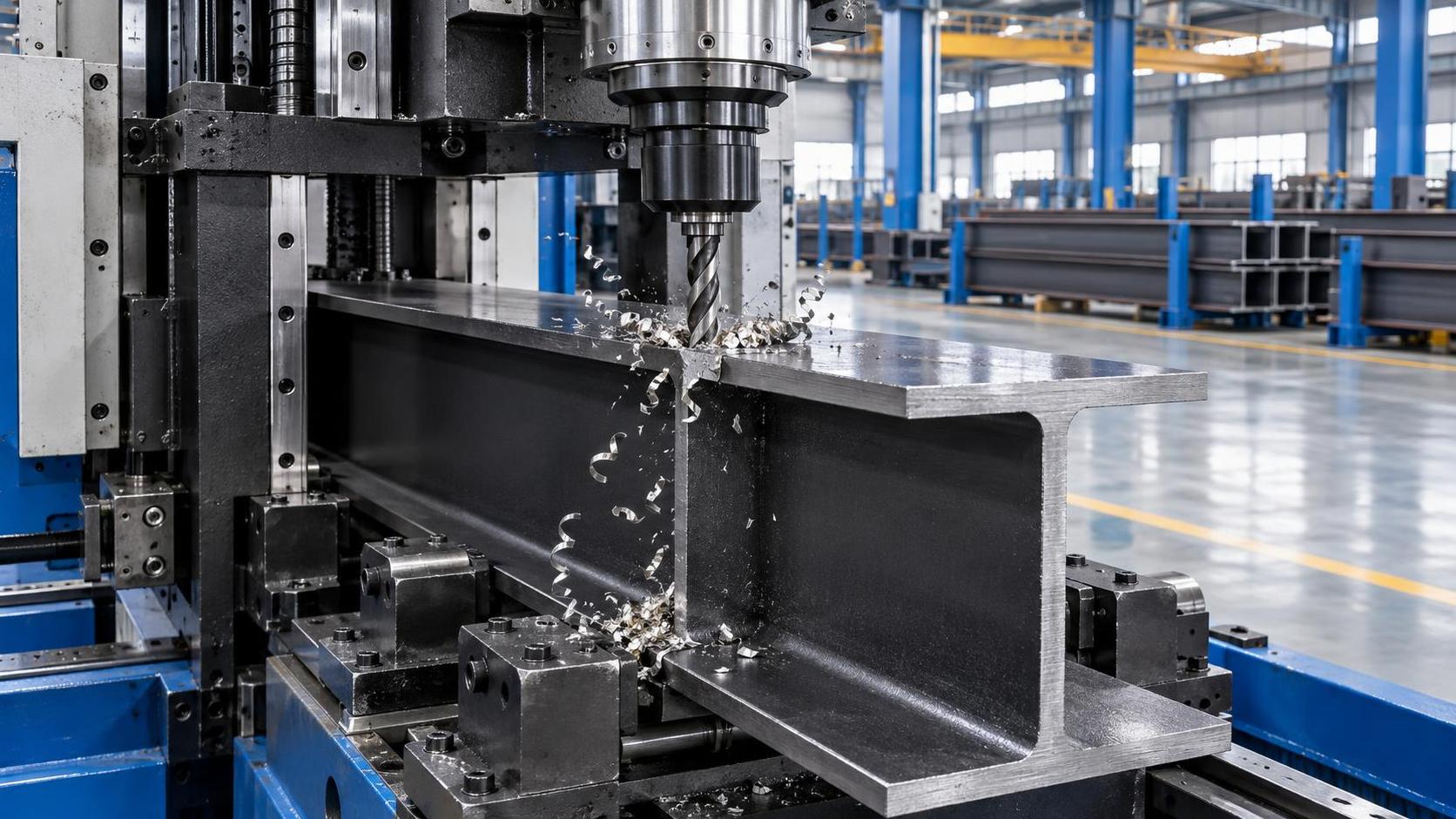
When you’re standing on the shop floor, reviewing a job ticket for 32 H-beams—each with unique flange and web hole patterns—and the delivery deadline is five working days away, speed isn’t abstract. It’s the difference between quoting confidently and adding a 48-hour buffer *just in case*. That’s where the real-world trade-off between flexibility and velocity becomes tangible—especially when batch sizes sit comfortably under 50 pieces.
General-purpose CNC machining centers are impressive machines. They mill, drill, tap, and bore with high repeatability across diverse part geometries. But ask one to handle an H-beam—typically 6–12 meters long, weighing hundreds of kilograms, with asymmetrical stiffness and variable cross-sections—and you’ll quickly hit operational friction: repositioning, multi-axis alignment, custom fixturing, tool path recalibration for each beam orientation, and repeated probing to compensate for thermal drift or material warp. These aren’t theoretical delays—they’re minutes that compound across setups, tool changes, and verification cycles.
Dedicated H beam 3D drilling machines, by contrast, are built *around* the geometry—not around the toolpath. Their kinematics assume the presence of an I- or H-profile. The gantry moves along the beam’s length; the drilling head rotates and tilts precisely to reach flange faces, web centers, and angled connection points without reorienting the workpiece. No fifth-axis reprogramming. No custom jig design per order. No manual leveling or laser alignment before every run. Just load, clamp, scan (if equipped), and execute.
Let’s quantify this—not with lab-condition benchmarks, but with observed throughput from actual fabricators using both platforms for identical small-batch jobs (≤50 pcs):
- **Setup time**: A CNC machining center averages 42–68 minutes per beam for fixturing, datum establishment, and first-part verification. A dedicated H beam 3D drilling machine reduces this to 7–12 minutes—largely because clamping is standardized, reference edges are auto-detected, and drilling positions are defined directly in beam coordinate space (not transformed through multiple datum shifts).
- **Cycle time per beam**: For a typical 8-meter H300×300×10×15 beam requiring 42 holes (flange + web), average drilling-only cycle drops from 28–35 minutes on a 5-axis CNC to 9–13 minutes on a dedicated unit—excluding loading/unloading. That’s not just faster tool movement; it’s fewer rapid traverses, no Z-axis retraction between holes at varying depths, and simultaneous multi-spindle capability on higher-end models.
- **Tool change efficiency**: CNC centers rely on ATC systems optimized for milling cutters and drills of varying diameters—but swapping a 25 mm drill for a 12 mm one still takes 4–6 seconds *per change*, and small batches often require frequent swaps. Dedicated machines use modular drill heads with pre-set tools grouped by diameter and depth range, reducing average tool-change overhead by ~70%.
- **First-piece qualification**: On CNC platforms, 3 out of 5 small-batch runs require at least one rework iteration due to misalignment or probe error. With beam-specific kinematic compensation and integrated vision-assisted positioning, dedicated units achieve >98% first-time-right accuracy across batches under 50—cutting QA loop time significantly.
None of this implies CNC machining centers are obsolete. They shine when handling mixed-part families, prototype iterations, or structural components requiring contour milling alongside drilling. But for repetitive, beam-centric fabrication—even at modest volumes—the dedicated machine isn’t “niche.” It’s precision-tuned economics.
That tuning extends beyond motion control. Consider thermal stability: H beams absorb and retain heat unevenly. A general CNC’s rigid cast-iron base compensates well for small parts—but over a 10-meter travel, ambient fluctuations affect positional accuracy more than many realize. Dedicated machines integrate temperature-compensated linear encoders *along the beam axis*, referencing the workpiece itself rather than the machine frame. Similarly, their clamping systems apply distributed, programmable pressure—not just brute-force grip—to minimize distortion during drilling. This matters when tolerances tighten to ±0.3 mm on hole position or ±0.5° on angular features.
And while we’re discussing precision, let’s talk about upstream readiness. A perfectly drilled H-beam is only as good as its flatness and straightness. Warped or cambered material introduces cumulative error—even with advanced probing. That’s why forward-thinking fabricators pair dedicated drilling lines with precision flattening solutions like the Plate leveling machine, which applies controlled, progressive deformation to eliminate residual stress and achieve consistent flatness across medium-to-thick plates. Its electric-hydraulic actuation allows fine roller gap adjustment—critical when preparing flange surfaces prior to drilling. Without that baseline uniformity, even the fastest drill won’t deliver reliable fit-up downstream.
Of course, ROI isn’t just about speed—it’s about predictability. When quoting, technical evaluators don’t just calculate minutes per part; they assess variance. A CNC center’s cycle time may vary ±18% depending on operator experience, tool wear history, or ambient humidity affecting coolant viscosity. A dedicated machine’s variation sits consistently below ±3%, thanks to closed-loop pressure control, adaptive feed-rate algorithms tied to real-time torque feedback, and standardized workflows embedded in the HMI.
This consistency also reshapes labor dynamics. Operators trained on CNC platforms spend significant time interpreting G-code, managing tool libraries, and troubleshooting coordinate system mismatches. With dedicated H beam 3D drilling machines, interface logic maps directly to fabrication terminology—“flange top,” “web centerline,” “staggered pattern”—reducing cognitive load and shortening ramp-up time for new staff.
Wuxi Samgins International Trade Co., Ltd. has supported fabricators across Southeast Asia, Europe, and the Americas in making this transition—not by pushing equipment, but by aligning machine capability with actual workflow pain points. Our CE-certified H beam drilling solutions integrate seamlessly with existing cutting, welding, and finishing lines—and crucially, they’re backed by ISO9001-compliant support, including on-site commissioning, process validation, and operator upskilling.
So if your evaluation hinges on whether to *sell H beam 3D drilling machine* solutions—or specify them—you’re not choosing between two machines. You’re choosing between managing complexity and engineering flow. Between reacting to variability and designing it out. Between quoting with caution and quoting with confidence.
Because in small-batch structural fabrication, speed isn’t measured in spindle RPM alone. It’s measured in how quickly you move from drawing review to verified part—in how little time you spend explaining delays to your client—and in how reliably your team walks away at shift end knowing tomorrow’s schedule won’t unravel before breakfast. That kind of speed doesn’t just save minutes. It compounds into reputation, repeat orders, and the quiet confidence that comes from knowing your equipment doesn’t just meet specs—it anticipates them.
search
Products Navigation
Send Us A Message