




What ISO and EN standards apply to space frame welding machine factory commissioning in EU projects?
What ISO and EN standards apply to space frame welding machine factory commissioning in EU projects?
Sep 21, 2026
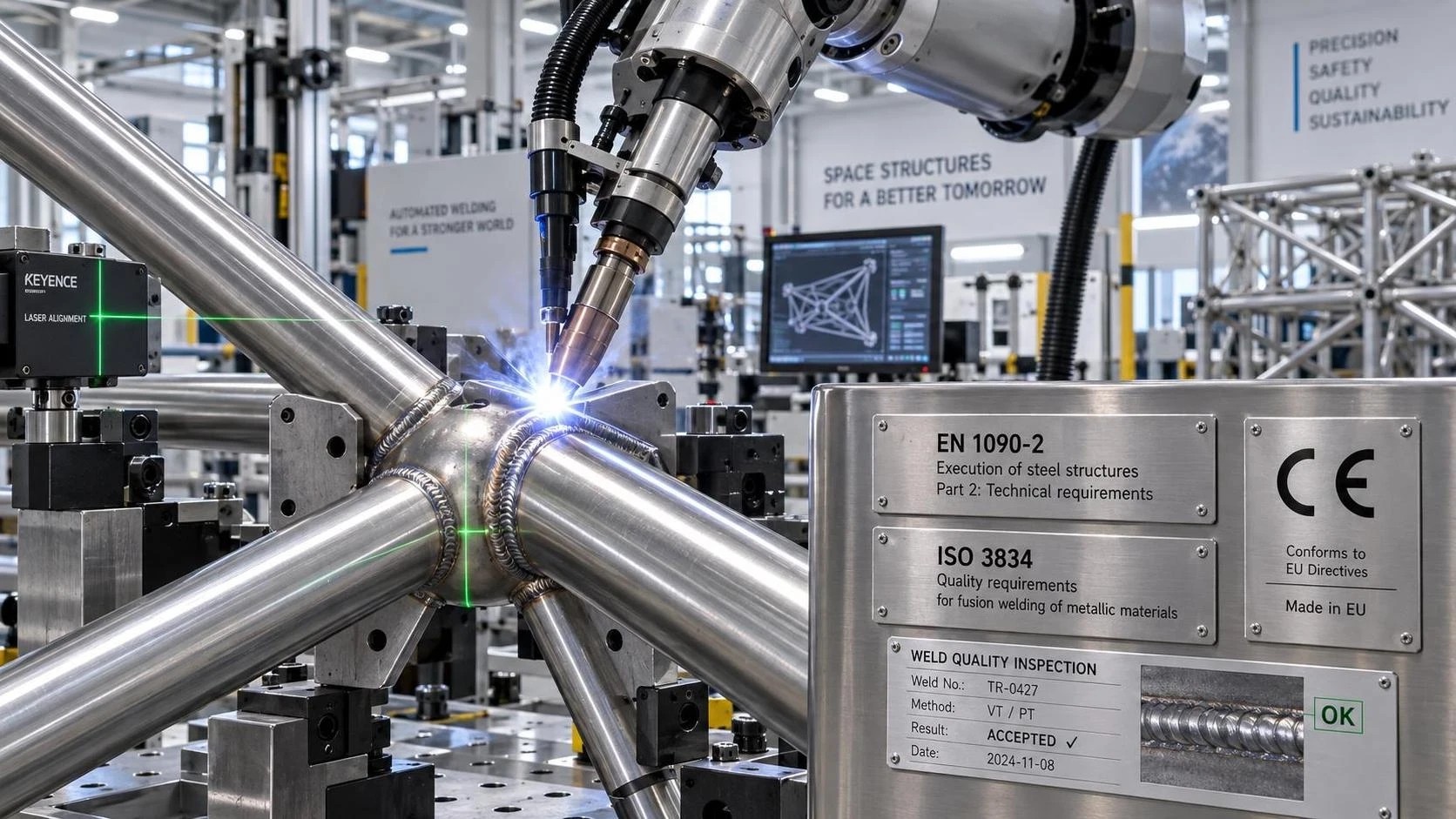
For business evaluators overseeing EU-based infrastructure or modular construction projects, understanding which ISO and EN standards govern space frame welding machine factory commissioning is critical to compliance, safety, and operational readiness. As a Wuxi-based manufacturer certified to ISO 9001 and EU CE directives, Samgins ensures every space frame welding machine factory meets rigorous technical, electrical, and functional safety requirements—including EN 1090-2 for structural steel execution, ISO 3834 for welding quality, and EN 60204-1 for electrical equipment. This article clarifies the core standards you must verify before commissioning.
Commissioning a space frame welding machine factory in the EU is not merely a technical handover—it is a regulatory checkpoint. Unlike general-purpose welding facilities, space frame production demands traceability, dimensional fidelity, and structural integrity across thousands of node welds. Failure to align with applicable harmonized standards risks non-acceptance by notified bodies, project delays, liability exposure, and rejection of fabricated components at site. The key lies not in accumulating certifications, but in verifying that each standard addresses a specific, enforceable requirement tied to design validation, process control, or personnel competence.
EN 1090-2 is the primary execution standard for structural steel components—and space frames fall squarely within its scope. It mandates execution classes (EXC) based on consequence class (CC) of the structure: EXC2 for most public infrastructure, EXC3 for bridges or high-risk buildings. For commissioning, this means the factory’s welding procedures must be qualified per EN ISO 15614-1, welders certified per EN ISO 9606-1, and welding coordinators appointed per EN 1090-2 Annex B—specifically holding either Level B (technical supervision) or Level C (full responsibility). Crucially, EN 1090-2 requires documented evidence—not just internal records—that these roles are actively fulfilled during production, not only during qualification.
ISO 3834-2 (or -3, depending on execution class) governs welding quality requirements. Its application is mandatory when EN 1090-2 applies. But ISO 3834 is often misinterpreted as a standalone “quality system” standard. In reality, it defines *what* must be controlled—not *how*. It specifies mandatory clauses like welding procedure specification (WPS) review, pre-production weld testing, non-destructive testing (NDT) planning, and traceability of consumables. A factory may hold ISO 9001, but unless its quality manual explicitly references and implements ISO 3834-2’s 27 mandatory requirements—including Clause 8.3 on personnel competence and Clause 9.2 on inspection documentation—it does not satisfy EN 1090-2’s quality system condition.
Electrical safety is governed by EN 60204-1, which applies to all machinery integrated into the factory—including robotic welding cells, positioners, fume extraction systems, and PLC-controlled conveyors. Commissioning requires verification that each subsystem carries CE marking *and* that the full integrated system complies with EN 60204-1’s risk-based requirements: emergency stop functionality, protective separation of circuits, interlocked guarding, and validated safe torque-off (STO) logic for collaborative robots. Notably, EN 60204-1 does not permit reliance on component-level CE declarations alone; the final integrated system must undergo functional safety assessment—typically via a Category 3 or 4 circuit design validated by a notified body.
Structural integrity extends beyond welds. EN 15085-2 (for railway applications) or EN 15085-3 (for rail vehicle manufacturers) may apply if the space frame serves rolling stock. More broadly, EN ISO 14731 mandates coordination of welding quality activities across design, production, and inspection functions—a requirement frequently overlooked during commissioning audits. When a factory supplies to multiple EU clients across sectors, its quality manual must demonstrate how it adapts execution class requirements per project—e.g., applying EXC3 controls for a stadium roof while using EXC2 for warehouse trusses—without conflating or diluting compliance.
Material traceability is another binding requirement. EN 1090-2 requires full traceability from raw material certificate (EN 10204 3.1 or 3.2) through cutting, forming, and welding—down to individual nodes. This necessitates digital or paper-based lot tracking integrated into the factory’s MES or ERP system. Commissioning verification includes checking that material certificates are archived with weld maps, that heat numbers are linked to WPS records, and that NDT reports reference exact weld locations—not just batch numbers.
Personnel competence remains a frequent audit failure point. EN 1090-2 Annex B requires documented evidence of welding coordinator appointment, including signed responsibilities and proof of training. Welder certification records must show validity dates, test positions, and base metal/thickness ranges matching actual production. Crucially, requalification intervals are not fixed—they depend on actual welding activity. A welder inactive for six months requires retesting per EN ISO 9606-1 Clause 8.3—even if their certificate hasn’t expired.
Environmental and auxiliary processes also fall under scrutiny. Surface preparation prior to welding must meet ISO 8501-1 Sa 2.5 or equivalent, verified by visual comparison and documented. Fume extraction systems must comply with EN 689 for workplace exposure limits—requiring airflow measurements, filter efficiency logs, and maintenance records. Even post-weld cleaning—such as deburring of laser-cut node plates—must be controlled to avoid introducing microcracks or hydrogen ingress. Equipment like the RNS 800 Sheet metal deburring machine must operate within validated parameters (e.g., abrasive belt speed, roller pressure) and maintain R-angle consistency across edges to prevent stress concentration points.
Commissioning documentation must be structured—not compiled. It should include:
- A signed declaration of conformity referencing EN 1090-1, EN 60204-1, and relevant harmonized standards;
- Factory production control (FPC) documentation demonstrating ongoing compliance—not just initial setup;
- Calibration records for all measuring instruments used in dimensional verification (e.g., coordinate measuring machines, laser trackers);
- NDT procedure qualifications and inspector certifications per EN ISO 9712;
- Risk assessments per EN 12100 covering all automated welding sequences.
Finally, note that CE marking applies to the *machine*, while EN 1090-2 compliance applies to the *factory’s execution capability*. A CE-marked robotic welding cell does not automatically confer EN 1090-2 compliance—the factory must prove it uses that cell within a validated FPC system. Business evaluators should treat CE marking as necessary but insufficient. The decisive evidence lies in auditable, project-specific records—not certificates on the wall.
search
Products Navigation
Send Us A Message