




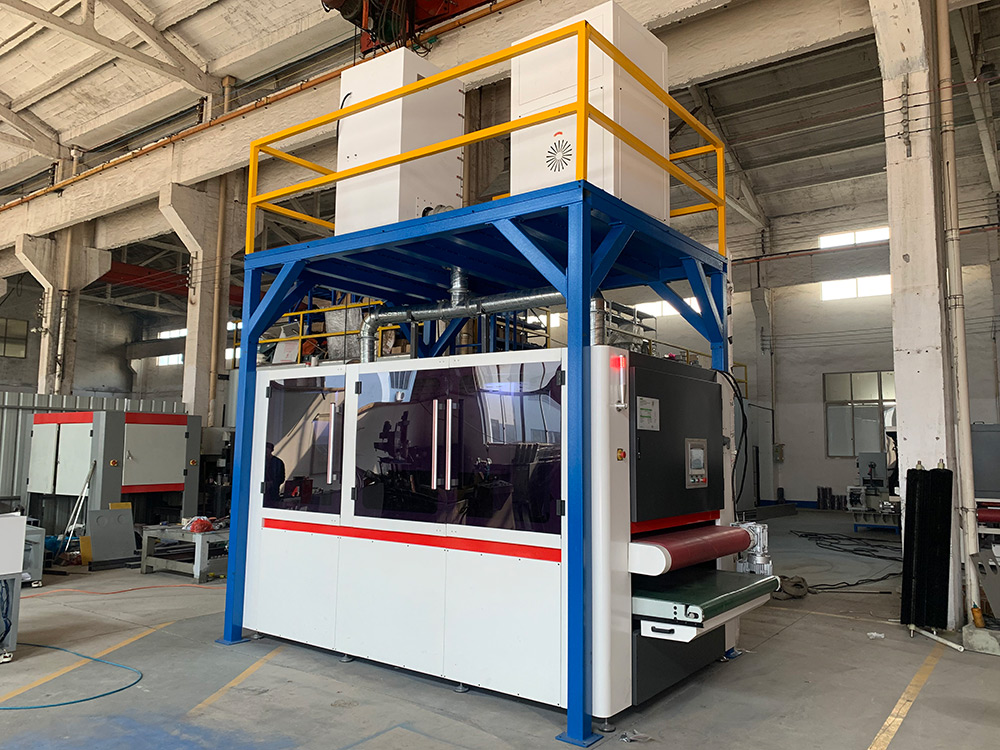
RNS 800 Sheet metal deburring machine
Full-range Machinery & Customized Non-standard Solutions
Authorized Certificates & Independent R&D Patents
Over 10 Years Global Export & Worldwide Project Cases
Navigation

RNS 800 Sheet metal deburring machine Description
1.Introduction for RNS 800 Sheet metal deburring machine:
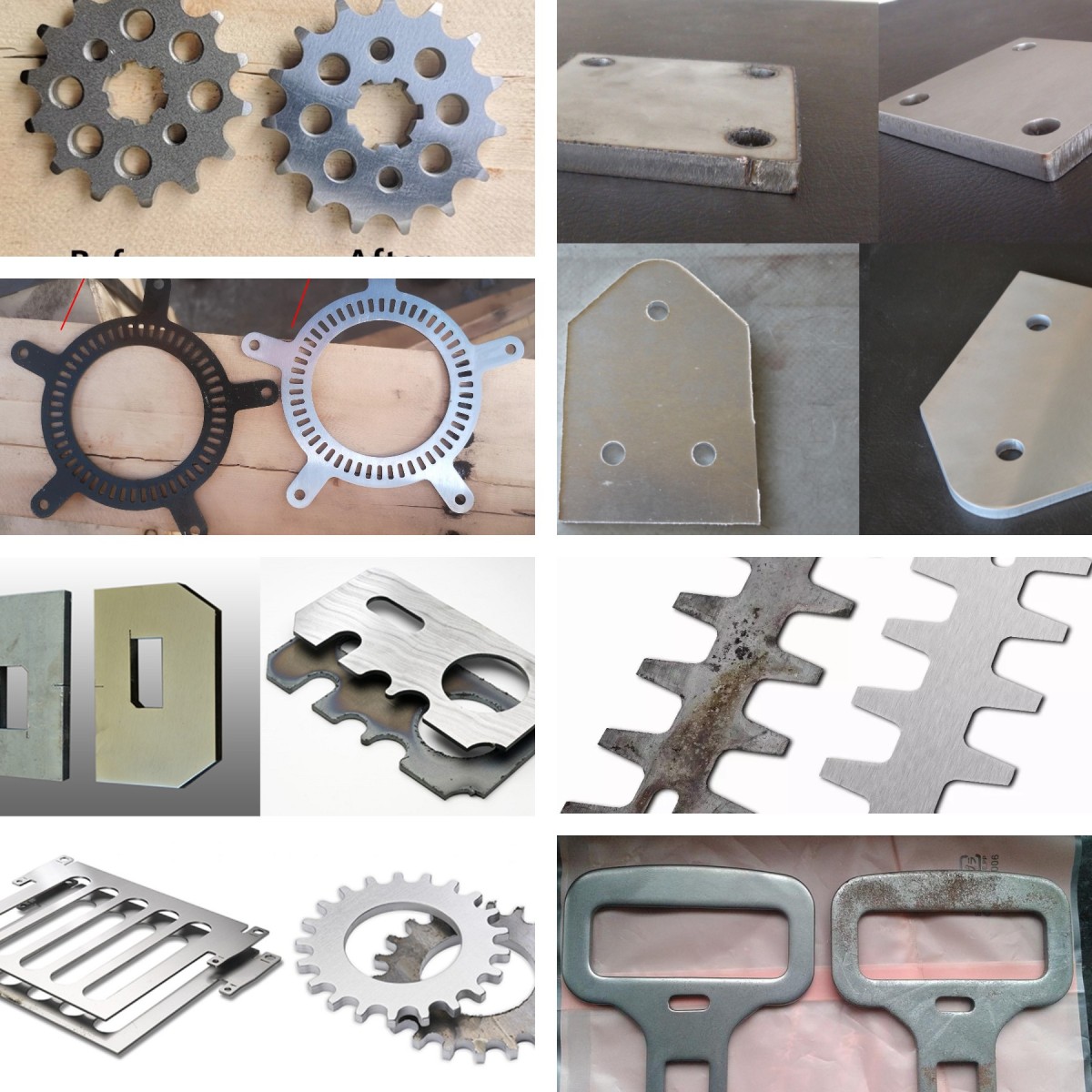
This equipment combines a dry sanding belt with four sets of universal sanding roller brushes. It is primarily designed for edge processing, hole deburring, and surface finishing of metal sheets, including drawing, descaling, and polishing. It effectively removes burrs generated by stamping, shearing, laser cutting, plasma cutting, and flame cutting in a single pass from all directions, delivering a smooth small R-arc finish on all edges and holes. The process is safe, reliable, and ensures superior workpiece quality.
1.1 Dual-Station & Independent Operation
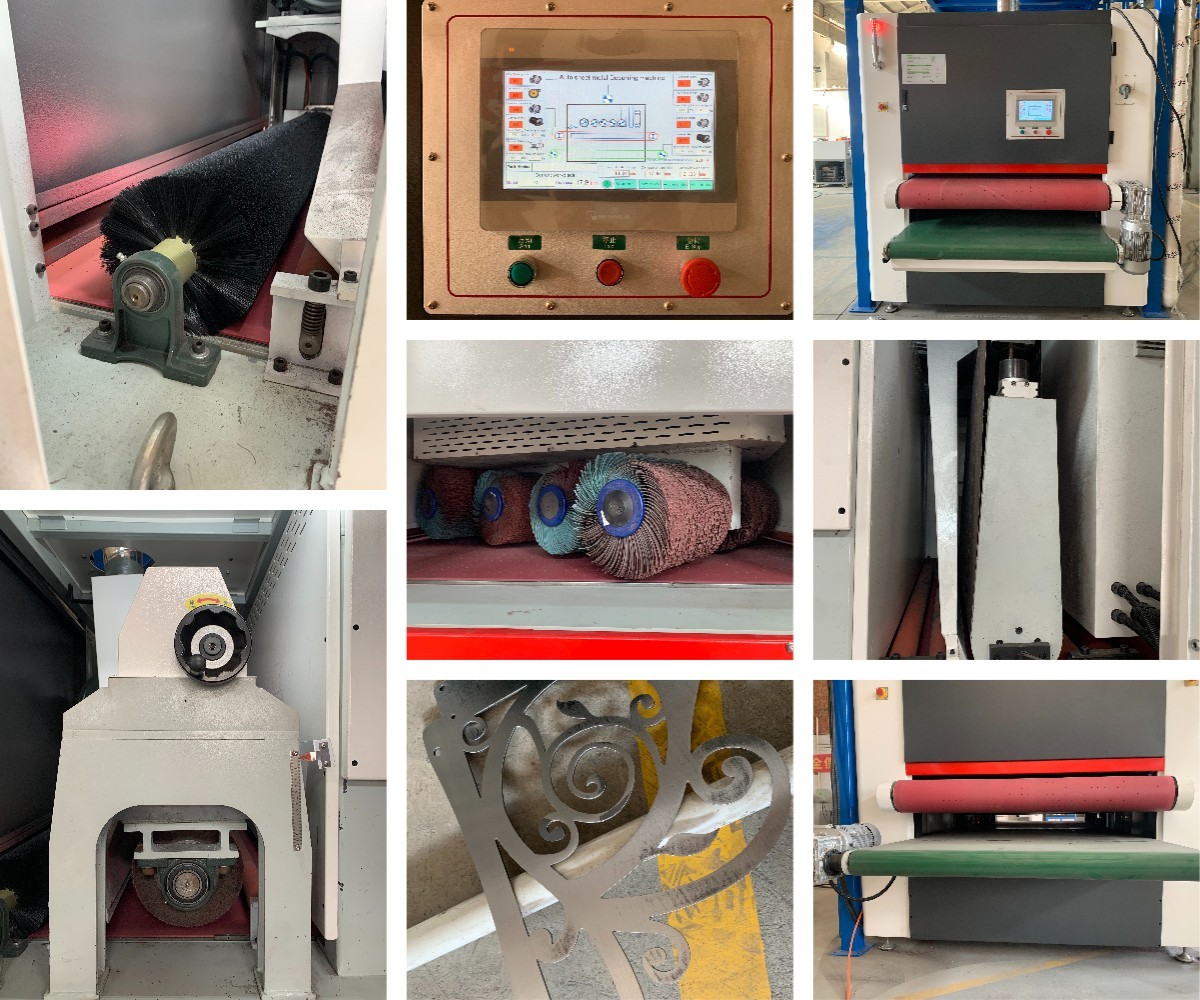
1.1.1 The abrasive belt station first removes large burrs and slag particles from the workpiece surface. The four universal sand roller brushes, with adjacent rollers rotating in opposite directions, then eliminate burrs on edges and inner holes while forming uniform R-angles, adjustable through process parameters and abrasive selection.
1.1.2 The pass-through processing method preserves the dimensional accuracy of the workpiece.
1.1.3 Both stations can operate independently: the belt station handles surface drawing, polishing, descaling, and slag removal, while the brush station provides 360° dead-angle-free deburring.
1.2 Flexible & Stable Conveying System
1.2.1 A vacuum negative pressure adsorption system securely holds workpieces during processing.
1.2.2 The conveying speed is infinitely adjustable, accommodating various workpieces and processing needs.
1.3 Efficient & Eco-Friendly Dust Removal
1.3.1 The machine is equipped with a wet vacuum cleaner. A high-pressure, high-flow top fan directs grinding dust into the dust removal chamber.
1.3.2 Dust is captured and deposited in water through a water spray system, ensuring environmentally friendly filtration and clean air emission.
1.3.3 The system also enables recycling of ground metal powder, supporting green production and providing operators with a safe, clean working environment.
2.Technical parameter for RNS 800 Sheet metal deburring machine
3.Characters for RNS 800 Sheet metal deburring machine:
3.1 This equipment combines a dry sanding belt with universal sanding roller brushes. Workpieces are secured by vacuum adsorption, with belt conveying and feeding ensuring stable transport throughout the process.
3.2 The two grinding stations can be used in combination or independently, depending on processing requirements. Each grinding head is controlled by its own electronic control system. The belt head station alone performs drawing, polishing, slag removal, and descaling on flat plate surfaces, while the sand roller brush station operates independently to deliver 360° dead-angle-free deburring.
3.3 The belt station is equipped with a laser beam photoelectric switch that controls the automatic belt correction function. This system is safe, stable, and features strong anti-interference capability.
3.4 The front end of the abrasive belt features a lock nut structure, which facilitates adjustment of the machine head's front-to-rear flatness and allows quick disassembly for convenient replacement of abrasive belt consumables.
3.5 Limit switches are installed at both the front and rear of the abrasive belt to prevent belt misalignment or breakage, triggering an automatic stop and braking function for enhanced operational safety.
4.More details for RNS 800 Sheet metal deburring machine:
5.Application for RNS 800 Sheet metal deburring machine:
products faq
A deburring machine is specifically designed to remove sharp edges, burrs, and slag from cut or punched metal sheets while preserving the workpiece's dimensional accuracy. It uses abrasive belts and rotating brushes to smooth edges and surfaces. A grinding machine, by contrast, is used for heavy material removal, surface flattening, or achieving tight thickness tolerances—often removing significantly more material and leaving a rougher finish.
Yes. Large workpieces are held in place by pressure rollers as they move through the machine. Smaller workpieces are secured by a vacuum table system underneath the conveyor belt, which prevents them from shifting during processing. The minimum part size typically starts from approximately 30×30 mm or 50×50 mm, depending on the model.
Many models support double-sided deburring, processing both the top and bottom surfaces simultaneously in a single pass. This eliminates the need to flip workpieces manually, saving up to 60% of processing time and significantly improving productivity—especially valuable for high-volume production environments.
The machine is suitable for a wide range of materials, including:
Stainless steel and carbon steel
Aluminum and aluminum alloys
Copper and brass
Galvanized steel
Surface-treated metals and some plastics
Processing parameters (such as conveyor speed and brush pressure) can be adjusted via the control system to accommodate different materials and thicknesses.
Routine maintenance includes:
Inspecting and replacing abrasive belts and brush rolls as they wear
Cleaning the vacuum table and dust collection system
Lubricating moving parts and conveyor components
Checking motor and drive system performance
Calibrating thickness sensors and pressure settings periodically
Our machines are designed with simple access to wear parts, minimizing downtime and making maintenance straightforward. We provide detailed maintenance schedules and spare parts support.