




CNC Laser Cutting Machine vs Fiber Laser Cutting Machine: What Is the Real Difference?
Why this comparison matters now
The phrase Cnc laser cutting machine is often used broadly in industrial discussions, yet it can describe very different cutting systems.
That is where confusion starts.
Some buyers compare a Cnc laser cutting machine with a fiber laser cutting machine as if they were direct equivalents.
In practice, the comparison usually mixes control architecture with laser source technology.
For metal fabrication, that difference affects cutting speed, energy use, maintenance, and long-term production economics.
It also matters because investment decisions are no longer based on machine price alone.
Capacity planning, labor structure, software integration, and export-standard compliance all shape the final choice.
In a machinery supply environment serving structural steel, sheet metal, and general fabrication, the wrong definition can lead to the wrong shortlist.
The real difference is not only the laser
A Cnc laser cutting machine refers to a machine controlled by a computerized numerical control system.
The term focuses on how the machine moves, positions, and executes programmed cutting paths.
A fiber laser cutting machine refers to the laser generation method.
It uses a fiber laser source to produce the beam that cuts the material.
Simple language helps here.
CNC describes the control system.
Fiber describes the beam source.
That means many fiber laser machines are also CNC machines.
So the more accurate business question is usually this:
Should the project use a conventional Cnc laser cutting machine with another laser source, or a CNC platform built around fiber technology?
Where the confusion comes from
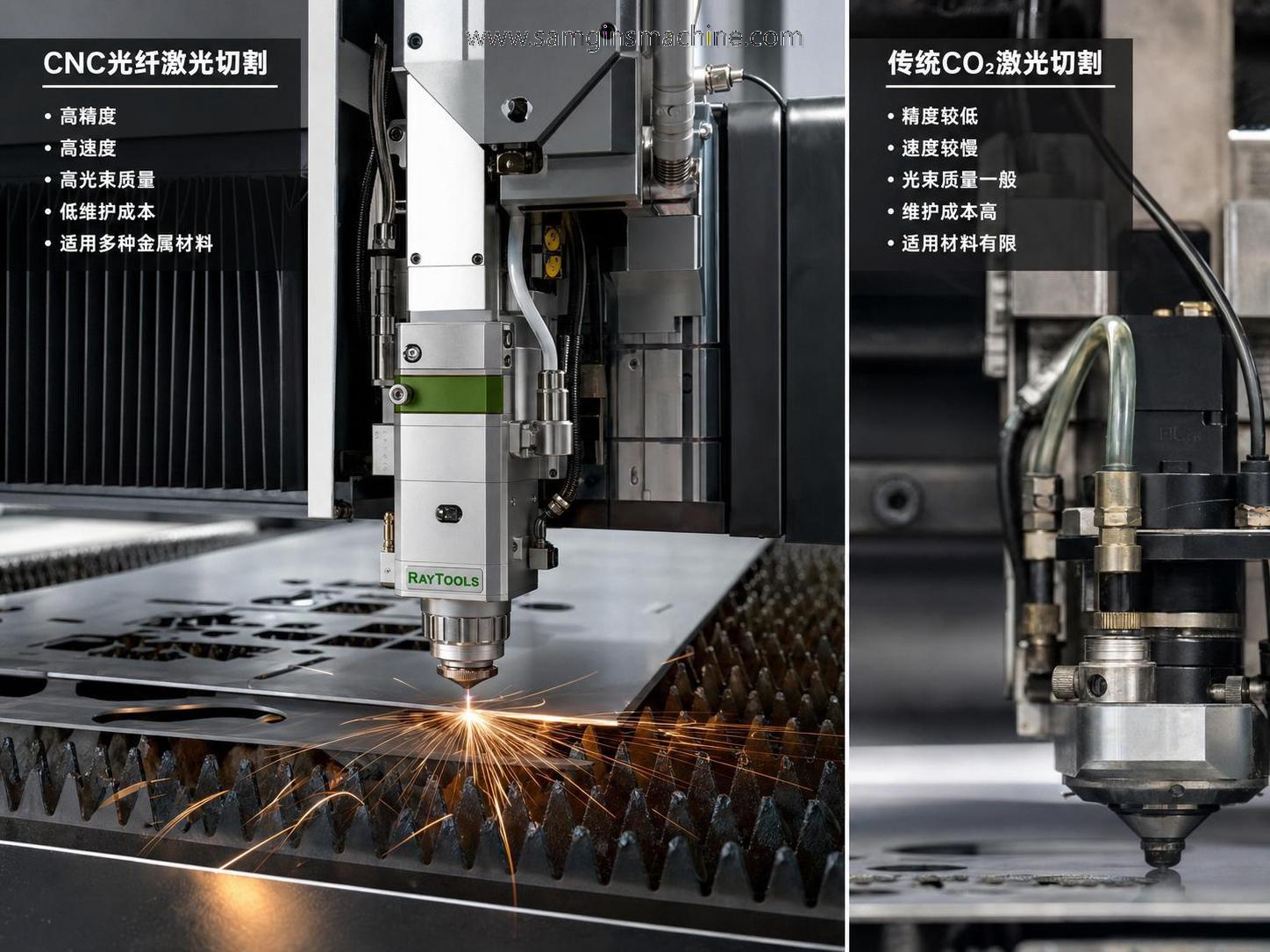
In the market, older CO2 systems are sometimes called standard Cnc laser cutting machine models.
Newer equipment is labeled fiber laser cutting machine.
That creates the impression that one is CNC and the other is not.
Technically, both can be CNC.
The practical distinction lies in beam efficiency, reflective material handling, cutting thickness range, and operating cost profile.
Performance differences that affect ROI
Once the terminology is clear, evaluation becomes more grounded.
The table below shows the differences that usually matter in production planning.
This is why a low purchase price can be misleading.
A machine that cuts slower and consumes more power may cost more across several years of operation.
That is especially true when throughput targets are aggressive.
How application changes the best answer
There is no universal winner.
The better option depends on material mix, production rhythm, and the surrounding fabrication process.
Thin sheet and batch flexibility
For carbon steel sheet, stainless steel sheet, and mixed batch jobs, fiber machines usually deliver stronger productivity.
Faster piercing and cutting reduce idle time between programs.
That supports short lead times and varied orders.
Heavy structural fabrication
In structural steel operations, cutting is only one stage in a larger workflow.
Fit-up accuracy, assembly speed, and weld preparation can be just as important as cutting speed.
That is why many lines combine laser cutting with downstream assembly and welding automation.
For example, after plate preparation, an H beam assembly machine can align the web and flange automatically before main welding.
With centering control, tack welding, hydraulic synchronization, and variable-frequency speed adjustment, it helps stabilize the next process instead of leaving accuracy to manual correction.
In other words, the cutting decision should be judged within the full line, not as a standalone machine purchase.
What the market is watching
Several trends have made fiber-based systems more attractive in recent years.
- Power costs are under closer review, so efficiency matters more.
- Orders are becoming more mixed, which favors flexible CNC programming.
- Material diversification increases demand for stable cutting on reflective metals.
- Labor structure pushes factories toward automation and easier maintenance.
- Export-oriented projects pay more attention to reliability and standard compliance.
These factors are visible across global machinery supply networks.
Companies with broad fabrication portfolios increasingly evaluate machines as part of integrated production capability.
Wuxi Samgins International Trade Co.,Ltd has operated in this environment since 2012, supplying CNC cutting, welding, milling, beam production, and sheet processing equipment to multiple overseas markets.
That kind of portfolio context matters.
It highlights that machine selection is often linked to line balance, installation standards, and after-sales practicality, not only headline specifications.
How to evaluate a Cnc laser cutting machine correctly
A useful evaluation process starts with production facts, not marketing categories.
The key is to compare the machine against the job mix it will actually run.
Questions worth putting on the table
- What materials make up most of the annual cutting volume?
- Is the workload dominated by thin sheet, medium plate, or mixed thickness?
- How important are speed and edge quality for secondary processing?
- What is the expected daily running time?
- How costly is downtime in the current production model?
- Will the machine connect with loading, sorting, welding, or beam assembly stations?
Cost should be viewed in layers
Machine price is only the visible layer.
The hidden layers include energy use, consumables, maintenance intervals, operator dependence, software adaptation, and scrap risk.
A fiber system often looks stronger when those layers are calculated over several years.
A conventional Cnc laser cutting machine may still be reasonable when budget pressure is high and workload is limited.
The point is to test the economics against real operating conditions.
A practical way to move forward
The real difference between a Cnc laser cutting machine and a fiber laser cutting machine is not a simple either-or label.
One describes control.
The other describes laser source technology.
Once that is clear, decision quality improves quickly.
Start by mapping material types, thickness ranges, target output, and the role of cutting inside the full production line.
Then compare energy efficiency, maintenance exposure, automation compatibility, and downstream process fit.
If the operation includes structural steel fabrication, it is worth checking how cutting quality supports assembly, welding, and beam handling later in the workflow.
That approach creates a more reliable basis for shortlisting equipment, validating quotations, and choosing a machine that will still make sense after production scales.
search
Products Navigation
Send Us A Message