




Custom CNC Hydraulic Swing Beam Shear: Key Specs That Reduce Rework and Scrap
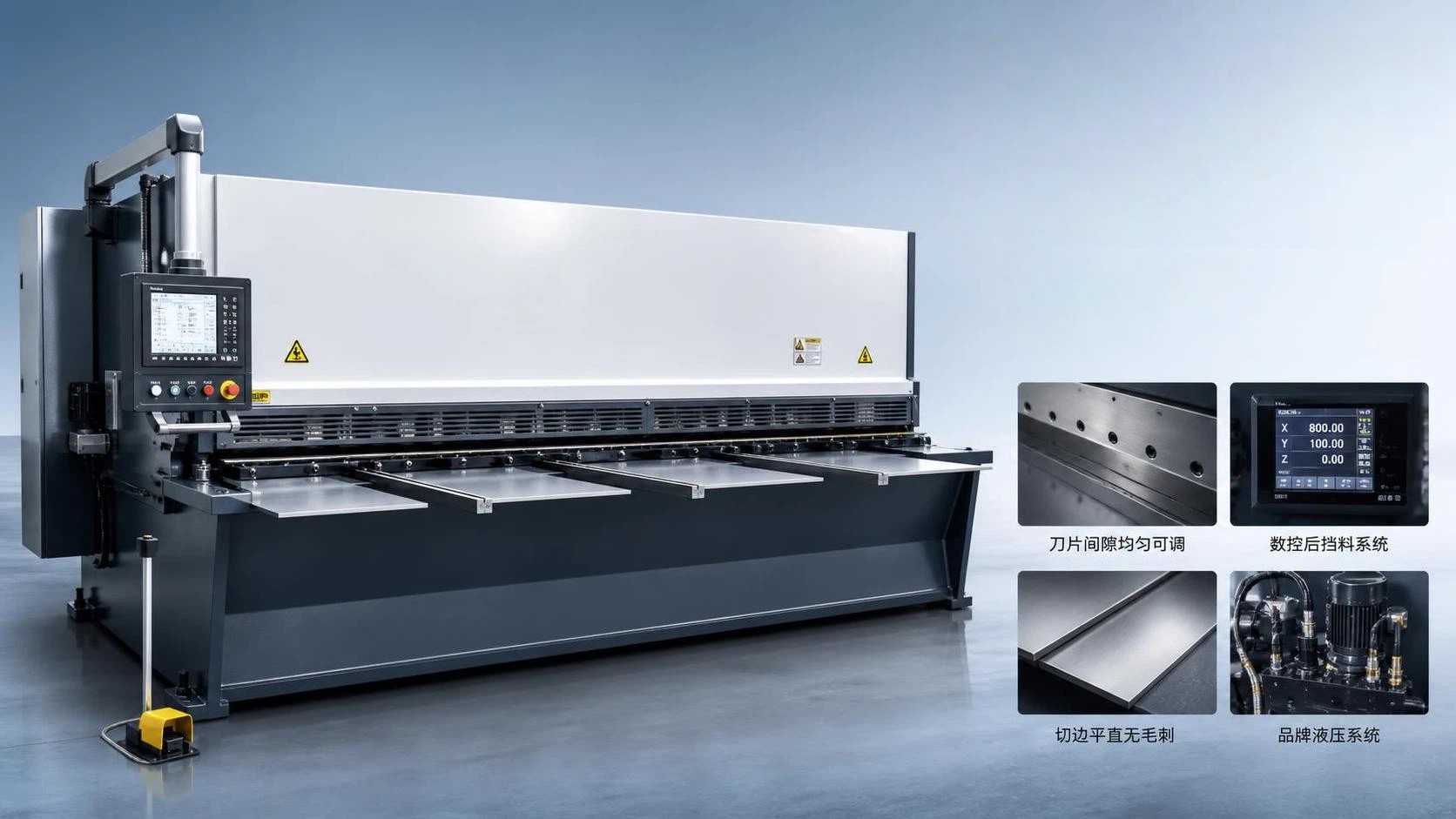
Scrap in sheet cutting often starts with small specification gaps that look harmless on a quotation sheet: a backgauge that drifts under vibration, a hydraulic circuit that heats up too quickly during repeated strokes, or a blade clearance adjustment that is too coarse for mixed material thicknesses. In a custom CNC hydraulic swing beam shear, those details directly affect cut squareness, edge condition, bend preparation quality, and traceability of finished parts. When a line handles carbon steel, stainless steel, or aluminum in short runs and frequent changeovers, the machine specification needs to control variation before it reaches downstream forming or welding.
The first point to examine is frame rigidity under working load. A swing beam shear relies on stable upper beam motion, so excessive deflection in the side frames or bed can show up as inconsistent clearance along the blade length. That inconsistency may produce burrs at one end of the sheet and rollover at the other, even when the blades are still sharp. For thicker plate or wider cutting widths, it is worth asking how the frame was stress-relieved, how the bed supports the workpiece, and whether the hold-down system keeps the sheet flat across the entire cut zone. If the machine is intended for narrow strips as well as full-width sheets, front support geometry matters too; unsupported offcuts can twist during the cut and cause false judgments about blade condition.
Backgauge Accuracy Is a Rework Variable, Not a Convenience Feature
On many parts, the actual reject trigger is not the sheared edge itself but cut length variation. A custom CNC hydraulic swing beam shear should therefore be specified around backgauge repeatability, screw and guide quality, and the way the gauge beam resists skew. If the gauge fingers are not parallel to the blade line or if the gauge carriage moves unevenly from left to right, the machine can still display the commanded value while the workpiece length changes from one side to the other.
Useful specification questions include the motion resolution of the CNC-controlled backgauge, the repeat positioning behavior after rapid travel, and whether the machine uses ball screws or another transmission method suited to the expected duty cycle. Swing beam shears that cut mixed batch sizes benefit from a backgauge with enough travel for long blanks but also enough stability at short positions where many errors cluster. Pneumatic sheet support or retractable support features can matter when thin stainless or aluminum sheets tend to sag or scratch during gauging.
It is also worth checking whether the controller stores job programs with material, thickness, gauge distance, blade gap, and stroke settings together. When those variables are separated across different screens or adjusted manually at changeover, setup mistakes become harder to detect. In environments where cut parts go directly to press brake forming, traceable program recall reduces the chance of an operator entering a familiar dimension while forgetting that the previous batch used a different material condition.
Blade Clearance Adjustment Has More Impact Than Many Buyers Expect
A large share of burr-related scrap comes from mismatch between blade clearance and material condition. Carbon steel, stainless steel, aluminum alloy, and coated sheet do not respond the same way, and the problem gets worse when a shop cuts across a wide thickness range. A custom machine should be matched to the actual product mix rather than only the maximum capacity shown in a catalog.
If blade clearance is adjusted manually with poor indication, repeatability between shifts can be weak. CNC-based or clearly indexed adjustment is usually easier to control, especially where process records matter. The specification should also clarify whether the machine keeps blade gap uniform across the full working length after repeated heavy cuts, because wear in pivot points or looseness in adjustment components can gradually push the shear outside acceptable edge quality even though the hydraulic system still appears normal.
Blade material and blade geometry deserve the same attention. Multi-edge blades can extend service life, but only if they are easy to rotate and reset without introducing alignment error. A machine that accepts common blade standards can shorten downtime during maintenance. For applications where downstream welding quality is sensitive to burrs and edge tearing, finer control of clearance usually pays back faster than simply choosing a higher tonnage model.
Hydraulic Stability Should Be Evaluated Over a Full Production Window
Hydraulic performance is often judged during a short demonstration, when oil temperature is still low and the machine has not settled into repetitive operation. In real production, pressure stability, valve response, seal quality, and heat management affect whether the stroke remains consistent over time. A custom CNC hydraulic swing beam shear working on frequent cycles can show different cutting behavior after extended operation if the hydraulic circuit is undersized or the return flow is poorly controlled.
For that reason, the specification should cover pump type, valve brand level if relevant to maintenance planning, oil tank design, filtration grade, and whether the machine includes temperature monitoring or pressure diagnostics. A hydraulic hold-down system should clamp the sheet firmly enough to prevent material lifting, but not mark sensitive surfaces unnecessarily. On pre-finished sheet, clamp pad condition and contact pressure become part of the quality discussion, not just a mechanical detail.
Noise, shock, and stroke-end impact also deserve attention. A shear that hits hard at the bottom of the stroke may still meet capacity requirements, yet repeated shock can accelerate loosening in mechanical joints and affect long-term cut consistency. Smooth deceleration and stable return motion generally indicate a better-matched hydraulic setup.
Blade Alignment and Rake Angle Determine Edge Behavior
Swing beam design uses a curved motion path, so upper and lower blade alignment must be maintained with care. Poor alignment can create edge twist, uneven burr height, or local tearing at the start and end of the cut. This matters even more when short parts are cut near one side of the machine, because localized wear or adjustment errors become easier to miss than in full-length cutting.
Rake angle selection should match the material range and production priorities. A larger rake angle lowers cutting force, which can help on thicker stock, but it may increase twist on narrow strips. Thin sheet with cosmetic requirements may respond better to a different balance between force, deformation, and stroke smoothness. A custom specification should therefore reflect actual part geometry: full sheets, narrow strips, short blanks, perforated stock, or pre-slotted material all behave differently in the shear.
On lines that combine thermal and mechanical cutting, comparing the shear with a process such as H beam cnc fiber laser cutting machine can help clarify tolerance expectations. Laser systems may reach positioning accuracy around ±0.01mm and repeat positioning accuracy around ±0.03mm for profile cutting, with narrow kerf control and low mechanical stress. A swing beam shear serves a different task, but that comparison is useful when teams mistakenly expect sheared edges and geometries to behave like non-contact CNC cutting. Matching the shear specification to the real dimensional and edge-finish requirement avoids false rejection standards.
Control System Design Affects Safety and Process Discipline
The CNC interface should support practical production control, not just axis movement. Program storage, parameter locking, alarm history, cycle counters, and maintenance reminders all reduce the chance of undocumented setting changes. A machine with a clear human-machine interface makes it easier to review whether a rejected batch came from wrong gauge position, blade gap drift, hydraulic instability, or material variation.
Foot switch logic, emergency stop placement, light protection if installed, and restart behavior after interruption should be reviewed in detail. One common risk appears after a stop during setup: if the control does not clearly show machine state and restart sequence, the next stroke may be made with the sheet not fully seated or with support arms in the wrong position. Guard design should allow necessary access for blade change and maintenance while still preventing routine bypass during normal production. Poorly placed guards often create their own safety problem by encouraging temporary removal.
Controller integration with upstream nesting, ERP routing, or barcode-based work order systems can be useful, but only if it reduces manual transcription. If the digital link merely adds another screen while dimensions are still typed by hand, it does little for quality control. In many cases, a smaller but disciplined set of stored cutting programs is more reliable than a highly connected setup with weak parameter governance.
Material Handling Around the Shear Often Decides Whether the Machine Performs Well
Even a well-built shear will produce scrap if the surrounding handling conditions are ignored. Large sheets need enough front support to stay flat before the cut and enough rear clearance to move without colliding with guarding or stacked blanks. Thin stainless can pick up scratches from rollers or support balls that are worn or contaminated. Aluminum sheet may require different support friction and clamp settings because surface marking and edge distortion are easier to trigger.
Transport and installation conditions matter as well. If the machine is installed on an uneven floor or anchored without following the required leveling sequence, frame twist can affect blade parallelism. That error may look like a blade issue at first, leading to unnecessary maintenance. After relocation, major maintenance, or heavy transport, a practical acceptance routine should include level verification, test cuts at both sides and center, and measurement of burr condition, cut squareness, and repeat length under several material conditions rather than one sample sheet.
Offcut disposal should also be considered in the original specification. Poor scrap discharge can let narrow strips catch under the machine or rebound toward the cut zone, creating both damage and unstable cycle flow. Where small blanks are common, conveyor or chute design can be just as relevant as main cutting capacity.
Maintenance Access and Inspection Points Need to Be Visible Early
A machine that is difficult to inspect rarely stays in tolerance for long. Blade change access, lubrication points, hydraulic filter replacement, gauge screw inspection, and hold-down cylinder maintenance should be straightforward enough that routine service is not postponed. Hidden wear points are especially problematic on shears because the process can degrade gradually: burr height increases, squareness drifts, and sheet marking appears one symptom at a time.
Inspection points should include blade edge condition, fastener tightness in the blade mounting area, backgauge parallelism, hydraulic hose condition, oil cleanliness, and clamp pad wear. If the machine includes a stroke counter or service interval reminder, that data is only useful when tied to an actual inspection routine. A custom CNC hydraulic swing beam shear intended for mixed workloads benefits from maintenance planning based on cut frequency, material hardness, and stroke length rather than calendar time alone.
When reviewing a specification, the most reliable approach is to treat every tolerance claim as a system claim. Cut accuracy depends on frame stiffness, blade condition, gauge motion, hydraulic stability, installation quality, and material handling acting together. A machine with balanced specifications usually generates fewer disputes over whether the problem came from the material, the setup, or the shear itself.
search
Products Navigation
Send Us A Message