




Face Milling Machine vs CNC Machining Center: Which Is Better for Flat Surface Work?
Face Milling Machine vs CNC Machining Center: Which Is Better for Flat Surface Work?
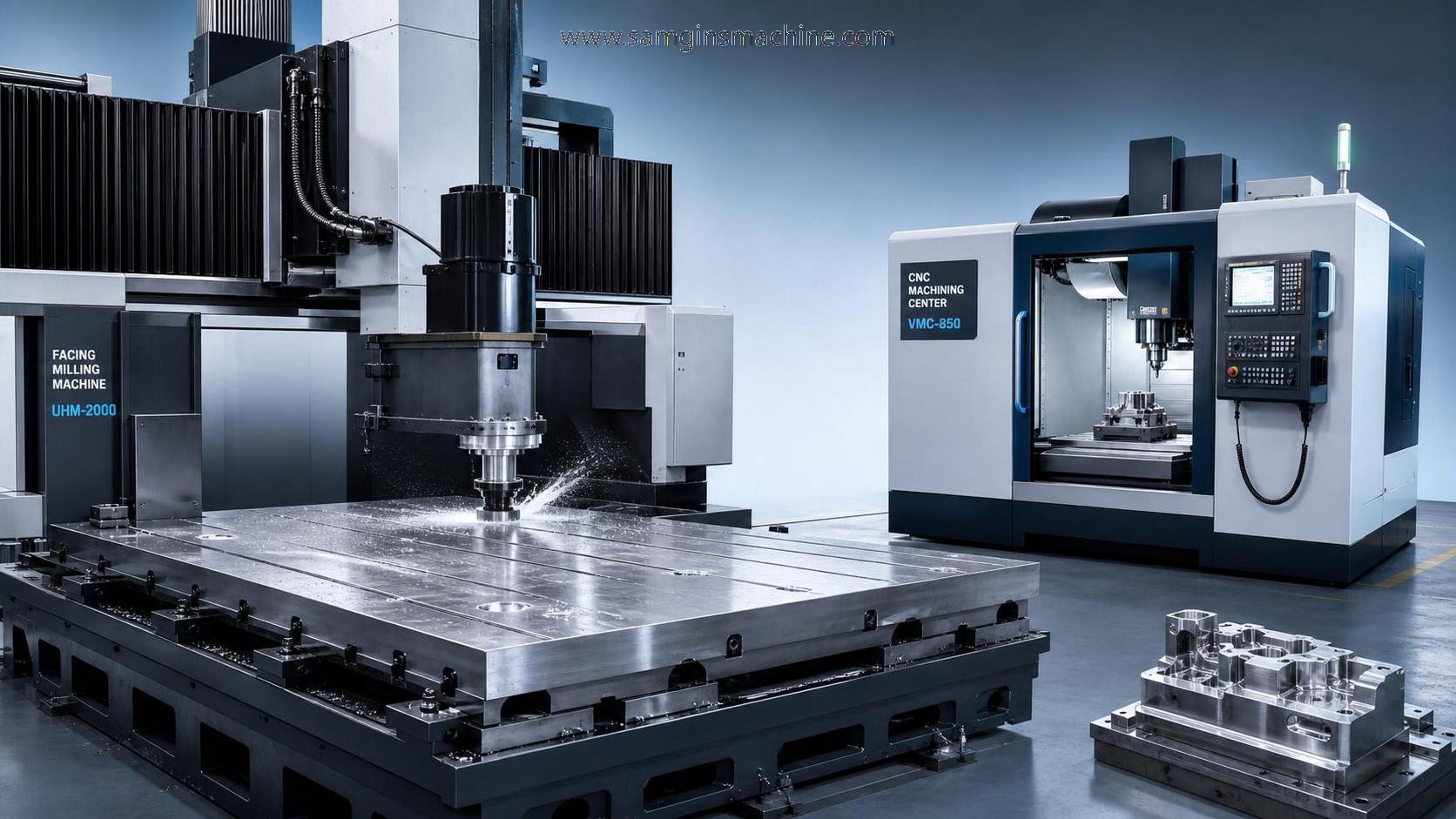
When choosing between a Face Milling machine and a CNC machining center for flat surface work, the real question is not which machine is more advanced.
The better question is which one fits your production target, tolerance needs, and investment plan.
Both machines can process flat surfaces, but they solve different factory problems.
A Face Milling machine is usually built for fast, stable, large-area surface machining.
A CNC machining center is more flexible and better for mixed operations on one setup.
For purchasing decisions, that difference affects cost, output, staffing, and future expansion.
What a Face Milling Machine Does Best
A Face Milling machine is designed to create flat, even surfaces with consistency.
It is commonly used for steel plates, welded structures, base frames, and large fabricated parts.
In many workshops, the Face Milling machine becomes the first choice when the workpiece is oversized.
Its core value is simple: remove material efficiently across a broad flat area.
This often leads to shorter cycle times for dedicated flat surface work.
- Strong performance on long or wide workpieces
- Simple operation for repeat surfacing tasks
- Lower complexity compared with multi-function CNC systems
- Good return in single-purpose, high-volume flat milling jobs
This is especially true in heavy fabrication lines where large components need end-face preparation before welding or assembly.
Where CNC Machining Centers Have the Advantage
A CNC machining center handles more than flat surface work.
It can mill, drill, bore, tap, and contour within one machine platform.
That flexibility matters when parts require several features beyond a flat face.
If the part needs precise hole locations, side features, or multi-face machining, a machining center usually wins.
It also reduces handling, because one setup can complete multiple operations.
- Better for complex parts with several machining steps
- Higher automation and program control
- Easier integration into digital production systems
- More suitable for lower-volume, high-mix production
So, if flexibility is the priority, the CNC machining center offers a broader operational range.
Flat Surface Quality: Which Machine Delivers Better Results?
For pure flatness, both solutions can perform well when matched to the right job.
A Face Milling machine often performs better on large, open surfaces that need efficient stock removal.
Its structure supports stable cutting over long travel ranges.
That helps when processing machine beds, structural beams, and plate edges.
A CNC machining center can still produce excellent flat surfaces.
However, its value appears more clearly when flatness must be combined with positional accuracy and feature accuracy.
In short, the better finish depends on the part geometry, fixture stability, cutting parameters, and required tolerance.
A simple rule for selection
- Choose a Face Milling machine for large flat work and repetitive surfacing
- Choose a CNC machining center for combined machining tasks and tighter feature control
Cost, Throughput, and Practical ROI
From a procurement view, machine price alone is not enough.
The more important metric is cost per qualified part over time.
A Face Milling machine may have a lower investment barrier for dedicated surfacing applications.
It can also improve output when jobs are large, repetitive, and dimensionally straightforward.
A CNC machining center usually costs more, especially with tooling, programming, and automation options.
Yet it may reduce outsourcing, manual repositioning, and secondary operations.
That means ROI depends heavily on job type, not on machine category alone.
Production Scenarios That Make the Choice Clearer
In actual business, the easiest way to choose is by part family and workflow.
Choose a Face Milling machine when:
- Most orders involve large plates or welded frames
- The main task is end-face or edge preparation
- Output speed matters more than multifunction capability
- Operators need straightforward setup and repeatable cycles
Choose a CNC machining center when:
- Parts require milling, drilling, and tapping together
- Production changes frequently across different drawings
- Tighter dimensional control is needed on several features
- Future automation and digital management are part of the plan
This is also where supplier experience becomes important.
Wuxi Samgins International Trade Co.,Ltd supplies a broad range of fabrication and machining equipment under ISO9001 and CE-oriented standards.
That matters when one production line includes milling, cutting, welding, and material preparation together.
For example, some factories combine flat surface preparation with automated welding cells such as 7 axis cantilever type welding robot.
That system supports workpieces up to 12000mm in length, 2000mm in width, and 650mm in height.
It is designed to improve welding efficiency and supports 3D drawing input, weld selection, arc tracking, and visible status alarms.
When flatness quality affects welding fit-up, equipment choices across the line should be evaluated together.
Common Buying Mistakes to Avoid
Several purchasing errors appear again and again.
- Buying a machining center for simple surfacing jobs that never use its full capability
- Buying a Face Milling machine when the part actually needs multiple precision features
- Ignoring fixture size, material flow, and crane access
- Comparing machine price without comparing labor and cycle time
- Skipping future expansion needs for new product categories
A better approach is to review twelve months of real orders before selecting equipment.
Look at part size, machining features, daily volume, rejection causes, and operator skill levels.
That data usually reveals whether specialization or flexibility creates more value.
Final Recommendation for Flat Surface Work
If flat surface work is the core task, a Face Milling machine is often the more practical investment.
It usually delivers stronger efficiency, simpler operation, and better economics for large, repetitive surfacing work.
If the production mix includes varied features and changing part designs, a CNC machining center becomes the stronger long-term choice.
So, which is better for flat surface work?
For dedicated large-area surfacing, the Face Milling machine usually leads.
For mixed machining demands, the CNC machining center offers more strategic flexibility.
The right decision starts with your actual parts, actual workflow, and actual growth plan.
search
Products Navigation
Send Us A Message