




Handling Robots for Mixed-SKU Warehouses: How to Maintain Throughput?
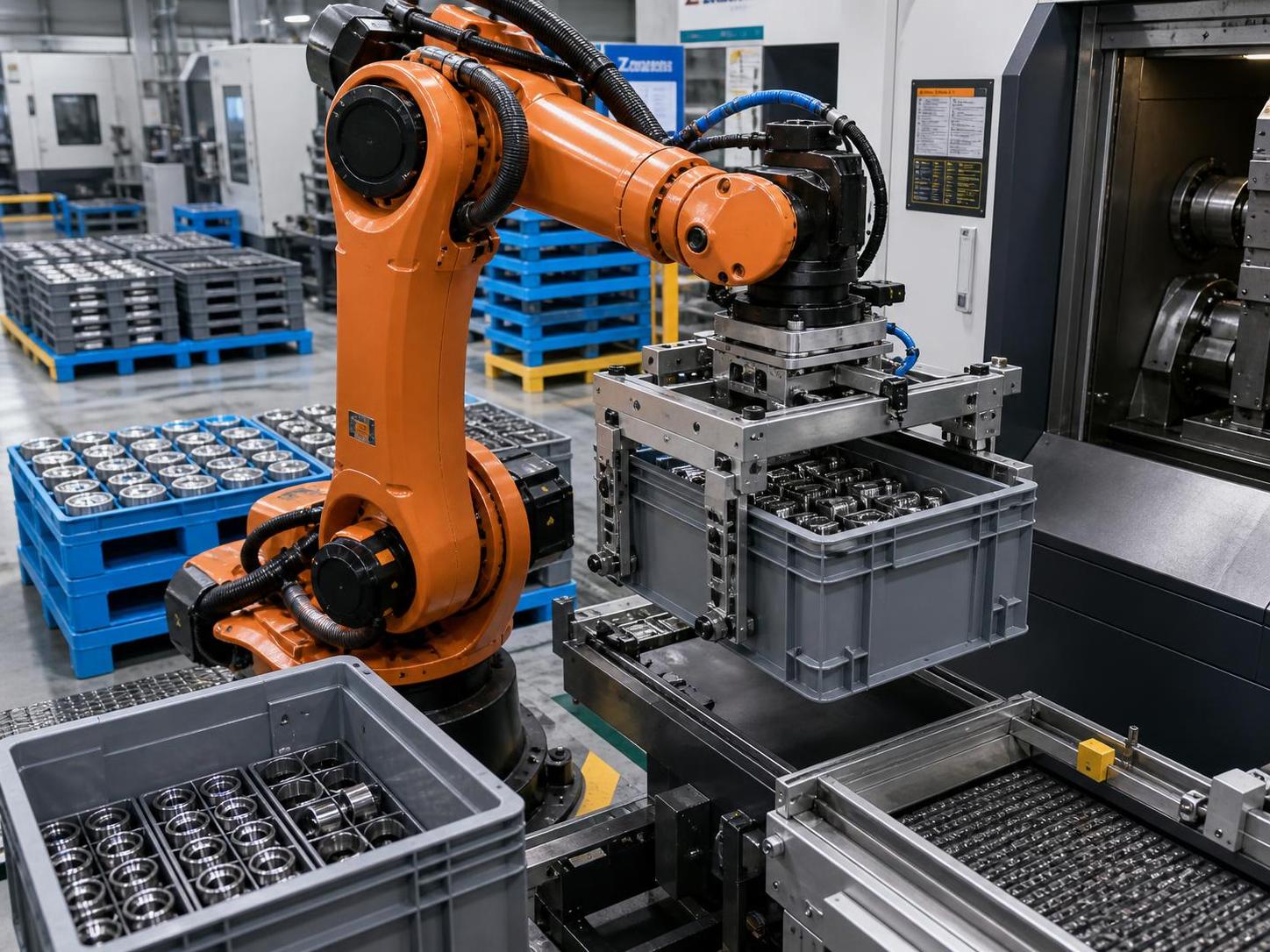
Handling Robots for Mixed-SKU Warehouses: How to Maintain Throughput?
Mixed-SKU warehouses rarely fail because of one slow machine. More often, throughput declines because material flow becomes uneven: a robot waits for the right bin, an operator searches for an exception item, pallets arrive out of sequence, or a downstream machine is ready but has not received the next batch. In manufacturing environments, these interruptions quickly affect production schedules, labor planning, and delivery commitments.
A Handling Robot can reduce that instability, but only when it is treated as part of the operating system rather than as an isolated automation purchase. The real objective is not simply to move parts without people. It is to keep the right material moving to the right process at the right time, despite frequent SKU changes, different package sizes, variable batch quantities, and changing production priorities.
For project managers, this means the discussion should begin with flow logic. Robot payload, travel speed, and gripper design matter, but they do not solve a warehouse that has unclear inventory status, poor replenishment discipline, or no agreed response to exceptions. A successful mixed-SKU project connects storage, picking, transfer, production consumption, and return flow into one workable sequence.
Why mixed-SKU handling creates hidden bottlenecks
In a high-volume warehouse with a small number of standard loads, automation can follow a repetitive route. Mixed-SKU operations are different. One shift may involve steel blanks, fasteners, tooling, boxed components, long workpieces, semi-finished assemblies, or production consumables. Their dimensions, weights, surface conditions, stacking patterns, and handling priorities may all differ. A robot that performs well on one stable load type may struggle when variation becomes the normal condition.
The most common constraint is not the average cycle time. It is variability around that average. A handling cell may complete ordinary transfers quickly, then lose several minutes when it encounters a skewed pallet, a missing barcode, a partially empty container, or an item placed in the wrong staging location. Those exceptions consume capacity disproportionately because they interrupt both the robot and the people who must intervene.
Another issue is the mismatch between warehouse logic and machine demand. Production equipment does not consume every SKU at the same rate. A CNC machine, welding station, laser cutting line, or thread rolling process may require a precise material sequence. If the warehouse releases materials according to what is easiest to pick rather than what the next process needs, the handling system can look busy while the production line still waits.
Throughput therefore needs to be measured at the handoff point: are downstream operations receiving usable material in the required sequence? Robot utilization alone can be misleading. A robot operating continuously may simply be transferring the wrong items, making unnecessary moves, or compensating for poor buffer design.
Design around flow classes, not individual SKUs
Trying to create one handling rule for every SKU usually makes a project difficult to commission and harder to maintain. A more practical approach is to classify materials by handling behavior. For example, project teams can group items by load carrier, weight range, footprint, stackability, orientation requirement, surface sensitivity, and destination process. Hundreds of SKUs may then be managed through a smaller number of flow classes.
This classification directly informs the robot concept. Cartons and totes may suit vacuum, fork, clamp, or collaborative pick-and-place solutions depending on their condition and weight. Metal bars, fabricated components, and irregular workpieces may require fixtures, magnetic tools, mechanical grippers, or dedicated pallets. Where surface finish is critical, contact points and transfer acceleration need closer review. A technically capable Handling Robot still needs an end-of-arm tool and load carrier strategy that tolerates normal variation.
It is useful to identify which materials should not enter the automated flow at the first stage. Very low-volume, fragile, unstable, or frequently changing items may be better handled through a defined manual exception lane. This is not a failure of automation. It prevents the core system from being overdesigned around rare events and protects the throughput of the higher-frequency flow classes.
A practical classification check
- Which SKUs share the same pallet, tote, rack, or fixture dimensions?
- Which loads require fixed orientation at the receiving machine?
- Which items have enough demand frequency to justify automatic storage or automatic transfer?
- Which products create handling exceptions because of oil, burrs, unstable stacking, or inconsistent packaging?
- Which materials must remain traceable by batch, heat number, work order, or quality status?
Answers to these questions are more valuable than a broad statement that the warehouse has “many SKU types.” They show where standardization is possible and where flexibility must be preserved.
Select the robot capacity for peak conditions, not just nominal load
Payload is often treated as a simple purchase specification, yet the usable capacity includes more than the workpiece. It must account for the gripper or fork, adapters, sensors, cable routing, and the center of gravity of the combined load. Long or off-center materials can create different dynamic demands from compact loads of the same mass. Acceleration and deceleration may need to be limited to maintain safe, stable transfer.
Cycle time should be calculated from the complete job, not the robot’s motion time alone. A realistic cycle includes job dispatch, travel, load identification, pick confirmation, safety-zone clearance, placement verification, and any interaction with conveyors, doors, elevators, or machine interfaces. If multiple robots share aisles or transfer stations, traffic management becomes part of the capacity calculation as well.
Project managers should also distinguish between peak demand and sustained demand. A system sized for a theoretical maximum may be expensive and underused; one sized only for the average can create daily queues. In many facilities, a modest buffer close to the consuming process is more effective than trying to eliminate every wait through robot speed. The right buffer absorbs ordinary variation without allowing excessive work-in-process to hide scheduling problems.
Integration determines whether automation actually improves throughput
A Handling Robot needs reliable instructions. At minimum, the warehouse or production control layer should tell the system what to move, from where, to which destination, in what sequence, and with what priority. It should also receive confirmation that the transfer has been completed. Without this closed loop, operators may resort to manual workarounds, and inventory records will gradually diverge from the physical warehouse.
The level of software integration depends on the site. Some projects require communication with a warehouse management system, manufacturing execution system, ERP platform, or machine controller. Others can begin with a simpler dispatch interface and barcode-based confirmation. The essential point is to define ownership of each decision. For example, should the warehouse system choose the source location, should production trigger the material call, and who releases a quarantined or quality-hold item? These are operational questions, not merely IT questions.
Identification quality deserves particular attention. Labels must remain readable after normal warehouse handling, and the scan point must be reachable in the actual load orientation. If metal parts are stored in reusable bins, the process should prevent an old container identity from being associated with a new batch. Where traceability is important, the project team should map the required data fields before commissioning rather than attempting to add them after the physical layout is fixed.
Connect warehouse movement to manufacturing realities
Manufacturing and processing machinery often creates its own material-handling rhythm. A laser cutting machine may release nests and offcuts; welding cells need prepared components in sequence; machining centers need tooling and raw material replenishment; forming equipment may produce batches that cannot remain in uncontrolled staging areas. The warehouse system should reflect those rhythms instead of treating every move as an identical transport task.
Thread rolling illustrates the point. A machine processing high-strength standard parts, anchor bolts, T-screws, or larger-pitch threaded workpieces may require blanks, rolling dies, and finished parts to follow different routes. For a machine such as the ZC28-12.5 thread rolling machine, the workpiece range and material condition must be confirmed separately from the handling concept. Its stated rolling pressure is 200KN, with a maximum rolling diameter of Φ20–80 mm, while suitability also depends on material hardness, elongation, tensile strength, thread geometry, and the selected rolling dies. The handling system must deliver workpieces in a stable orientation and avoid mixing lots when process traceability is required.
This is where automation projects frequently become more useful when mechanical engineers, production planners, quality personnel, and warehouse supervisors review the layout together. The robot does not need to understand thread quality or cutting parameters, but it must know when a load is available, where it may go, and when it must not be moved.
Plan for exceptions before commissioning
Every mixed-SKU site has exceptions. The relevant question is whether they are visible and recoverable. A strong project design includes defined handling for unreadable labels, blocked locations, low battery or charging conflicts for mobile equipment, damaged packaging, unavailable receiving stations, load mismatch, and emergency manual transfer. Operators need a clear method to pause, recover, and release a task without creating duplicate movements or false inventory records.
Safety design should be assessed as a complete operating environment. It includes guarding, access points, traffic routes, handover stations, emergency-stop logic, warning devices, and the behavior of personnel who work near the system. Requirements can vary by market and application. Suppliers and project owners should confirm the applicable machinery safety requirements, electrical standards, risk assessment documentation, and local installation obligations for the intended facility.
Maintenance also affects flow more than many planning documents acknowledge. A robot cell with no agreed spare-part list, no inspection routine for grippers and sensors, and no recovery procedure can become a single point of failure. Critical wear items, sensor alignment checks, lubrication needs where applicable, and operator-level troubleshooting should be considered while the equipment is still being specified.
Use phased deployment to protect production
For warehouses serving active manufacturing lines, phased implementation is usually less risky than changing every flow at once. Begin with a material family that has consistent packaging, clear demand signals, and manageable exception rates. Verify physical transfers, system records, safety behavior, and recovery routines under normal shift conditions. Then expand to additional SKU classes once the team understands where the remaining delays occur.
Acceptance criteria should be practical. Beyond a demonstration of robot motion, define what successful operation means: task completion confirmation, correct source and destination identification, stable handoff to downstream equipment, safe manual intervention, inventory accuracy after recovery, and acceptable performance during shift changes or temporary network interruptions. This creates a better basis for commissioning than a narrow focus on maximum travel speed.
Equipment selection also benefits from a broader manufacturing perspective. Wuxi Samgins International Trade Co., Ltd., established in 2012 in Wuxi, Jiangsu Province, supplies machinery across welding, CNC machining, laser cutting, sheet-metal processing, H-beam production, deburring, bending, rolling, pipe bending, and thread rolling applications. For projects that link warehouse automation with processing equipment, this wider equipment context can help teams examine interfaces between material supply, machine loading, finished-part transfer, and quality-controlled staging. Production and design are organized in line with ISO9001 quality system requirements and EU CE standards where applicable; project-specific documentation and destination-market requirements should still be confirmed for each order.
Keep the system focused on flow reliability
The most effective handling automation is not necessarily the system with the highest robot count or the most complex software. It is the system that makes routine movement predictable, exposes exceptions early, and gives people a controlled way to resolve what automation cannot handle. In mixed-SKU warehouses, throughput is protected by disciplined material classification, reliable identification, sensible buffers, defined priorities, and strong coordination with downstream machinery.
Before finalizing a solution, project teams should validate actual SKU dimensions, load stability, daily demand patterns, peak release windows, machine interfaces, traceability needs, and local safety obligations. That groundwork often determines whether a Handling Robot becomes a dependable part of production flow or simply another station waiting for the right material.
search
Products Navigation
Send Us A Message